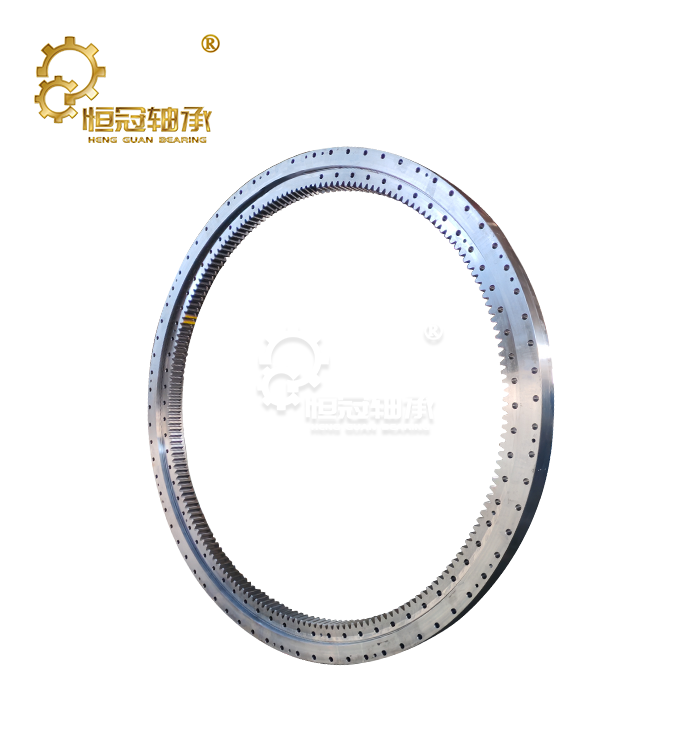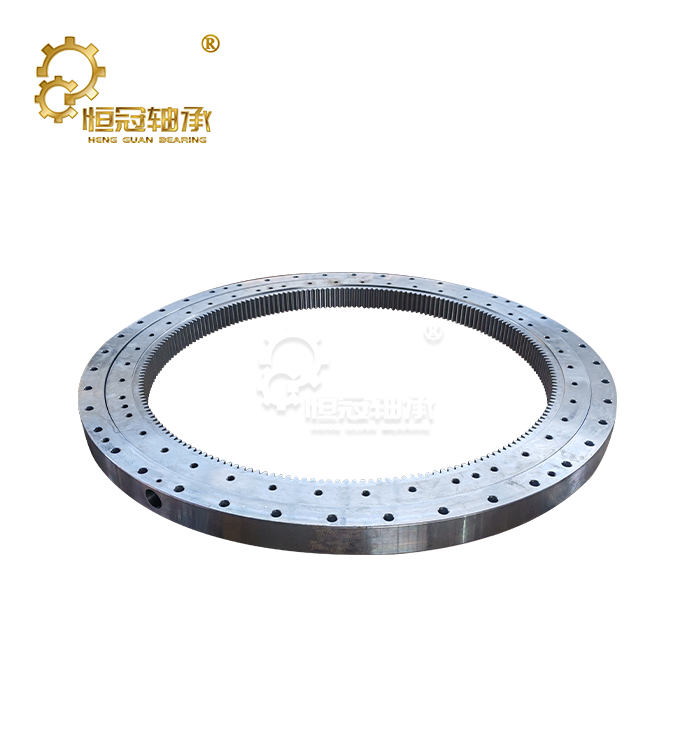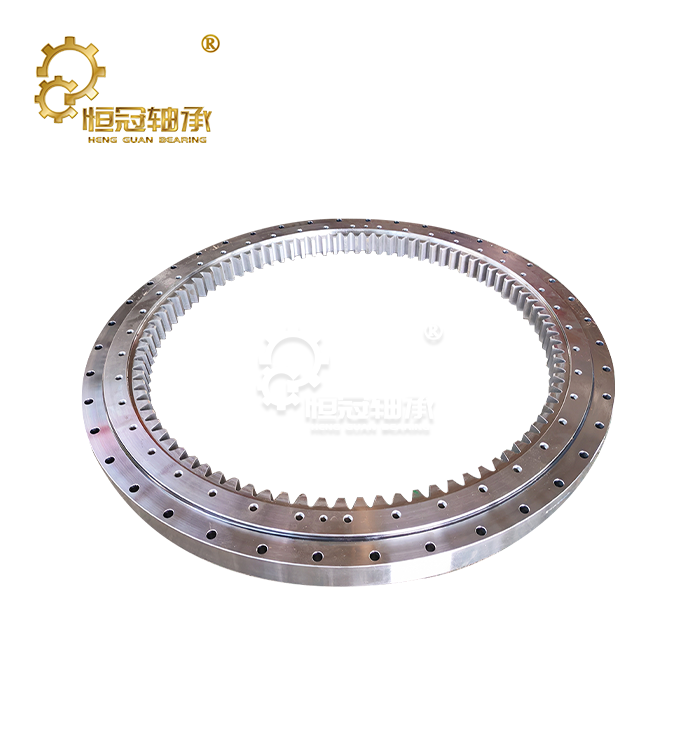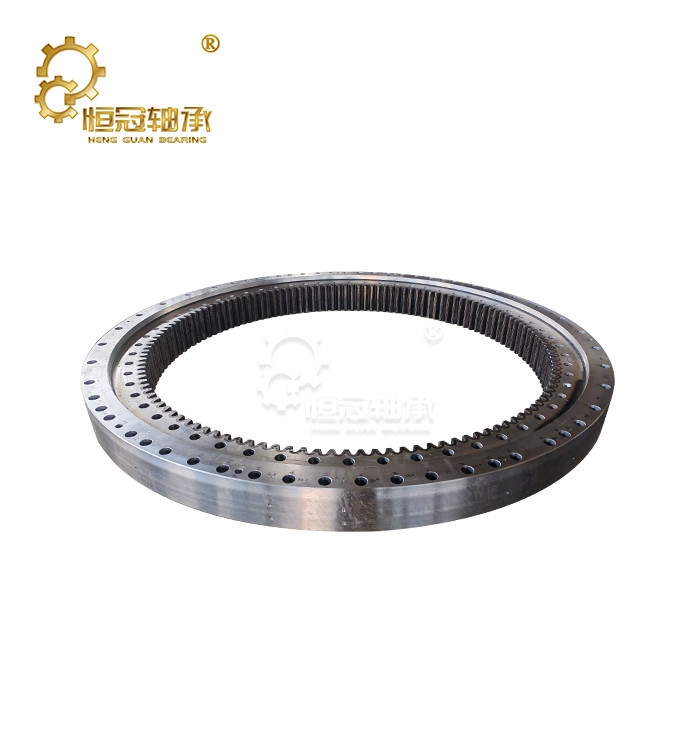




How to Choose a Single Row Cross Roller Slewing Bearing - HJ Series?
In projects requiring accuracy under mixed loads, selecting the proper rotating support component might be difficult. Here comes Luoyang Heng Guan Bearing Technology Co., Ltd. (LYHGB). Use this guide to evaluate the Single Row Cross Roller Slewing Bearing - HJ Series for cranes, turntables, or automation platforms. It covers design logic, performance factors, and proper sizing and mounting, using technical data from LYHGB's Luoyang production line.
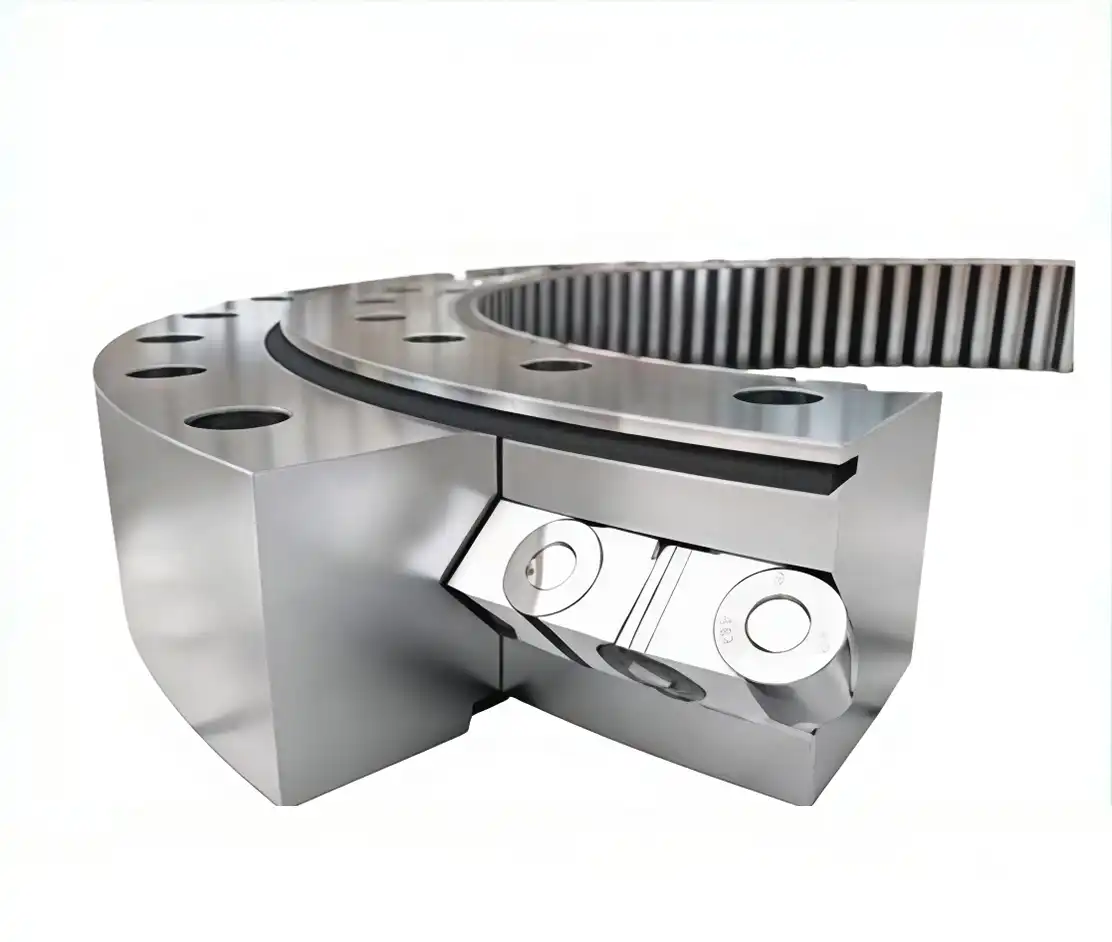
What Makes Single Row Cross Roller Slewing Bearing - HJ Series Different?
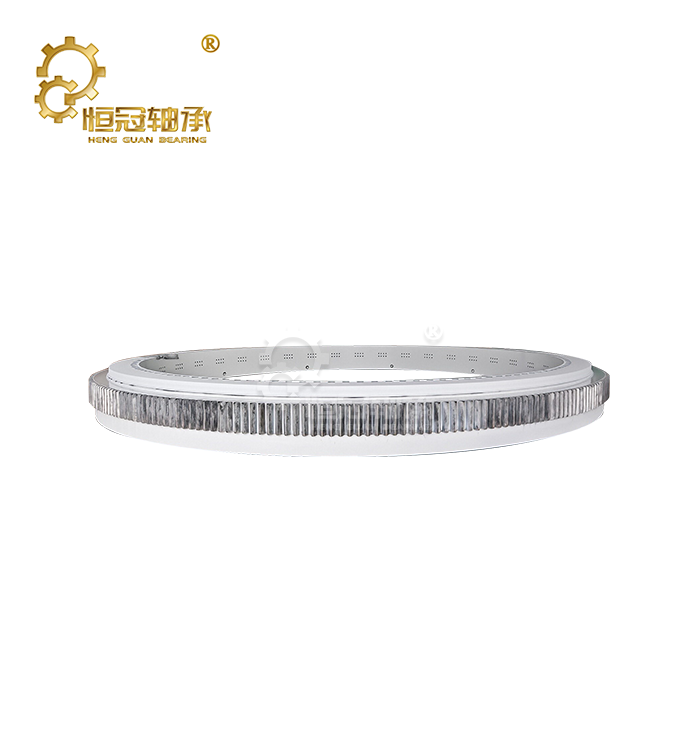
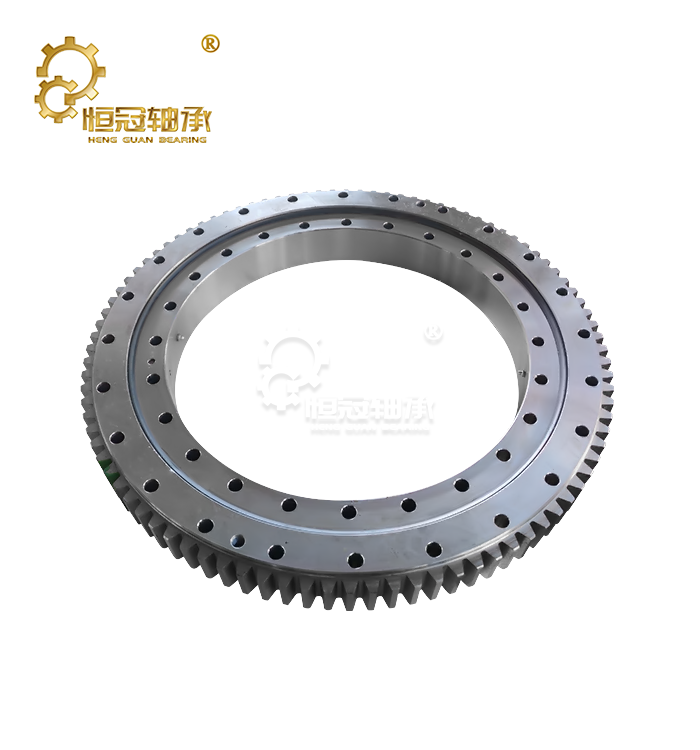
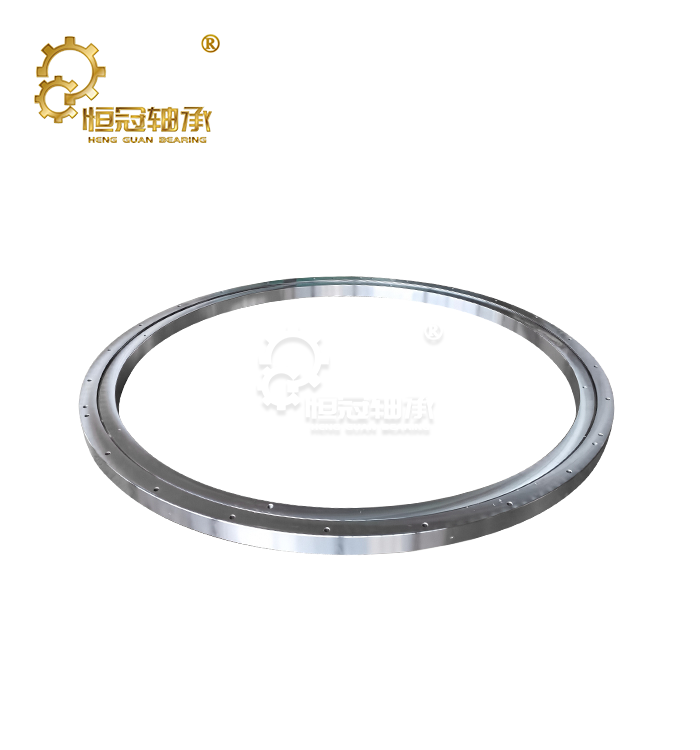
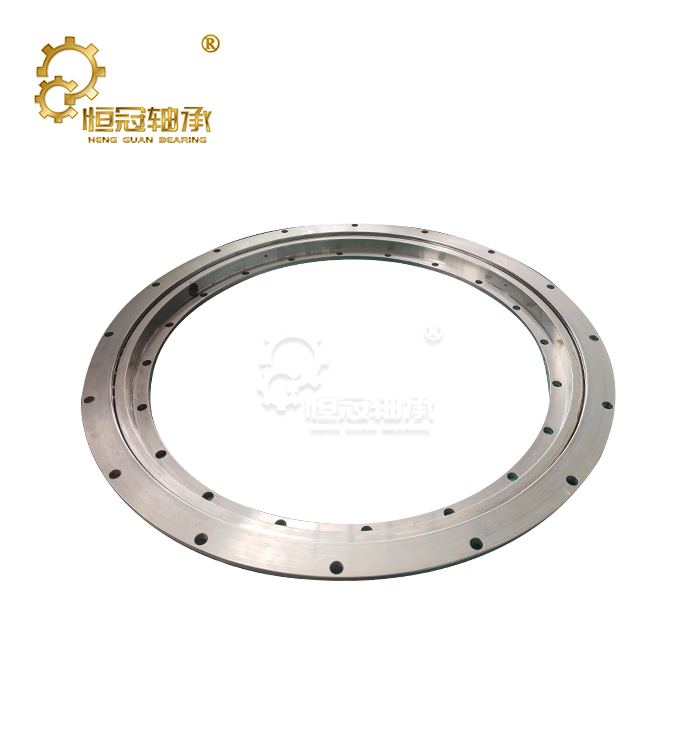
The HJ Series uses cylindrical rollers in a 1:1 cross pattern, each pair positioned at 90° inside a V-groove between two sitting rings, instead of four-point contact balls. The Series HJ-Single Row Crossed Roller Slewing Bearing structure combines axial, radial, and tilting forces into one compact ring, eliminating the need for multiple bearings. Roller contact results in greater load distribution, making the HJ Series 3-4× more rigid than a ball-type slewing ring of the same diameter. In point-contact systems, significant radial loads may create the "hammering effect"; 360° continuous support precludes this. Internal clearance is minimal; thus, installation accuracy is more important than with typical designs. Mounting surface flatness must be maintained within 0.03 mm per 1,000 mm, and a slightly uneven base might ruin a flawless bearing. HJ Series rings weigh 25–35% less than multi-row systems, and the integrated mounting face removes the need for external flanges.
| Feature | HJ Series (Cross Roller) | Standard Ball Slewing Ring |
|---|---|---|
| Rolling element | Cross-arranged cylindrical rollers (1:1, 90°) | Balls |
| Contact type | Line contact | Point contact |
| Stiffness | 3–4× higher than equivalent ball type | Baseline |
| Weight | ~25–35% lighter than multi-row | Heavier |
| Combined load handling | Axial + radial + moment simultaneously | Good, but lower radial capacity |
| Structure variants | HJB (gearless), HJW (external gear), HJN (internal gear) | Multiple row configurations |
| Mounting | Integrated mounting face, no external flange | Often requires external flange |
| Split-ring option | Available with controllable preload (positioning accuracy 0.01 mm) | Not typically available |
Key Load Capacity, Precision, and Performance Factors
When comparing a Single Row Cross Roller Slewing Bearing - HJ Series against alternatives, three factors deserve your attention: load capacity, rotational precision, and raceway hardness. Because cross-arranged rollers make line contact, this slewing ring distributes load over a larger surface, improving fatigue life under heavy or shock loading. The rollers also absorb emergency-braking impact through elastic deformation, keeping speed fluctuation within ±2%. Precision grades span P0, P6, P5, and P4 (ISO standard), with raceway roundness held to ≤0.01 mm and tooth-pitch deviation ≤0.015 mm.
Preloaded split-ring variants achieve positioning accuracy of 0.01 mm with repeatability of ±0.03 mm over 10,000 cycles — making them ideal for robotics, CNC turntables, and optical platforms where wobble isn't acceptable. Raceway surfaces are induction-hardened to HRC 58–64 with a 3–5 mm hardened case depth, leaving compressive residual stress at the surface while the core stays tough.
If you'd like tailored guidance on which grade suits your torque and speed profile, our engineering team is happy to help — just reach out to mia@hgb-bearing.com with your load chart, and we'll walk you through the options together.
| Technical Parameter | Specification |
|---|---|
| Diameter range | 50 mm – 10,000 mm (custom available) |
| Raceway center diameter (DL) | 625 mm – 4,540 mm (standard catalog) |
| Outer diameter (D) | 725 mm – 4,860 mm |
| Inner diameter (d) | 525 mm – 4,210 mm |
| Section height (H) | 80 mm – 240 mm |
| Roller size series | 20, 30, 36, 45, 50 (designation code) |
| Ring material | GCr15 / 42CrMo / 50Mn bearing steel |
| Rolling element material | High-carbon chromium bearing steel (GCr15 class) |
| Raceway surface hardness | HRC 58–64 (induction quenching) |
| Hardened case depth | 3–5 mm |
| Precision grade | P0, P6, P5, P4 (ISO) |
| Raceway roundness | ≤ 0.01 mm |
| Tooth-pitch deviation | ≤ 0.015 mm |
| Positioning accuracy (preloaded type) | 0.01 mm |
| Repeatability | ±0.03 mm / 10,000 cycles |
| Thermal dimensional stability | ±0.05 mm across full operating temperature range |
| Gear accuracy | DIN 3967 Grade 6 |
| Gear module | m = 5, 6, 8, 10, 12, 14, 16, 18, 20, 22, 25, 28, 30 |
| Gear type | External (HJW) / internal (HJN) / gearless (HJB) |
| Sealing | 3-layer labyrinth (standard); NBR / FKM (optional); marine-grade elastic lip seal |
| Operating temperature | -40 °C to +80 °C (custom extended range available) |
| Mounting holes | 18–72 holes, φ18–40 mm |
| Weight (catalog range) | 100 kg – 8,760 kg per unit |
How Do You Select the Right Size and Mounting Configuration?
Sizing a Single Row Cross Roller Slewing Bearing - HJ Series starts with your combined load data: maximum axial force, radial force, and overturning moment, plus rotational speed and duty cycle. From there, outer diameter, gear type (HJB gearless, HJW external, or HJN internal), bolt-hole pattern (18–72 holes at φ18–40 mm), and roller size series (20–50) all follow. Gear module selection runs from m5 to m30, with external-gear tooth counts from 101 to 222 and internal-gear counts from 74 to 1,854, so the bearing can match nearly any existing pinion. Since assembly clearances are small, mounting surface flatness (≤0.03 mm per 1,000 mm) and bolt torque sequencing are just as important as bearing selection itself.
LYHGB verifies every order with a 1:1 drawing check — matching mounting-hole pattern, gear parameters, and load ratings against your equipment — and uses laser tracking plus digital calipers for reverse engineering when original drawings are unavailable. It's also worth asking whether a split-ring preloaded variant would improve your positioning accuracy without adding cost.
| Selection Input | Why It Matters | HJ Series Range / Option |
|---|---|---|
| Combined load data (axial, radial, moment) | Determines diameter and roller size series | DL 625–4,540 mm; roller series 20–50 |
| Gear configuration | Affects drive layout, cost, and pinion matching | HJB (gearless) / HJW (external) / HJN (internal) |
| Gear module & tooth count | Must match existing pinion | m5–m30; ext. 101–222 teeth, int. 74–1,854 teeth |
| Mounting flatness | Impacts running accuracy and bearing life | ≤0.03 mm / 1,000 mm required |
| Bolt-hole pattern | Must align with equipment mounting flange | 18–72 holes, φ18–40 mm |
| Precision grade | Sets rotational accuracy vs. cost trade-off | P0 (general) → P4 (precision positioning) |
| Seal type | Determines service life in contaminated environments | 3-layer labyrinth / NBR / FKM / marine lip |
| Duty cycle & environment | Guides lubrication interval and seal choice | Relube 500 h (clean) / 200 h (dusty); -40°C~+80°C |
Common Applications of Single Row Cross Roller Slewing Bearing - HJ Series
Thanks to its compact profile, high stiffness, and combined-load capability, this Series HJ-Single Row Crossed Roller Slewing Bearing appears across a broad spectrum of equipment. In cranes and port machinery, the line-contact rollers handle heavy radial loads and shock during lifting cycles. In construction and mining equipment, the 360° continuous support survives high-vibration environments where point-contact bearings would pit prematurely. Precision applications — CT scanners, satellite tracking antennas, robotic welding arms, and CNC turntables — rely on the sub-0.01 mm positioning accuracy and low rotational noise that preloaded HJ variants deliver. Military systems use the bearing for fine positioning where backlash must be minimal. Because LYHGB produces diameters from 50 mm to 10,000 mm across all four precision grades, the HJ Series scales from small lab fixtures to large industrial turntables.
Custom marine variants add zinc-rich epoxy coating, stainless steel hardware, and marine-grade grease for offshore cranes and ocean equipment. If your project involves wind power, metallurgy, or port handling, this cross-roller logic often applies — worth discussing with an engineer before finalizing a design.
| Industry | Typical Application | Key HJ Advantage | Recommended Variant |
|---|---|---|---|
| Cranes & port machinery | Tower cranes, ship-to-shore cranes, crawler cranes | Line-contact fatigue resistance under heavy radial load | HJW (external gear), P0/P6 |
| Construction & mining | Excavators, loaders, high-vibration equipment | 360° support prevents hammering effect | HJN (internal gear), labyrinth seal |
| Robotics & automation | Welding robot arms, CNC turntables, positioning stages | 0.01 mm positioning accuracy, ±0.03 mm repeatability | HJB (gearless) split-ring preloaded, P4 |
| Medical equipment | CT scanners, imaging tables | Ultra-smooth rotation, low noise, non-magnetic | HJB (gearless), P5, NBR seal |
| Military & defense | Radar platforms, fine-positioning systems | Minimal backlash, high stiffness | HJB/HJN, P4, FKM seal |
| Marine & offshore | Offshore cranes, ocean equipment | Saltwater corrosion resistance | Marine variant: zinc-epoxy + stainless hardware + marine grease |
| Wind energy | Wind turbine drive systems | Combined load capacity in compact envelope | HJW/HJN, P6, FKM seal |
| Testing & measurement | Precision test platforms, optical equipment | Thermal stability ±0.05 mm, high repeatability | HJB split-ring, P4 |
Conclusion
The HJ Series pairs compact design with strong combined-load performance — 3–4× higher stiffness, 25–35% lighter weight, and positioning accuracy down to 0.01 mm. Heng Guan Bearing combines 20+ years of engineering experience with flexible customization across a 50–10,000 mm diameter range, four precision grades, and three gear configurations, helping you match precision, load, and budget.
|
|
FAQ
Q: What loads can the HJ Series handle simultaneously?
A: Axial force, radial force, and overturning moment — all at once. The 1:1 cross-arranged rollers make line contact with the raceway, distributing stress over a larger surface than point-contact ball designs.
Q: What precision grades are available?
A: Four ISO grades: P0 for general machinery, P6 for standard industrial use, P5 for precision platforms, and P4 for high-accuracy positioning systems. Raceway roundness is held to ≤0.01 mm.
Q: Does the HJ Series come with gearing?
A: Yes — three variants are offered: HJB (gearless), HJW (external gear), and HJN (internal gear). Gear module ranges from m5 to m30 with DIN 3967 Grade 6 accuracy.
Q: What size range does Heng Guan produce?
A: Diameters from 50 mm up to 10,000 mm. The standard catalog covers raceway center diameters from 625 mm to 4,540 mm, with custom sizes available beyond that range.
Q: Why does mounting flatness matter so much?
A: Small internal clearances mean an uneven base — anything beyond 0.03 mm per 1,000 mm — can reduce rotational accuracy and shorten bearing life. The integrated mounting face helps, but the supporting structure must still meet flatness requirements.
Engineer Your Next Precision Rotation Project with HJ Series Confidence
Don't leave your rotation-critical component to chance. LYHGB Bearing delivers Single Row Cross Roller Slewing Bearing - HJ Series solutions in GCr15 / 42CrMo / 50Mn steel with HRC 58–64 induction-hardened raceways, 3–5 mm case depth, DIN 3967 Grade 6 gear accuracy, four precision grades (P0–P4), three gear configurations, and diameters from 50 mm to 10,000 mm — backed by CMM full inspection of 47 key dimensions per unit, vibration testing under simulated load, and 20+ years of cross-industry experience. Send your drawings, load charts, or sample photos to mia@hgb-bearing.com today and receive a tailored recommendation with a quotation within 24 hours.
References
1. Harris, T. A., & Kotzalas, M. N. — Rolling Bearing Analysis, CRC Press.
2. International Organization for Standardization — ISO 76: Rolling Bearings — Static Load Ratings.
3. Brändlein, J., Eschmann, P., Hasbargen, L., & Weigand, K. — Ball and Roller Bearings: Theory, Design, and Application, Wiley.
4. Deutsches Institut für Normung — DIN 3967: Gear Tooth Tolerance System.
5. American Bearing Manufacturers Association — ANSI/ABMA Standards for Slewing Ring Bearings.
6. Zupan, S., & Prebil, I. — "Carrying Capacity of Large Rolling Element Bearings," Engineering Failure Analysis.

WHAT OUR CUSTOMERS SAY
Here is the customer's evaluation of us