




Advantages of the internal & external slewing bearings?
When selecting a slewing bearing for a crane, excavator, wind turbine, rotary table, or other rotating machine, the position of the gear teeth can affect more than the appearance of the bearing. An Internal Gear Slewing Bearing places the teeth on the inside of the bearing ring, while an external gear slewing bearing has the teeth on the outside circumference.This variation influences how the drive pinion is mounted, the space the drive consumes, and how easy it is to check and keep the gearing safe. Neither setup is automatically better for all machines. The choice of the proper one is depending on the available installation space, the torque needed, the bearing loads, the environment, the access for maintenance and the overall drive setup. Also, a well selected slewing bearing shall be examined according to its axial load, radial load, overturning moment, rotation speed, lubrication needs, sealing arrangement and mounting conditions. Liebherr and other manufacturers sell slewing bearings with internal gearing , external gearing or without gearing at all . The gearing is a design choice , not a universal performance rating .
How do internal and external slewing bearings differ in design?
A slewing bearing is a small rotating support comprised of a racetrack and two bearing rings. It can transmit axial loads, radial loads, and overturning moments, depending on the design, while providing a gear interface for rotational drive.
The main difference between internal and external geared variants is the position of the teeth and hence the position of the mating pinion.
Internal Gear Slewing Bearing Configuration
An internal gear slewing bearing is machined with teeth on the inner diameter of the bearing ring. The mating pinion is located inside the bearing envelope. This method can reduce the amount of external space needed for the drive and can give a more protected gear arrangement where the bearing is included in an appropriate machine structure.
This layout is very advantageous when the designer desires to maintain the drive components in a compact enclosure. Internally geared slewing rings are often considered if installation space is at a premium and some shielding of the gear mesh from the surrounding environment is desired.
However, the internal arrangement of the teeth should not be taken as a substitute for proper housing or sealing. Dust, water, abrasive particles, and contaminated oil can still get to the bearing and gear system, even when the overall machine design provides appropriate protection.
External Gear Slew Ring Configuration
In an external gear slewing bearing, the teeth are machined on the outside periphery of the gear ring. The pinion is external to the bearing and meshes directly with these teeth.
One of the biggest practical benefits is accessibility. The gear teeth are usually more visible for inspection, cleaning, lubrication, and monitoring during maintenance. This is useful on equipment where the drive system must be often accessed by personnel.
Because the pinion is outside the bearing, external gearing makes it easier to assemble specific combinations of motors and gearboxes. The final arrangement, however, is still subject to available space, driving torque, mounting geometry, and protection needs.
Why Bearing Construction Matters as Much as Gear Position?
Gear position is but one aspect of slewing-bearing selection. The inner bearing structure may have an even bigger influence on load capacity and stiffness.
Typical designs include single-row ball slewing bearings, double-row ball slewing bearings, three-row roller slewing bearings, and crossing roller slewing bearings. The best configuration is a function of the combination of axial load, radial load, overturning moment, stiffness, speed, and positioning accuracy required.
Examples are (crossed-roller designs) when rigidity and precision are crucial and (three-row roller arrangements) for challenging heavy-load applications. Depending on the bearing architecture and machine configuration, the gear may be internal or external. Manufacturers offer both geared configs with differing bearing constructions.
Where Do Internal Gear Slewing Bearings Offer Practical Advantages?
The internal gear arrangement is especially beneficial when the machine designer wishes to control the outward dimensions of the rotating assembly.
Compact Drive Arrangement
The pinion of an internal gear system is arranged in the bearing circumference. This means that the drive does not need to extend out from the bearing in the same manner as an external gear arrangement.
This can simplify equipment setups if space surrounding the bearing is limited. Typical examples are compact rotary machines, positioning devices, material handling equipment, and other machines where the surrounding construction offers little space for a gearbox and pinion.
The crucial thing is that the space saving is due to the driving arrangement, not that the bearing automatically becomes smaller. The bearing still has to be sized for the loads exerted and mounting requirements.
Better Protection of the Gear Mesh
With internal gearing, the tooth engagement region may be positioned within the surrounding bearing structure. Which can reduce direct exposure to dust, dirt, and accidental touch versus exposed exterior gear.
But the exact amount of protection will be set by the whole machine design. Seals, coverings, housings, coatings, and lubrication all safeguard the environment. Liebherr, for example, says that the sealing principles are designed based on the working conditions, for example, in dusty or saline environments.
This differentiation is significant for mining, construction, port, and outdoor equipment. The internal gear offers a structural advantage that can be advantageous, but it must be paired with a proper sealing and maintenance approach.
Cleaner External Machine Profile
The gear teeth are inside the bearing; thus, the outside diameter can be rather smooth. This may be helpful when other machine components need to be near to the rotating assembly.
A cleaner exterior profile can also help to prevent interference with surrounding components. This can provide better cable routing, guarding, structural support, and equipment packaging in tight machinery.
Suitable for Compact Torque Transmission
The internal gear bearing is a single system combining the bearing support with the gear ring. This reduces the need for a separate huge gear ring in various machine architectures.
Actual torque capacity, however, depends on gear module, teeth shape, material, hardness, pinion design, lubrication, alignment, and operating load. The internal position of the teeth is not sufficient to ensure a higher torque capacity.
Therefore, for an internal gear slewing bearing, the engineer should specify the desired output torque, rotation speed, duty cycle, and load conditions to the manufacturer, rather than simply picking the bearing by its diameter.
Where External Gear Slewing Bearings Can Be the Better Choice?
External gearing remains widely used because accessibility and drive integration can be valuable advantages in many industrial machines.
Easier Gear Inspection
External teeth are visible from outside the bearing. This makes it easier for maintenance personnel to inspect tooth condition, lubrication coverage, surface damage, and abnormal wear.
The ability to visually inspect the gear mesh can be particularly useful in equipment operating under variable loads or frequent start-stop cycles. Technicians can identify problems such as damaged teeth, poor lubrication, or abnormal contact before the problem develops into a more serious failure.
Proper maintenance remains essential for both configurations. Major slewing bearing manufacturers recommend monitoring lubrication and gear condition rather than assuming that either internal or external gearing is maintenance-free. Thyssenkrupp Rothe Erde, for example, emphasizes sufficient lubrication of gear flanks and regular checking of bearing condition and sealing.
Convenient Lubrication and Maintenance Access
External gear teeth are normally easier to reach with a brush, spray system, or automatic lubrication system.
This does not mean external gears always require more maintenance. Lubrication frequency depends heavily on operating conditions, load, rotation, environment, and the manufacturer's instructions. Liebherr's technical documentation, for example, notes that gear lubrication intervals can vary significantly with operating intensity and load.
Therefore, the more useful comparison is maintenance accessibility, rather than claiming that one gear configuration always has a longer lubrication interval.
Flexible Drive Integration
With the pinion positioned outside the bearing, designers have considerable freedom to position the gearbox and motor around the rotating structure.
This can be useful when the machine already has an external drive layout or when the gearbox needs to be easily removed during service.
External gearing can therefore be attractive for cranes, construction machinery, material-handling equipment, and other industrial systems where accessibility has a high priority.
Suitable for Applications with Existing Protective Structures
An exposed external gear does not necessarily create a problem if the surrounding machine already includes a suitable guard or housing.
For example, an equipment designer may have sufficient space to install a protective cover around the gear and pinion. In that situation, the accessibility of an external gear can be more valuable than the compact envelope of an internal gear.
The decision should therefore consider the complete machine architecture rather than treating external gears as inherently unsuitable for dirty or outdoor applications.
Internal vs. External Slewing Bearings: Key Selection Factors
The choice between the two configurations should be made from the machine's operating requirements rather than from gear position alone.
Installation Space and Drive Envelope
Start with the available space around the bearing.
If the equipment has limited external clearance, an internal gear configuration may provide a more compact way to position the pinion and gearbox. If there is sufficient room outside the bearing, an external gear may provide easier access and a simpler service arrangement.
Engineers should consider both radial and axial clearance, including the space required to remove the gearbox, inspect the teeth, replace seals, and perform lubrication.
Load, Torque, and Rotation Requirements
The bearing should be selected based on actual operating loads.
At minimum, the manufacturer should receive:
Axial load
Radial load
Overturning moment
Static load condition
Dynamic load condition
Required torque
Rotation speed
Start-stop frequency
Duty cycle
A larger bearing is not automatically a better bearing. Oversizing can increase weight, cost, and drive requirements, while undersizing can reduce service life and create excessive raceway or gear stress.
Environmental Conditions
Operating conditions can strongly influence the final configuration.
For dusty applications, the designer should evaluate sealing, housing, lubrication, corrosion protection, and gear accessibility together. In coastal environments, salt exposure and corrosion protection require particular attention. In high-temperature industrial equipment, the seal material, lubricant, heat treatment, and clearance must all be checked against the operating temperature.
This is why manufacturers commonly configure seals and coatings according to the application rather than using one standard solution for every slewing bearing.
Maintenance Strategy
If technicians need frequent visual access to the gear teeth, external gearing may offer a practical advantage.
If the priority is a compact drive layout with greater physical protection of the gear mesh, internal gearing may be more appropriate.
Maintenance planning should also cover the raceway, seals, bolts, gear teeth, pinion alignment, and lubricant. For example, Thyssenkrupp Rothe Erde recommends checking the sealing condition and monitoring internal gear slewing bearing wear in addition to maintaining adequate gear lubrication.
What B2B Buyers Should Check Before Ordering
For OEMs and industrial equipment manufacturers, choosing between internal and external gearing is only the first step. A complete technical inquiry helps the supplier calculate the correct bearing instead of offering a model based only on diameter.
Technical Information to Include in an RFQ
A useful inquiry should include the following information:
- Bearing dimensions: Specify the required inner diameter, outer diameter, overall height, and available mounting space.
- Load conditions: Provide axial load, radial load, overturning moment, shock load, and whether the values are static, dynamic, or peak loads.
- Gear requirements: State internal or external gearing, required module, approximate gear ratio, pinion information, required output torque, and rotation speed when available.
- Mounting details: Provide the bolt-hole pattern, bolt size, mounting surface requirements, and any restrictions on flange dimensions.
- Operating environment: Identify temperature, dust, water, salt spray, corrosive media, vibration, and outdoor exposure.
- Lubrication: Explain whether manual or automatic lubrication will be used and whether there are specific grease requirements.
- Sealing: Specify whether standard sealing is sufficient or whether additional environmental protection is required.
- Service requirements: Tell the manufacturer how frequently the bearing can be inspected and whether gear access is limited after installation.
This information gives the manufacturer a much clearer basis for bearing selection and load calculation.
Material and Manufacturing Quality
Material selection should be evaluated together with heat treatment, raceway hardness, gear hardness, machining accuracy, and quality control.
Materials such as 42CrMo and 50Mn may be used for slewing bearing rings in different product designs, but the exact material should be confirmed against the manufacturer's technical specifications rather than presented as a universal requirement.
The same principle applies to rolling elements and seals. NBR, FKM, or another seal material should be selected according to temperature and chemical exposure, while the rolling elements and raceways need to meet the requirements of the selected bearing design.
Supplier Engineering Support
For large or customized slewing bearings, supplier support can be as important as the quoted unit price.
A capable manufacturer should be able to review the application load, recommend a suitable bearing structure, confirm gear parameters, provide mounting information, and explain lubrication and maintenance requirements.
This is especially important when replacing an existing bearing. The replacement should not be selected only because the outside diameter and bolt pattern appear to match. Load ratings, gear geometry, internal clearance, mounting conditions, and drive compatibility also need to be verified.
How to Make the Final Decision?
A simple decision process can make the selection more practical.
Choose an internal gear slewing bearing when the project places a strong emphasis on a compact external envelope, protected gear positioning, or integration of the pinion inside the bearing structure.
Consider an external gear configuration when easy gear inspection, convenient lubrication access, or an established external gearbox arrangement is more important.
For either option, confirm the bearing load capacity and gear capacity with the manufacturer. A slewing bearing supports combined loads, so selecting it only according to diameter or gear position can lead to an unsuitable design.
The best solution is therefore the one that provides an appropriate balance between load capacity, drive requirements, installation space, environmental protection, maintenance access, and total ownership cost.
Conclusion
Heavy machinery in the building, mining, wind power, and precision equipment industries all rely on internal gear slewing bearing and external gear slewing bearings to enable smooth rotation. Internal gear setups work best in small designs that need to be protected from the environment and have easy access for upkeep. This makes them perfect for tractors, wind turbines, and other enclosed uses. External gear bearings are a cheap way to handle very large sizes and make it easier to check and maintain them. They are good for portal cranes and other uses where protective housings are already present. When choosing bearings, it's important to think about the budget, the load needs, the room available, the environment, and how easy it will be to maintain. Working with skilled makers that offer customization options, expert support, and full service guarantees top-notch bearing performance over longer equipment lifespans.
|
|
FAQ
1. What factors most significantly affect slewing bearing lifespan?
Over 96% of a bearing's life depends on how well it is oiled. Other important factors include keeping the bearing clean and installing it correctly. Using high-pressure grease on a regular basis, as set by the maker, keeps the film thickness between the rolling elements and raceways. Fretting rust and structural looseness that speed up wear can be stopped by keeping the mounting surfaces clean and tightening the bolts to the stated preload values. If you stay within the design load limits and avoid shock loads, the service life of properly kept systems can go beyond 100,000 hours.
2. How do I select the right bearing configuration for crane applications?
When using a crane, you need to look at its highest lifting ability, boom length, slew speed, and duty cycle. For small turret designs and environmental safety, mobile cranes usually need internal gear bearings. Portal cranes and ship-to-shore cranes often have gear setups that are on the outside so that they can be easily accessed for repair. For heavy-duty uses, three-row roller structures work well, while single-row four-point contact ball structures are fine for smaller service classes. Talking to bearing makers during the planning process makes sure that the specifications are perfect.
3. Can slewing bearings be customized for unique applications?
Customization options are wide-ranging and include unique mounting hole designs, non-standard sizes, seal setups, and materials that are best for the job. During retrofit jobs, custom bolt circle diameters allow current equipment to connect to new systems. In marine settings, special treatments make things less likely to rust. Changes to gear ratios make speed and power work best in certain drive systems. Companies that have their own tech teams work together to make unique solutions that meet the exact needs of each application.
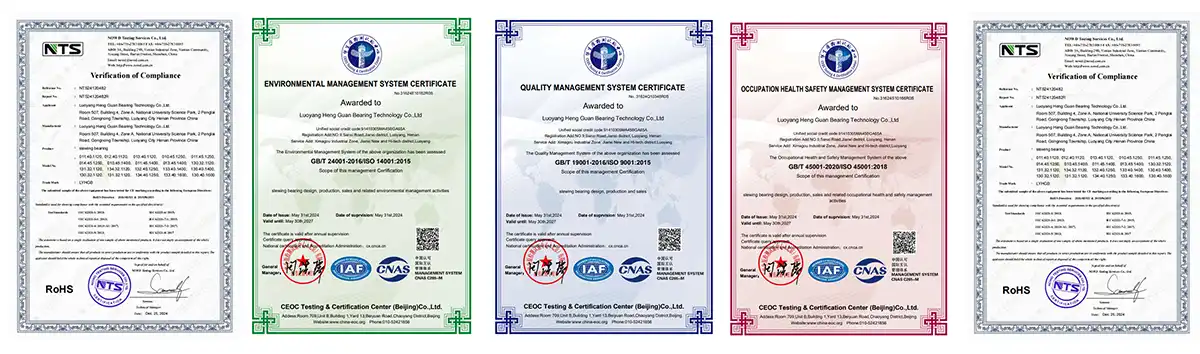
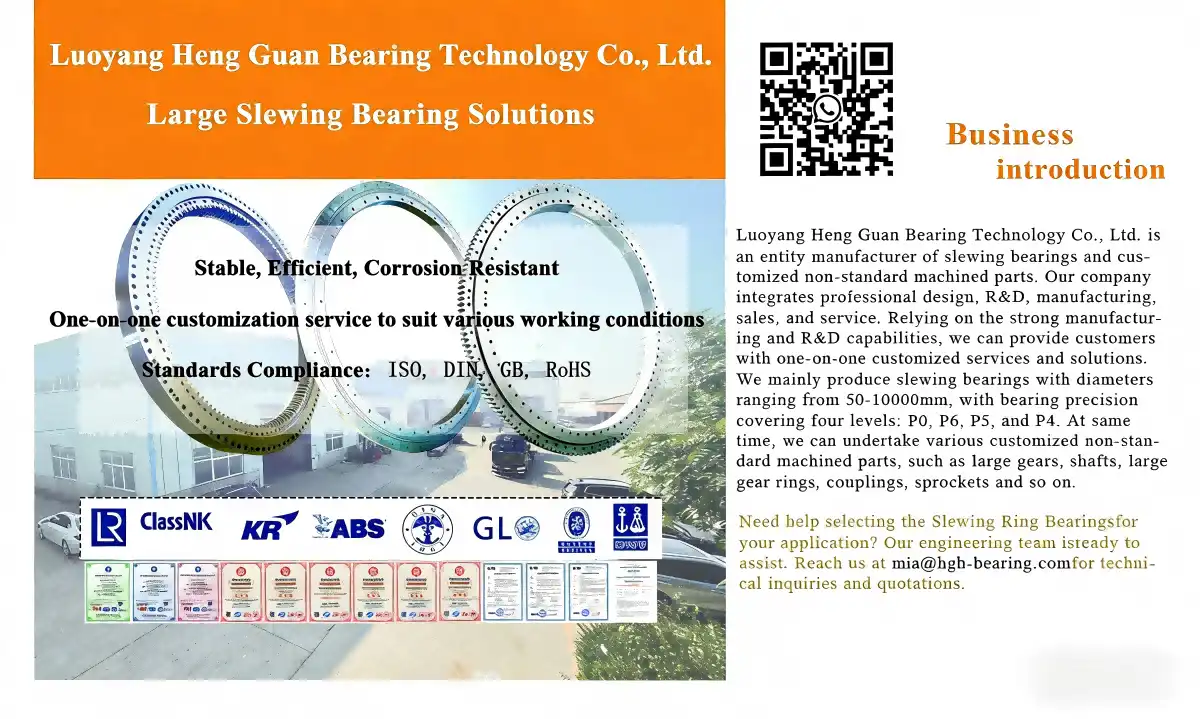
Partner with Heng Guan for Your Slewing Bearing Solutions
Luoyang Heng Guan Bearing Technology Co., Ltd. has been creating and making high-quality internal and external gear slewing bearings for tough industrial uses for more than 20 years. Our engineering team of more than 30 bearing experts creates custom solutions using precision grades ranging from P0 to P6, different types of structures such as single-row, double-row, three-row roller, and cross-roller designs, and a wide range of materials, such as 42CrMo and 50Mn special alloy steel. As a well-known company that makes internal gear slewing bearing for customers in more than 50 countries, we keep our ISO9001 certification and RoHS compliance up to date while also providing customized optimization design, flexible production, and full installation support. Email our technical team at mia@hgb-bearing.com to talk about your unique needs and get advice on how to choose the best bearing configuration for your tools. We provide high-performance goods that are also very cost-effective, along with dependable service for the entire operating lifecycle of your equipment.
References
1. Rodgers, T.M. (2018). Heavy Equipment Bearing Systems: Design Principles and Application Guidelines. Industrial Press.
2. Chen, H. & Kumar, A. (2020). "Load Distribution Analysis in Multi-Row Slewing Bearings for Construction Machinery," Journal of Mechanical Engineering Science, 234(8), 1567-1582.
3. European Bearing Manufacturers Association. (2019). Technical Guidelines for Slewing Bearing Selection and Installation. EBMA Technical Publication Series.
4. Nakamura, Y. (2017). "Environmental Protection Strategies in Rotating Machinery Components," Tribology International, 112, 245-258.
5. Williams, D.R. & Schmidt, P. (2021). Lifecycle Cost Analysis of Industrial Bearings: A Procurement Guide. Technical Publishing International.
6. ISO 12240-1:2018. Spherical plain bearings and slewing bearings — Part 1: Slewing bearings. International Organization for Standardization.

WHAT OUR CUSTOMERS SAY
Here is the customer's evaluation of us