



Slewing Ring Bearings: Complete Guide for Industrial Applications
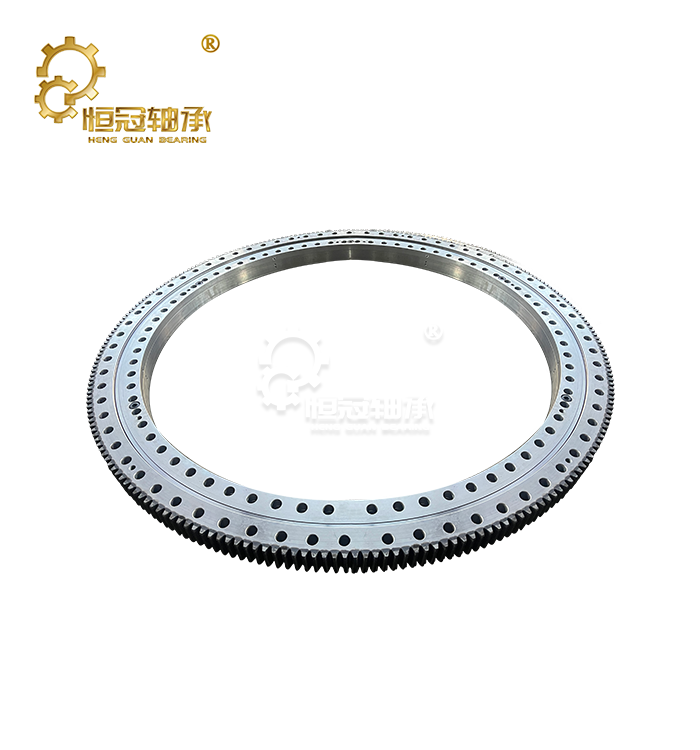
Slewing ring bearings are large diameter bearings designed to handle axial loads, radial loads and overturning moments and to allow one machine structure to spin relative to another. A slewing ring bearing is generally fitted directly between two structural parts, e.g. a machine frame and a rotating platform. Normal bearings are normally mounted around a Shaft. This design makes slewing ring bearings the perfect solution for use in excavators, cranes, wind turbines, industrial turntables, material-handling equipment, aerial work platforms and other machines that require regulated rotation under heavy loads. The bearing can be a ball or a roller depending on the purpose. It can also have an internal or external gear to transmit the direct drive. Choosing the suitable bearing for engineers and buying teams is more than matching an outer diameter. Also there are load combinations, moment capacity, mounting conditions, rotation speed, lubrication, sealing, gear requirements, operating environment and estimated service life to consider all combined.

What Is a Slewing Ring Bearing?
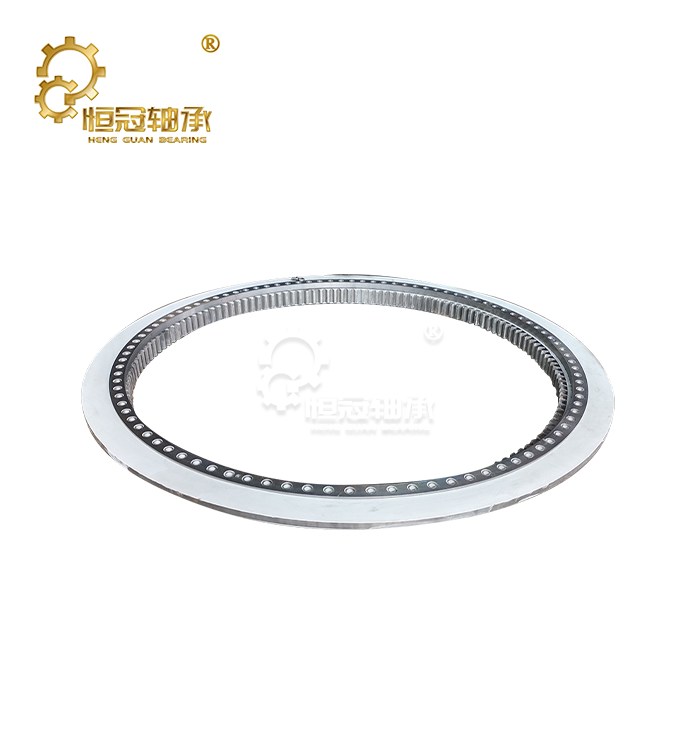
A slewing ring bearing is a large-diameter rotary bearing consisting mainly of inner and outer rings, rolling elements, raceways, seals, and, depending on the design, a cage or spacer system and an integrated gear.
The bearing connects a static structure with a spinning structure and absorbs the occurring forces during operation. For example, in an excavator the upper structure rotates relative to the undercarriage. The bearing supports the weight of the upper structure and the stresses generated during the digging and lifting.
An essential property is the unusually high diameter relative to the cross-sectional height. This shape allows the bearing to carry a big moment without the need for a typical bearing arrangement at each end of a shaft.
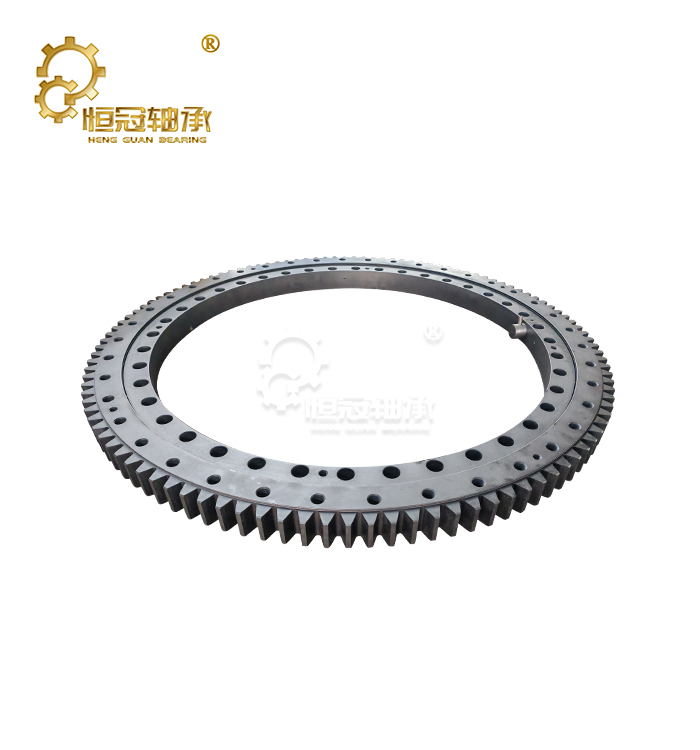
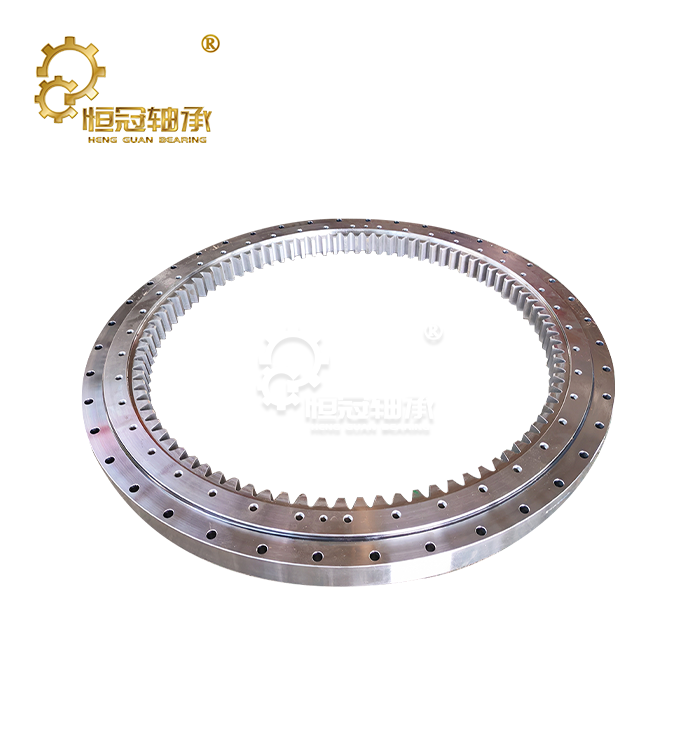
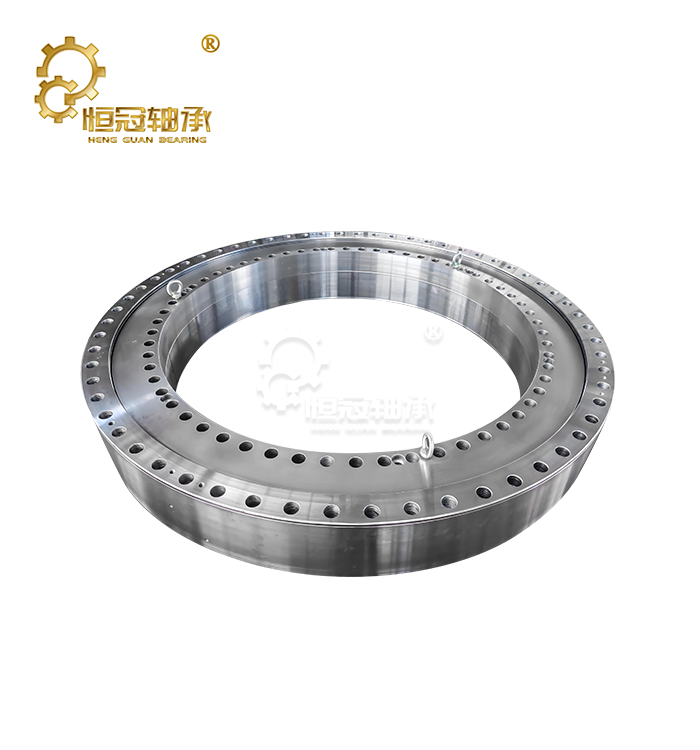
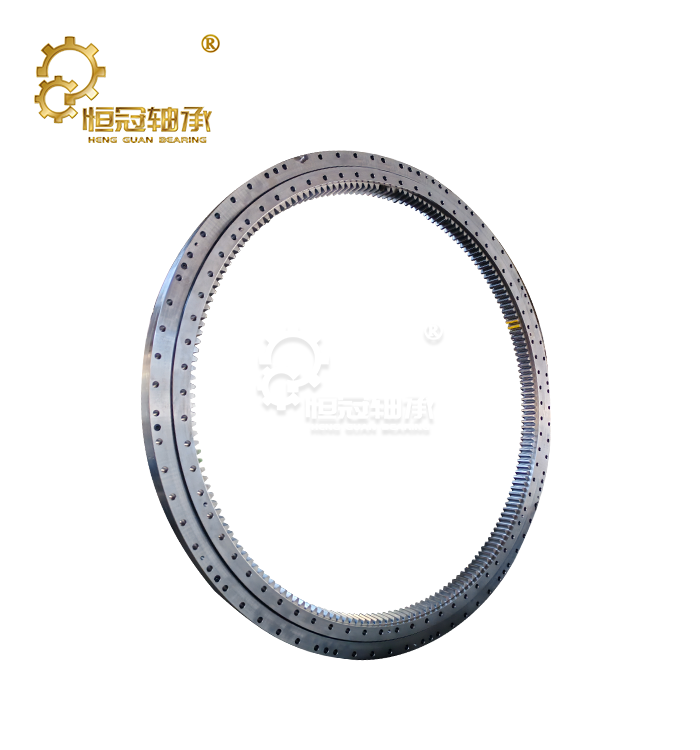
Some designs have mounting holes scattered around the inner and outer rings. Some have gear teeth on one of the rings so that a pinion can rotate the bearing directly. The ultimate layout will rely on the space available on the machine, the load requirements, the drive layout, and the manner of installation.
How do slewing ring bearings carry combined loads?
The fundamental engineering advantage of a slewing bearing is its capacity to accommodate several load components in one bearing system.
Axial Load
The axial load is directed along the rotating axis of the bearing. For example, a load or a spinning platform in hoisting equipment might apply a large axial force.
The axial load capacity of a bearing is a function of the raceway geometry, the size and number of rolling elements, the material qualities, the contact angle, and the particular bearing design.
Radial Load
Radial load is applied perpendicular to the axis of rotation. Radial loading can be caused by excavation forces, external equipment loads, wind forces, and machine loads that are not evenly distributed.
As well as being able to take radial loads, a slewing bearing must be considered based on the load magnitude and direction in conjunction with the axial force and overturning moment, and not as a separate number.
Overturning Moment
The overturning moment is especially critical in many slewing applications. If a load is applied away from the center of the bearing, then this load will create a moment that will tend to tilt one ring relative to the other.
The operating radius can have a major effect on the resulting moment for a crane, excavator, or aerial platform. Therefore, two machines with equal equipment weight may need extremely different bearing capacities if they have different load centers or operating radii.
This is why the bearing selection should be done based on the load case and not just by selecting a bearing based on the exterior diameter.
Main Slewing Ring Bearing Configurations
Varying arrangements of raceways and rolling elements can meet varying criteria of load, rigidity, speed, and installation.
Single-Row Four-Point Contact Ball Bearings
Single-row four-point contact ball bearings are utilized in applications where a relatively small design is required to accommodate combined axial, radial, and moment stresses.
The balls are able to carry loads from many directions due to the four-point contact configuration. These bearings are often used in equipment such as compact cranes, aerial work platforms, positioning equipment, and light- to medium-duty rotating structures.
Their applicability depends not only on the name of the application but also on the actual load spectrum. This design should be selected after engineers review the manufacturer’s load curves and allowable operating circumstances.
Double-Row Ball Bearings
Double row ball configurations offer increased load-carrying potential over many single row arrangements but preserve a relatively compact structure.
They can be considered for applications that receive larger loads but do not require the full load capacity or rigidity of some multi-row roller arrangements.
The final selection should be based on the available installation area, rotation requirements, load distribution, and estimated operation cycle.
Cross-Roller Slewing Bearings
Cross-roller designs have rollers in opposite directions. This arrangement can yield great rigidity and strong rotational precision for applications in which positioning performance is crucial.
They are more often used with precision rotary equipment than with very big shock-loaded machinery. Possible uses include industrial automation, positioning systems, robots, and specialized equipment.
Stiffness, friction, and rotational accuracy might all be relevant at the same time. So the bearing must be chosen based on the actual motion profile and precision requirements.
Three-Row Roller Slewing Bearings
Three-row roller bearings have raceways for the different parts of the load. This arrangement can offer excellent load capacity and rigidity to large industrial machinery.
These are generally used for heavy-duty applications such as giant excavators, port cranes, mining equipment, and other machinery under heavy axial, radial, and moment loads.
A bearing with more rolling elements and a more complicated structure can increase the size, weight, and manufacturing cost of the bearing. Thus, this design is used where the application justifies its load and stiffness advantages.
Materials and Manufacturing Factors
Material selection directly affects the bearing's load capacity, fatigue resistance, hardness, dimensional stability, and ability to withstand repeated loading.
Ring Materials
High-strength bearing steels and alloy steels are commonly used for slewing bearing rings. Materials such as 42CrMo and 50Mn may be selected for specific applications, subject to the manufacturer's design and heat-treatment requirements.
The material itself does not determine bearing performance. Heat treatment, raceway hardness, microstructure, machining accuracy, residual stress, and manufacturing quality also influence the final properties.
Rolling Elements
Balls or rollers must have appropriate hardness, dimensional accuracy, surface finish, and internal material quality. Bearing steel such as GCr15 is commonly used for rolling elements in many bearing applications.
The rolling elements must work together with the raceway geometry. A high-quality rolling element cannot compensate for an unsuitable raceway design or inadequate heat treatment.
Heat Treatment
Heat treatment gives the bearing rings and rolling elements the requisite hardness and mechanical qualities.
For raceways, the objective is normally to provide adequate surface hardness and wear resistance, with satisfactory toughness below the hardened region. The specific treatment will depend on the material, bearing design, size, and projected load circumstances.
Sealing and Surface Protection
Seals prevent dust, water, and other impurities from entering and aid to keep lubrication in. NBR-based sealing materials are widespread in many industrial applications, but the seal material should be selected based on temperature, chemicals, lubricant compatibility, and environmental exposure.
Corrosion protection could also be required for outdoor, maritime, or offshore equipment. Corrosion protection for slewing ring bearings should be seen in a holistic way, including surface treatment, coatings, paint systems, and material selection—not just as an extra item thereafter.
Where Are Slewing Ring Bearings Used?
The application determines the load pattern and therefore has a direct influence on bearing selection.
Construction Equipment
Excavators are one of the most recognizable applications. The slewing bearing supports the upper structure while allowing it to rotate relative to the undercarriage.
During digging, the bearing may experience rapidly changing combinations of axial force, radial force, and overturning moment. Shock loads and vibration can further increase the demands placed on the raceways and mounting structure.
Cranes and Lifting Equipment
Cranes require bearings capable of supporting significant loads while maintaining controlled rotation. Load magnitude, boom position, lifting radius, acceleration, braking, and operating frequency all affect the bearing's duty cycle.
For cranes, it is especially important to evaluate the maximum moment rather than selecting the bearing based only on the rated lifting capacity.
Wind Turbines
Slewing bearings may be used in pitch and yaw systems. These components operate outdoors and can be exposed to wind, temperature changes, moisture, vibration, and difficult maintenance conditions.
Bearing selection therefore needs to consider not only load capacity but also sealing, lubrication, corrosion protection, fatigue performance, and maintenance accessibility.
Port and Material-Handling Equipment
Ship loaders, stackers, reclaimers, container-handling equipment, and other large machines can require large rotary bearings.
These applications may combine high loads with frequent starts and stops. For bearings with an integrated gear, the gear and bearing should be considered as one drive system because incorrect gear alignment or backlash can affect overall performance.
Industrial Rotary Equipment
Industrial turntables, positioning systems, welding equipment, rotating platforms, and automation machinery may use slewing bearings where a large opening or compact rotary arrangement is required.
In precision applications, rotational accuracy, runout, stiffness, friction torque, and mounting accuracy can become more important than maximum static load capacity.
How to Select Slewing Ring Bearings
Choosing a bearing should begin with the machine's operating conditions rather than the bearing catalog.
1. Define the Load Cases
Identify the maximum and typical axial loads, radial loads, and overturning moments. If the machine operates through several load conditions, provide each relevant load case to the bearing manufacturer.
Peak load and normal operating load should not be treated as identical. A machine may spend most of its operating time under moderate loads but occasionally experience a much higher peak load.
2. Determine Rotation Requirements
Specify the required rotation speed, oscillation angle, acceleration, deceleration, and duty cycle.
A bearing used for slow intermittent rotation has different requirements from one used for continuous rotary motion. Starting torque and friction may also become important when the equipment operates frequently.
3. Check Mounting Dimensions
Important dimensions include:
Outside diameter
Inside diameter
Overall height
Mounting-hole diameter and pitch circle
Mounting flange dimensions
Gear dimensions, when applicable
Available structural clearance
The mating structures must provide adequate stiffness and dimensional accuracy. A correctly selected bearing can still perform poorly if the mounting structure is distorted or inadequately machined.
4. Evaluate the Operating Environment
Temperature, water, dust, mud, chemicals, salt spray, vibration, and outdoor exposure can all affect bearing performance.
For harsh environments, the specification should address sealing, grease selection, corrosion protection, inspection frequency, and maintenance access.
5. Confirm Gear Requirements
If the bearing incorporates an integral gear, engineers should specify whether an internal or external gear is required and provide information about the drive arrangement.
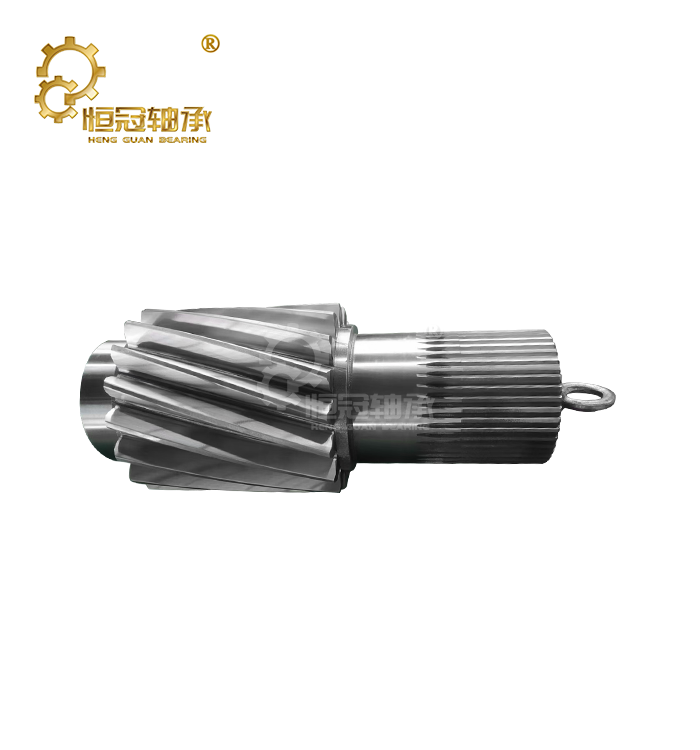
Gear-related parameters may include module, number of teeth, pressure angle, gear accuracy, tooth hardness, backlash, and pinion dimensions.
The bearing and pinion should be checked as a complete transmission system because mounting errors can influence tooth contact and wear.
Installation and Maintenance Practices
Correct installation is essential because a slewing bearing is directly connected to the machine's structural components.
Mounting Surface Accuracy
The mounting structure should have sufficient stiffness and appropriate flatness. Excessive deformation can introduce uneven raceway loading and affect bearing rotation.
Before installation, inspect the mounting surfaces, bolt holes, bearing seating areas, and related structural components.
Mounting Bolts
High-strength mounting bolts should be selected according to the manufacturer's requirements. Bolt size, grade, tightening method, tightening sequence, and preload are important.
Improper bolt tightening can cause uneven clamping forces and may reduce the reliability of the bearing connection.
Lubrication
Grease is commonly used for many slow- to moderate-speed slewing applications. The appropriate grease depends on load, speed, temperature, water exposure, and compatibility with the seal material.
Relubrication intervals should be established according to the manufacturer's recommendations and the actual operating environment rather than relying on a universal interval.
Inspection
Routine inspection should include:
Unusual noise or vibration
Abnormal operating temperature
Lubricant condition
Seal damage
Mounting-bolt condition
Gear wear and backlash
Excessive rotational clearance
Corrosion or contamination
Trend-based inspection can be more useful than simply checking the bearing after a failure has already occurred.
Quality Control and Technical Documentation
For industrial procurement, bearing quality should be evaluated through both the product and the manufacturer's quality-control process.
Important quality-control activities can include raw-material verification, dimensional inspection, heat-treatment control, hardness testing, raceway inspection, gear inspection, assembly checks, and final testing.
For OEM projects, buyers should also consider the documentation supplied with the bearing.
Depending on the project, useful documents may include the following:
Material certificates
Dimensional inspection reports
Hardness or heat-treatment records
Product drawings
Load and performance data
Gear specifications
Lubrication recommendations
Installation instructions
Inspection or test reports
Certificate of conformity
Traceability is particularly valuable for Slewing ring bearings used in large or safety-critical equipment because it allows the manufacturer and customer to identify the production batch and relevant inspection records if a quality issue occurs.

Common Mistakes When Buying a Slewing Ring Bearing
A number of purchasing mistakes can be avoided by involving the bearing manufacturer early in the design process.
Selecting by Diameter Alone
A bearing with the correct outside diameter may still have insufficient load or moment capacity. Load cases must be evaluated together with dimensions.
Ignoring the Mounting Structure
Bearing performance depends on the stiffness and accuracy of the mating structure. A bearing should not be evaluated independently from the machine frame or rotating platform.
Treating Maximum Load as the Normal Load
Peak load, average load, load frequency, and duty cycle all affect bearing selection and service life. Providing only one maximum load value may not give the manufacturer enough information for a reliable calculation.
Overlooking the Gear
For geared slewing bearings, the bearing and gear cannot be treated as completely independent components. Pinion alignment, backlash, lubrication, gear load, and installation accuracy also matter.
Using a Generic Lubrication Schedule
Different operating environments produce different lubrication demands. Water, dust, temperature, rotation frequency, and load can all change the appropriate maintenance interval.
What Information Should You Send to a Slewing-Bearing Manufacturer?
For a new OEM project, providing complete technical information can significantly improve the efficiency of bearing selection.
A typical inquiry should include:
Required inside and outside diameter
Bearing height or available installation space
Axial load
Radial load
Maximum overturning moment
Rotation speed or oscillation angle
Operating cycle and expected service life
Operating temperature
Indoor or outdoor environment
Water, dust, salt, or chemical exposure
Gear requirement
Mounting-hole arrangement
Preferred material, if specified
Lubrication requirements
Applicable industry or customer standards
If the bearing is a replacement part, an existing drawing, bearing number, dimensional drawing, photographs, or samples can also help the manufacturer identify the required configuration.
Why Work With an Experienced Slewing Ring Bearing Manufacturer?
For standard bearings, dimensional matching may be relatively straightforward. For large industrial equipment, however, the bearing is often part of the machine's structural and drive system.
An experienced manufacturer should therefore be able to support more than basic product supply. Engineering assistance can include bearing configuration selection, load evaluation, material recommendations, gear design coordination, mounting guidance, lubrication recommendations, inspection, and customized production.
Heng Guan provides slewing ring bearings for industrial applications and supports customers from product selection through manufacturing and technical coordination. For OEM and replacement projects, the engineering team can review application requirements such as dimensions, axial and radial loads, overturning moment, rotation conditions, gear configuration, and operating environment.
For a customized inquiry, providing the available drawing and load information at the beginning can help reduce unnecessary specification changes and make the selection process more efficient.
Conclusion
Slewing ring bearings are an important component in machinery that needs controlled rotation while carrying combined axial loads, radial loads, and overturning moments. Their performance depends not only on bearing diameter or rolling-element type but also on raceway configuration, material, heat treatment, sealing, lubrication, mounting accuracy, gear design, and operating conditions.
The appropriate bearing configuration should therefore be selected according to the complete machine load case and duty cycle. Single-row ball designs may suit compact applications, while double-row, cross-roller, or multi-row roller configurations can be considered when different combinations of capacity, stiffness, and precision are required.
For industrial and OEM applications, accurate technical information is the foundation of reliable bearing selection. By working with a manufacturer that can evaluate the complete operating environment and provide appropriate engineering and quality documentation, customers can reduce specification errors and improve the reliability of the final machine.
|
|


Partner with Heng Guan for Superior Slewing Ring Bearing Solutions
Heng Guan delivers precision-engineered slewing ring bearings that meet the most demanding industrial requirements. Our experienced engineering team provides comprehensive design support, from initial concept through installation guidance, ensuring optimal bearing selection for your specific application. As a trusted slewing ring bearing manufacturer with over two decades of industry expertise, we combine advanced manufacturing capabilities with personalized service to deliver exceptional value. Contact our technical specialists at mia@hgb-bearing.com to discuss your bearing requirements and discover how our custom solutions can enhance your equipment performance and reliability.
References
1. Harris, T.A., & Kotzalas, M.N. (2019). Advanced Concepts of Bearing Technology: Rolling Bearing Analysis. 6th Edition. CRC Press Engineering Materials and Processes Series.
2. Burton, R.A. & Staph, H.E. (2018). "Load Distribution Analysis in Large Diameter Slewing Bearings for Wind Turbine Applications." Journal of Tribology and Bearing Technology, Vol. 45, No. 3, pp. 287-301.
3. ISO 12043-1:2020. Rolling bearings - Single-row and double-row slewing bearings - Part 1: Dimensions and tolerances. International Organization for Standardization Technical Committee 4.
4. Mechanical Engineering Handbook Editorial Committee. (2017). Heavy Machinery Bearing Systems: Design Principles and Industrial Applications. 4th Edition. Industrial Press Technical Reference Series.
5. Zhang, L., & Mueller, J.K. (2021). "Fatigue Life Prediction Models for Large-Scale Turntable Bearings in Offshore Wind Applications." International Conference on Renewable Energy Bearing Technology Proceedings, Vol. 12, pp. 156-172.
6. American Society of Mechanical Engineers. (2020). ASME Standard B3.18-2020: Guidelines for Slewing Ring Bearing Installation and Maintenance in Critical Applications. ASME Press Standards Collection.

WHAT OUR CUSTOMERS SAY
Here is the customer's evaluation of us
_1776668700508.webp)