



Reliable Ball Bearing Slewing Rings for Heavy Duty Use
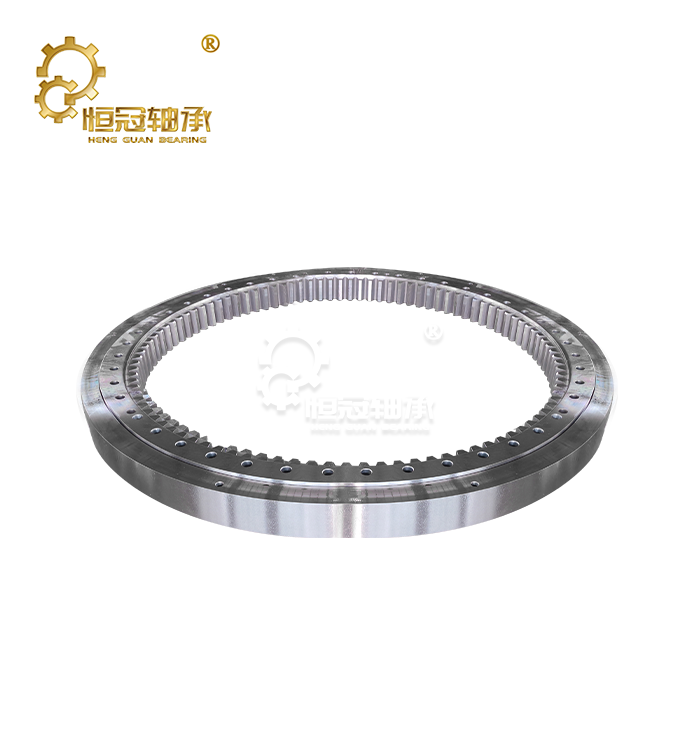
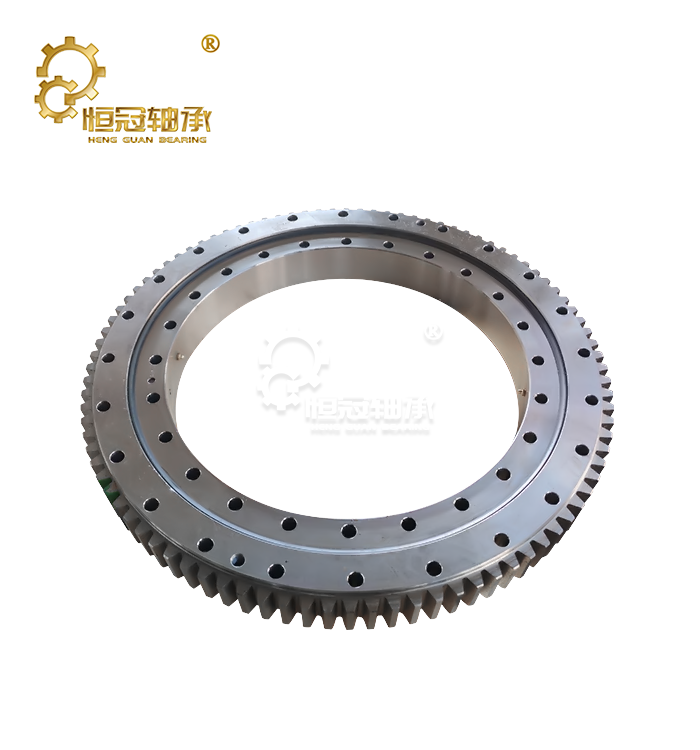
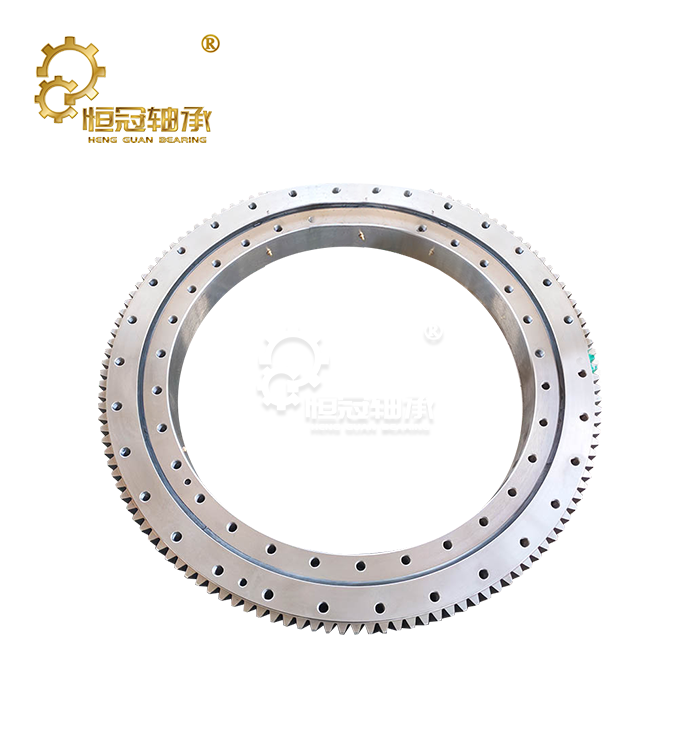
Ball Bearing Slewing Rings are large-diameter rolling bearings developed for machinery that needs controlled rotation while carrying combined axial loads, radial loads, and overturning moments. Unlike conventional bearing arrangements that may require several separate components, a slewing ring integrates the raceway and rolling elements into a compact structure that can also incorporate mounting holes and gear teeth.
This configuration makes ball bearing slewing rings suitable for equipment such as cranes, excavators, aerial work platforms, wind turbines, mining machinery, and industrial automation systems. However, choosing the right slewing ring involves more than matching an outside diameter to the available installation space. Load conditions, mounting stiffness, operating speed, lubrication, sealing, gear arrangement, and maintenance access all influence the final bearing specification.
Luoyang Heng Guan Bearing Technology Co., Ltd. supplies slewing bearing products for construction machinery, mining equipment, wind energy systems, and industrial applications. Its product range covers different bearing structures and dimensional requirements, with engineering support available for projects requiring customized dimensions, mounting patterns, gear configurations, or sealing arrangements.

How Ball Bearing Slewing Rings Handle Heavy and Combined Loads?
Raceways, Rolling Elements, and Ring Structure
A ball bearing slewing ring generally consists of an inner ring, an outer ring, raceways, rolling elements, seals, and, depending on the design, an integrated gear. The rings provide the primary structural support, while the balls transfer operating forces through the raceway system.
The raceway geometry is particularly important because it determines how loads are transferred between the rings and rolling elements. In a properly selected bearing, the contact arrangement allows the bearing to accommodate the combination of forces generated by the equipment rather than treating axial and radial loads as completely independent conditions.
Material selection also depends on the intended application. Slewing bearing rings may be manufactured from steels selected for strength, toughness, machinability, and heat-treatment response. Materials such as 42CrMo or 50Mn may be specified for certain bearing structures, while the exact grade should be confirmed according to the manufacturer's design and the application's loading requirements.
The rolling elements require controlled dimensional accuracy and surface quality. Bearing steels such as GCr15SiMn may be used for ball elements in suitable applications. Heat treatment and grinding processes are used to achieve the required hardness, geometry, and surface condition.
Why Four-Point Contact Is Important?
Four-point contact raceways are widely used in ball slewing ring designs because a single ball can establish contact with the raceway at multiple points under appropriate loading conditions. This allows the bearing to accommodate axial and radial forces as well as overturning moments within one bearing assembly.
This is particularly useful for machinery where the load direction changes during operation. A crane, for example, can experience different force combinations when the boom moves, a load is lifted, or the upper structure rotates. An excavator can experience changing loads as the boom and bucket move through different working positions.
The actual load capacity of a bearing still depends on its design, dimensions, contact geometry, material, heat treatment, mounting conditions, and operating parameters. Therefore, four-point contact should not be interpreted as a guarantee that every bearing can accommodate any combination of loads.
Sealing and Protection Against Contamination
Seals form another important part of the slewing ring assembly. Construction, mining, and outdoor equipment may operate around dust, mud, water, metal particles, and other contaminants. If these materials enter the raceway, they can affect lubrication and surface condition.
NBR and FKM are examples of elastomer materials that may be used for sealing, depending on temperature, chemical exposure, and application requirements. The appropriate seal material should be selected according to the actual operating environment rather than simply choosing a material based on general specifications.
For outdoor or marine applications, sealing may also need to be considered together with corrosion protection, lubricant selection, and surface treatment.
Where Ball-Bearing Slewing Rings Are Used?
Cranes and Construction Machinery
Cranes are a major application for slewing rings because the upper structure needs to rotate relative to the fixed base while supporting substantial loads. The bearing connects these two sections and transfers forces generated during lifting and rotation.
Mobile cranes, crawler cranes, tower-related lifting systems, and other construction machines can experience frequent starts, stops, acceleration, braking, and changes in load position. These operating conditions place different demands on the raceway, mounting bolts, gear teeth, and supporting structure.
Excavators also depend on slewing bearing assemblies to rotate the upper structure around the undercarriage. During digging, lifting, and dumping, the position of the working attachment changes continuously, producing variable loading conditions.
For these applications, bearing selection should consider more than static load. Engineers should evaluate the maximum axial force, radial force, overturning moment, operating cycle, rotational speed, and mounting structure before confirming the bearing model.
Wind Turbines and Renewable Energy Equipment
Wind turbines use large rotating components that must operate under changing environmental and mechanical conditions. Slewing bearing technology can be used in yaw and pitch systems, depending on the turbine architecture.
A yaw bearing supports the rotation of the nacelle around the tower axis, allowing the turbine to change its orientation. Pitch bearings allow the blades to rotate around their own axes so that the blade angle can be adjusted.
Wind applications require attention to fatigue loading, temperature variation, lubrication, sealing, corrosion protection, and maintenance accessibility. Offshore installations introduce additional considerations because salt spray and high humidity can influence exposed surfaces and sealing systems.
For these applications, the bearing specification should be matched to the turbine manufacturer's mechanical design and operating requirements rather than selected solely according to bearing dimensions.
Mining and Heavy Industrial Equipment
Mining equipment places demanding requirements on large mechanical components. Excavators, stacker reclaimers, rotary equipment, and other machinery may operate continuously while exposed to dust, vibration, impact loading, and changing environmental conditions.
In such equipment, a slewing ring needs to work as part of the complete mechanical system. The bearing itself is only one part of the load path. The supporting structure, mounting bolts, gear drive, lubrication system, and maintenance procedure can all influence actual operating performance.
For this reason, mining applications benefit from a selection process based on real operating data. Information about load cycles, rotation frequency, contamination levels, expected operating hours, and maintenance access can help the manufacturer recommend a more appropriate configuration.
How to Select the Right Slewing Bearing Configuration?
Ball Design or Roller Design?
Ball and roller slewing bearings have different load-transfer characteristics, so the choice should be based on application requirements.
Ball bearing slewing rings are often considered when smooth rotational movement, compact construction, and the ability to accommodate combined loads are important. Their suitability depends on the specific bearing geometry and operating conditions.
Roller slewing bearings use rollers rather than balls. The larger line-contact area can provide characteristics that are advantageous for applications with particular heavy-load requirements.
Neither configuration should automatically be considered superior. Engineers should compare the expected axial load, radial load, overturning moment, rotational speed, required accuracy, available space, duty cycle, and maintenance conditions before choosing between the two designs.
Internal Gear or External Gear?
The gear arrangement determines how the slewing ring interfaces with the equipment's drive system.
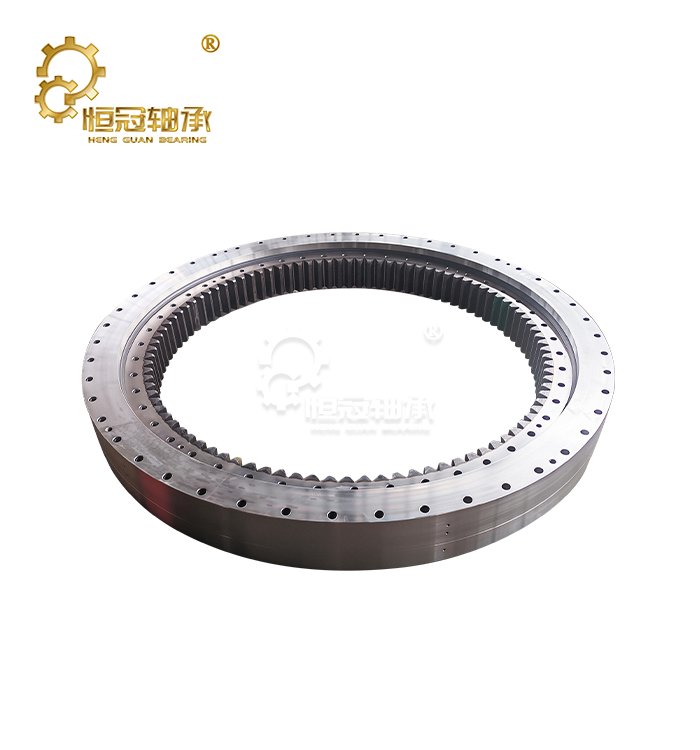
With an internal gear configuration, the teeth are positioned inside the bearing diameter. This arrangement can be useful when the equipment layout benefits from keeping the drive interface within the bearing envelope.
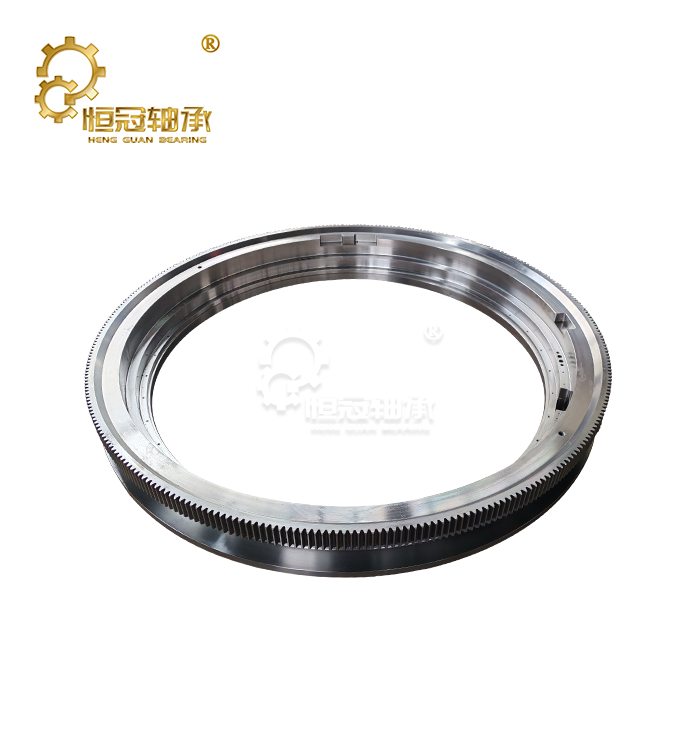
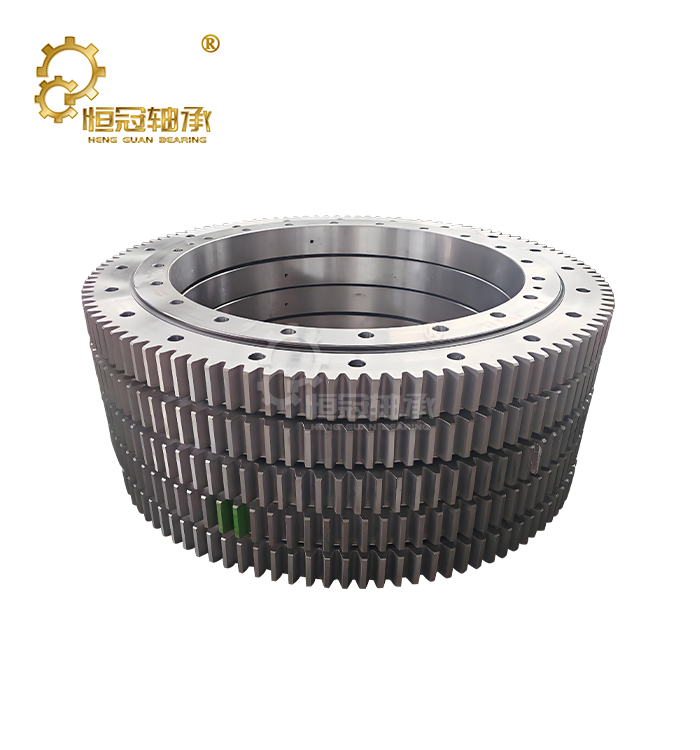
An external gear configuration places the teeth around the outside circumference. It may provide convenient access for certain drive arrangements and inspection procedures.
Gear selection should therefore be based on the complete equipment layout. Engineers should consider pinion position, available installation space, gear module, tooth dimensions, lubrication access, maintenance requirements, and the expected transmission load.
Gear machining accuracy is also important. Proper tooth geometry and controlled manufacturing tolerances help the pinion and ring gear engage consistently during operation.
Single-Row and Other Structural Configurations
Slewing bearings are available in different structural arrangements to suit different combinations of load and movement requirements. A single-row four-point contact ball design is one common configuration, but other structures may be considered when the application calls for different load distribution characteristics or higher stiffness.
The final structure should be selected from engineering calculations rather than from bearing size alone. A larger outside diameter does not automatically mean that a bearing is appropriate for a particular machine.
What Should Engineers Check Before Ordering?
Start With the Complete Load Case
The first step in selecting Ball Bearing Slewing Rings is to define the actual load case.
Important information can include:
- maximum axial load
- maximum radial load
- overturning moment
- static and dynamic operating conditions
- rotational speed
- acceleration and braking conditions
- duty cycle
- expected operating hours
Load values should be provided as accurately as possible. If the equipment operates under several different working conditions, each important load case should be considered.
For example, a crane may have a significantly different load case when the boom is fully extended compared with when it is operating close to the machine. Using only an average load can therefore produce an incomplete bearing selection.
Check the Mounting Structure
The supporting structure is just as important as the bearing itself. The mounting surfaces should provide adequate stiffness and dimensional accuracy so that the bearing can transfer loads as intended.
Potential issues include surface deformation, insufficient support, incorrect bolt patterns, and uneven mounting conditions. If the support structure deforms excessively under load, the raceway may experience uneven loading even when the bearing has been correctly manufactured.
Before ordering, buyers should therefore provide mounting drawings and relevant structural information whenever possible.
Define Environmental and Maintenance Conditions
The operating environment should be included in the specification. Outdoor equipment, mining machinery, coastal installations, and equipment exposed to water or dust may require different sealing and surface-treatment solutions.
Maintenance requirements should also be discussed in advance. Lubrication access, inspection frequency, gear accessibility, seal replacement, and bolt inspection can influence the practical design of the bearing system.
A bearing that meets the calculated load requirements may still be inconvenient to maintain if the equipment layout prevents technicians from reaching critical service points.

Standard and Customized Ball Bearing Slewing Rings
When a Standard Bearing Is Appropriate
Standard slewing rings can be suitable when the required dimensions, load capacity, gear arrangement, and mounting configuration correspond to an existing product design.
Using an established design may simplify engineering coordination and procurement because the manufacturer already has defined production and inspection procedures for that configuration.
Before selecting a standard model, however, buyers should still confirm the actual operating requirements. Product dimensions alone do not provide enough information to determine whether a bearing is suitable for the complete machine.
When Custom Engineering Makes Sense
Some equipment requires a customized slewing ring because of restricted installation space, unusual mounting dimensions, special gear requirements, or specific operating conditions.
Customized solutions may involve:
- special inner and outer diameters
- customized mounting-hole patterns
- internal or external gear configurations
- application-specific sealing
- specified material grades
- customized dimensional requirements
- special inspection documentation
Luoyang Heng Guan Bearing Technology Co., Ltd. can support customized slewing bearing projects by reviewing application information, installation drawings, dimensional requirements, and operating conditions. This type of engineering communication helps ensure that the selected bearing is evaluated as part of the complete machine rather than as an isolated component.
Manufacturing and Quality Checks That Matter
Machining and Heat Treatment
Manufacturing accuracy has a direct relationship with the dimensional and geometric characteristics of a slewing ring. CNC machining can be used to produce the ring structure, mounting features, raceways, and gear teeth according to the specified design.
Heat treatment is another important stage for bearing components. The process is selected according to the material and required mechanical properties. Properly controlled heat treatment can establish the required hardness and structural characteristics for the intended application.
Raceway machining and finishing of ball bearing slewing rings also require attention because the raceway is the primary contact surface between the rolling elements and rings.
Assembly and Final Inspection
During assembly, manufacturers need to control rolling element installation, internal clearance, seal positioning, lubrication, and other relevant parameters.
Final inspection may include dimensional checks, mounting-hole verification, raceway inspection, gear inspection, and other tests specified by the product design or customer requirements.
For industrial procurement, buyers should request the documentation relevant to the project. Depending on the order, this may include the following:
- dimensional inspection records
- material documentation
- heat-treatment records
- product drawings
- quality inspection reports
- Certificates of Conformity or other agreed documentation
The exact inspection scope should be confirmed with the manufacturer before production begins.
Maintenance Practices for Long-Term Bearing Operation
Establish a Suitable Lubrication Schedule
Lubrication should follow the bearing manufacturer's recommendations and the actual operating conditions. Grease selection can depend on load, temperature, rotation speed, water exposure, contamination, and operating cycle.
Both insufficient and excessive lubrication can create operational problems. The maintenance plan should therefore define the appropriate grease type, quantity, lubrication points, and service interval.
For equipment operating under severe contamination or high-duty conditions, the lubrication schedule may need to be reviewed more frequently.
Inspect Bolts, Seals, and Gear Teeth
Routine inspection should cover the components that influence the bearing's mechanical connection with the equipment.
Maintenance personnel can monitor the following:
- mounting-bolt condition
- seal condition
- lubrication condition
- gear-tooth condition
- unusual noise
- abnormal vibration
- excessive clearance
- visible contamination
Mounting bolts deserve particular attention because inadequate tightening or changes in bolt condition can affect the load transfer between the bearing and supporting structure.
Gear teeth should also be inspected for abnormal wear, surface damage, or lubrication issues. The inspection procedure should follow the equipment manufacturer's maintenance requirements.
Avoid Operating Outside the Design Conditions.
Even a properly manufactured slewing ring can perform differently if the equipment operates beyond its specified conditions.
Operators and maintenance teams should understand the bearing's intended load range, rotational speed, lubrication requirements, and environmental limitations. Changes to the machine, such as increasing lifting capacity or modifying the drive system, should trigger a review of the bearing selection.
This approach is particularly important for heavy-duty machinery where operating conditions may change after the original equipment has been commissioned.
How to Evaluate a Slewing Bearing Supplier
Look Beyond Product Dimensions
For industrial buyers, supplier evaluation should include more than price and delivery time. A suitable manufacturer should be able to communicate clearly about product structure, material selection, manufacturing requirements, inspection procedures, and application conditions.
Before placing an order, buyers can ask for the following:
- product drawings
- technical specifications
- load-related information
- material documentation
- inspection documentation
- customization capabilities
- packaging and delivery details
- engineering support
Clear technical communication at the beginning of a project can prevent specification errors later in the production process.
Provide Complete Information for a Faster Quotation
When requesting a quotation for a slewing ring, buyers should provide as much relevant information as possible.
A useful inquiry package may include:
- Equipment type and application.
- Required inner and outer diameter.
- Axial and radial loads.
- Overturning moment.
- Rotation speed and duty cycle.
- Internal or external gear requirement.
- Mounting-hole dimensions.
- Operating temperature and environmental conditions.
- Lubrication requirements.
- Expected delivery schedule.
If drawings are available, supplying them together with the technical data can make communication more efficient.
Luoyang Heng Guan Bearing Technology Co., Ltd. provides standard and customized slewing bearing solutions for industrial applications. Its engineering team can review project requirements and support the selection of suitable bearing structures, dimensions, gear arrangements, and related specifications.
Conclusion
In heavy-duty industrial applications, ball bearing slewing rings provide an efficient solution for achieving reliable rotation under complex loading conditions. Their ability to accommodate axial forces, radial loads, and tilting moments makes them important components in construction machinery, mining equipment, wind turbines, and other large mechanical systems.
Selecting the correct slewing ring requires careful consideration of load requirements, installation conditions, environmental factors, gear configuration, and long-term maintenance plans. The bearing should be evaluated together with the supporting structure, drive system, lubrication arrangement, and actual operating cycle rather than selected by dimensions alone.
Working with an experienced slewing bearing manufacturer allows customers to receive both a suitable bearing configuration and technical support during the specification process. Luoyang Heng Guan Bearing Technology Co., Ltd. provides slewing bearing solutions for standard and customized industrial applications, supporting customers with product selection, engineering communication, manufacturing, and inspection requirements.
|
|


FAQ
1. What makes ball bearing slewing rings suitable for heavy-duty applications?
Ball Bearing Slewing Rings work great in heavy-duty settings because they can handle axial, radial, and moment loads all at the same time in a single, small unit. The carefully planned track layout with sharpened steel balls evenly distributes the load, and high-quality materials such as 42CrMo alloy steel keep the structure strong. Modern sealing systems keep internal parts clean from the dirt and dust that are typical in building and mining sites.
2. How can I figure out what size and specs I need for my project?
To get the right size, you need to look at the load conditions, the size limitations, and the working needs. It is important to think about the highest load capacities in all directions, the mounting room that is available, and the accuracy needs. Our engineering team does thorough application research to make sure that the Ball Bearing Slewing Rings we choose will work well in real-world situations.
3. What kinds of upkeep can make a slewing ring last longer?
Systematic greasing management using the right high-quality greases is the basis for upkeep. Regular inspections should check the state of the raceways, the soundness of the seals, and the tightness of the mounting bolts. The right way to clean gets rid of dirt while protecting seal systems. Following the manufacturer's instructions for how often to lubricate and check Ball Bearing Slewing Rings makes them last a lot longer.
Partner with Heng Guan for Superior Ball Bearing Slewing Ring Solutions
Luoyang Heng Guan Bearing Technology Co., Ltd. is ready to meet your heavy-duty application needs with precision-engineered Ball Bearing Slewing Rings manufacturer solutions. Our wide range of products has choices with diameters from 20 to 10000 mm and accuracy levels from P0 to P4. They are made with high-tech tools and strict quality control procedures. Get in touch with our technical team at mia@hgb-bearing.com to talk about your unique needs and find out how our custom bearing solutions can help your tools work better and be more reliable.
References
1. Harris and T. A. M. N. Kotzalas & Co. "Essential Concepts of Bearing Technology: Rolling Bearing Analysis, Fifth Edition." The CRC Press, 2019.
2. A. Warda; B. & Chudzik, A. The Journal of Mechanical Engineering Science published a paper in 2018 called "Fatigue Life Prediction of Rolling Element Bearings: Engineering Tribology and Reliability Assessment."
3. ISO 14728-1:2017 "Rolling bearings – Linear motion rolling bearings – Part 1: Dynamic load ratings and rating life." ISO stands for the International Organization for Standardization.
4. Company Schaeffler Technologies AG & Co. KG. Publishing in 2020, "Large Size Rolling Bearings: Technical Handbook for Slewing Bearings and Their Applications."
5. Palmer, D. & Fish, M. In 2019, Mechanical Systems and Signal Processing published a paper called "Slewing Ring Bearing Technology: Design Principles and Industrial Applications in Heavy Machinery."
6. The Society of American Mechanical Engineers. Published by the ASME Standards Committee in 2013 as "ASME B105.1M-1984 (R2013): Specification for Rolling Element Bearings - Metric Design."

WHAT OUR CUSTOMERS SAY
Here is the customer's evaluation of us