



How to Select the Right Slewing Bearing for Tower Crane Projects?
To choose the right slewing bearing for a tower crane, you will have to look hard at a number of technical and practical issues. The selection of the proper slewing bearing influences the stability of the tower crane, the rotation effect, the maintenance and the service life. Selection should not be made solely on the basis of bearing diameter or rated load. Engineers and procurement teams additionally need to consider axial load, radial load, overturning moment, operating conditions, mounting arrangement, material quality, lubrication and supplier support. This manual will walk you throughout the important variables to consider when choosing a slewing bearing for a tower crane, starting with load analysis and ending with supplier assessment and ongoing maintenance.

Start with the Crane's actual load conditions.
Calculate Axial, Radial, and moment loads.
The first step is to establish the loads that the bearing will experience during operation. A tower crane slewing bearing may be subjected to vertical axial loads from lifted materials, radial loads from the structure and working forces, and overturning moments caused by the boom, suspended load, wind, and other external forces.
Do not select a bearing from the lifting capacity alone. The engineering calculation should consider the maximum working condition, load combinations, dynamic effects, and applicable crane design requirements. Where relevant, wind and seismic conditions should also be included.
The selected bearing should have sufficient static and dynamic capacity for the actual load spectrum, with the required safety margin defined by the crane design and applicable standards.
Consider Load Frequency and Operating Cycles
Two cranes with the same rated lifting capability may need different bearings because of their varying operation cycles. A crane working continually on a busy construction site can impose larger cumulative pressures on the bearing than one that operates infrequently.
Note the intended rotation frequency, loading distribution, duty cycle and usual operating circumstances. This information provides the bearing manufacturer with a more meaningful basis for assessing capacity and service-life expectations.
Match the Bearing Design to the Application
Compare Bearing Configurations
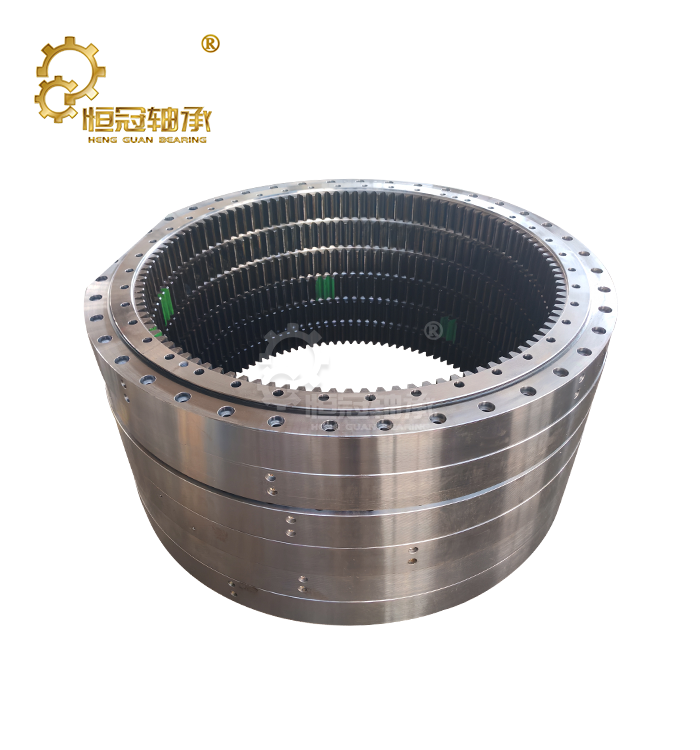
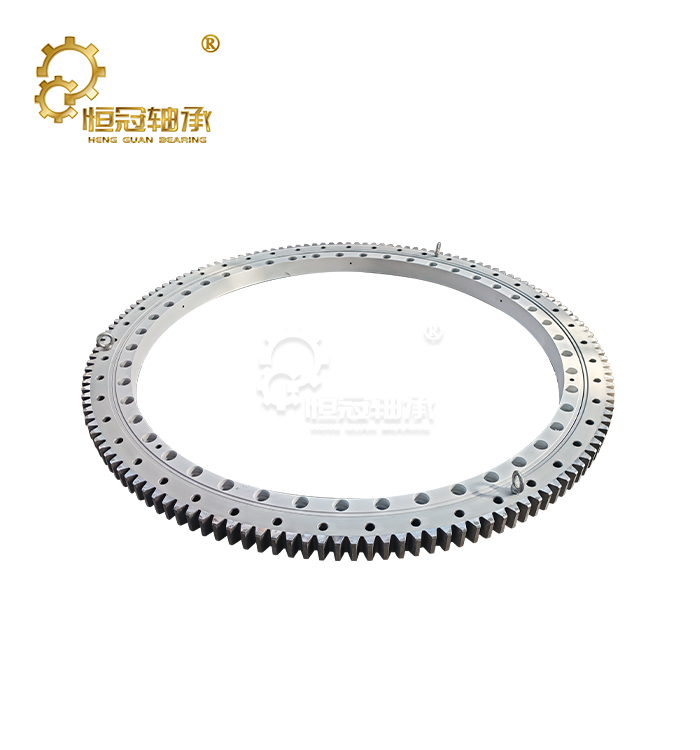
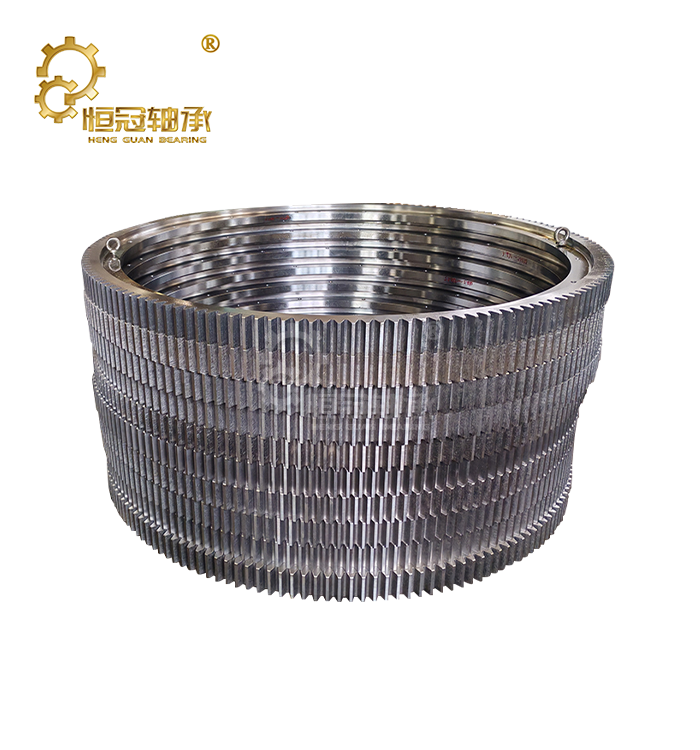
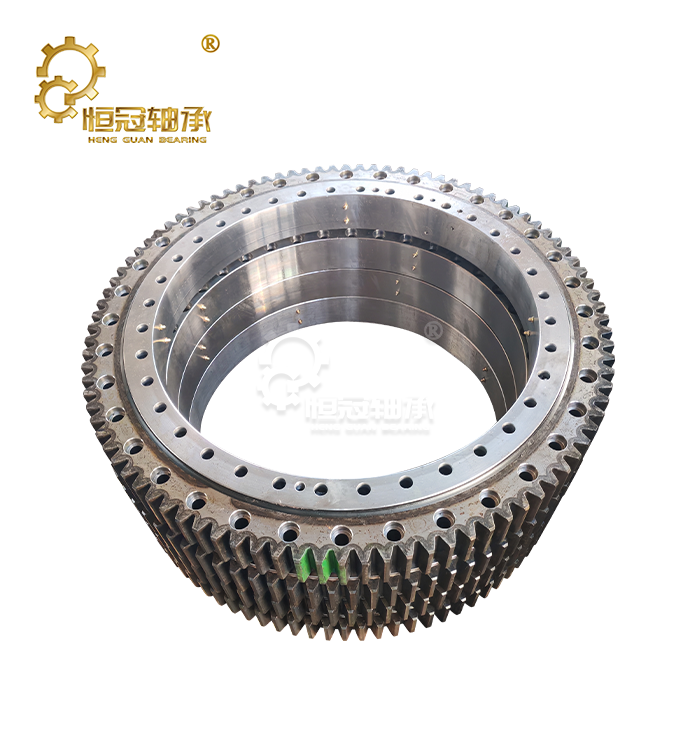
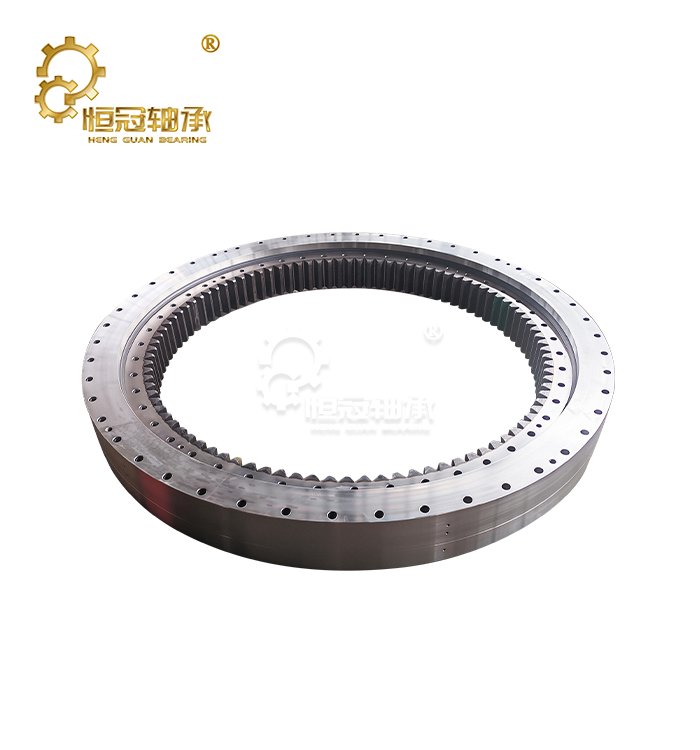
Tower crane applications may use different slewing bearing configurations depending on load, space, stiffness, and rotation requirements. Common options include:
Single-row four-point contact ball bearings: suitable for applications where compact dimensions and combined load capacity are important.
Double-row ball bearings: provide increased load capacity where the application requires greater support.
Cross-roller bearings: offer high stiffness and can be considered where rotational accuracy and moment resistance are important.
Triple-row roller bearings: provide high load-carrying capability for demanding applications where bearing size and weight are acceptable.
The final choice should be based on calculated loads and the manufacturer's design data rather than the bearing type alone.
Check Mounting and Gear Arrangement
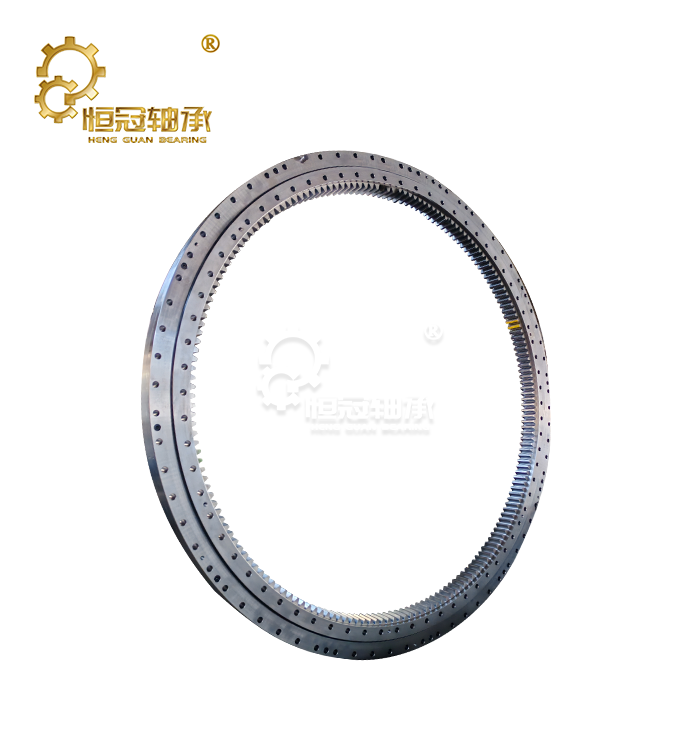
A slewing bearing is part of a larger rotation system. Engineers should check the mounting bolt pattern, bearing dimensions, gear arrangement, clearance, pinion engagement, installation surface, and surrounding structure before placing an order.
For geared bearings, the gear module, tooth geometry, hardness, backlash, and pinion alignment also need to be compatible with the crane's drive system. A bearing that meets the load requirement can still create operational problems if the mounting or gear interface of the slewing bearing for a tower crane is incorrect.
Evaluate Material, Manufacturing, and Quality
Review Steel and Heat Treatment
Large slewing bearings commonly use alloy or medium-carbon steels selected according to the required strength, toughness, wear resistance, and manufacturing process. Materials such as 42CrMo and 50Mn may be used in different bearing components, but the material grade alone does not demonstrate product quality.
Ask the supplier for material specifications, heat-treatment information, dimensional inspection records, and other relevant quality documents. For critical applications, traceability from raw material to finished bearing can provide additional confidence.
Distinguish Quality Systems from Product Standards
ISO 9001 concerns quality management systems, while bearing-related standards may address dimensions, tolerances, accuracy, or other technical characteristics. These should not be treated as interchangeable certifications.
When evaluating a supplier, check which standards actually apply to the bearing design and request supporting inspection or compliance documentation. Product drawings, certificates, test reports, and inspection records for slewing bearing for a tower crane are more useful than a general statement that a product meets “international standards.”

Account for Site Conditions and Maintenance
Adapt the Bearing to the Environment
Construction site bearings are subject to rain, dust, sludge, salt air, temperature changes and other pollutants. Projects in coastal areas may require additional corrosion protection, while dusty sites place additional demands on seals and lubrication procedures.
And when selecting grease, seals and related components, you should also consider the operating temperature. If the crane will be used in an extremely hot, cold, humid, or corrosive environment, submit these circumstances to the bearing manufacturer before final selection.
Plan Lubrication and Inspection
An important factor in reducing raceway and gear wear is lubrication. The kind and amount of grease to be used and the lubrication interval should be specified by the bearing manufacturer and adjusted for actual operating conditions if necessary.
Maintenance records should include lubrication dates, results of inspections, any odd noise or vibration, temperature changes, gear condition, checking of bolts and any excessive rotational resistance. Regular monitoring helps discover problems as they occur, preventing them from causing unnecessary downtime.
Compare Suppliers Before Placing the Order
Look Beyond the Purchase Price
A low initial price does not necessarily mean the lowest total price. Poor dimensional correctness, inadequate documentation, irregular heat treatment, delayed delivery or limited technical support might cause installation challenges and costly downtime.
When comparing vendors, check out the following:
Technical application and design support
Control of material and heat treatment
Traceability and inspection procedures
Documentation, Dimensional & Performance
Ability to customize
Production and supply capacity
Warranty conditions
After-sales assistance and spare components
When judging supplier capability for a vital tower crane part, pricing isn’t the only consideration.
Request the Right Technical Documents
Before approval, request the bearing drawing, material information, applicable tolerances, mounting requirements, lubrication recommendations, inspection records and other papers related to the project.
If the bearing is a replacement part, not a new build, supply the original bearing number, dimensions, gear data, mounting data and accessible load information. That lowers the chances of you picking a replacement that looks the same but is technically incompatible.
Verify the Bearing Before Full Operation
Inspect Installation Quality
Even a well-designed bearing might fail prematurely if it is poorly fitted. Before commissioning, check the mounting surface, bolt tightness, alignment, gear engagement, clearance, lubrication, seals and rotation condition according to the manufacturer’s recommendations.
Don't think that a new bearing instantly compensates for faults with the crane structure or mounting system. "The surrounding components should be inspected before the crane is put back into service."
Establish a Baseline for Monitoring
After installation note pertinent baseline conditions such as rotational resistance, gear condition, lubrication state, clearance when appropriate, and unusual noise or vibration.
This can then be used as a baseline for future inspections. Changes in operational behavior can signal lubrication problems, contamination, mounting problems, gear wear, or other emerging flaws.
Build a Long-Term Maintenance Plan
Combine Manufacturer Guidance with Actual Use
The maintenance intervals must be established according to the manufacturer's recommendations and the real working environment of the crane. There is no set lubrication interval that fits every tower crane.
Severe weather, pollution, heavy duty, or frequent rotation may demand more frequent inspection and lubrication. Maintenance workers should also know the proper grease, method of application, inspection spots and warning indicators of bearing degeneration.
Keep Complete Maintenance Records
The maintenance diary should include lubrication, inspections, checks of bolts, condition of gears, repairs, hours of operation and anomalous observations. Maintenance personnel can use these records to see trends and make smarter choices on when to check or replace.
Good documentation also helps procurement teams determine if a bearing or supplier is providing the service performance expected for long-term projects.
Conclusion
When selecting a slewing bearing for a tower crane, it is not just a matter of size and price. Begin with the axial load, radial load, overturning moment, duty cycle and operational environment of the crane. Then check the bearing arrangement, material, heat treatment, fitting arrangement, lubrication needs and quality documents.
Selecting the supplier is just as crucial. A competent manufacturer will be able to give technical drawings, inspection data, application support and practical recommendations based on the crane operating conditions. A disciplined selection procedure decreases the danger of premature wear, installation problems and unplanned downtime and helps to control the total cost of ownership.
|
|


FAQ
1. How should I determine the required slewing bearing capacity?
Start with the maximum axial load, radial load, and overturning moment from the crane's design calculations. Also consider load combinations, dynamic effects, operating cycles, and environmental conditions. The bearing manufacturer can then verify the appropriate capacity and configuration.
2. How often should a tower crane slewing bearing be lubricated?
There is no universal interval. Lubrication frequency depends on the bearing design, grease specification, operating hours, load, rotation frequency, and site conditions. Always start with the manufacturer's recommended lubrication schedule and adjust it only when supported by operating conditions and maintenance data.
3. What documents should I request from a slewing bearing supplier?
Useful documents may include product drawings, material specifications, heat-treatment records, inspection reports, dimensional data, lubrication instructions, installation requirements, and traceability information. For replacement bearings, also verify compatibility with the original mounting and gear arrangement.
4. Can a slewing bearing be customized for a tower crane?
Yes. Depending on the manufacturer, customization may cover dimensions, mounting holes, gear configuration, material selection, sealing, clearance, and other application-specific requirements. The supplier should review the crane's technical data before confirming the design.
Partner with Heng Guan for Tower Crane Slewing Bearing Solutions
Heng Guan Bearing Technology provides slewing bearing solutions for tower cranes and other heavy-duty applications. Its product range covers bearing diameters from 20 to 10,000 mm, with options including different precision grades and material configurations.
For project-specific requirements, buyers can provide the required bearing dimensions, load data, gear information, operating conditions, and installation details for a slewing bearing for a tower crane. Heng Guan's engineering team can use these inputs to evaluate the bearing configuration and provide technical recommendations, helping customers select a solution suited to their actual application rather than relying on size or price alone.
Get in touch with our experts at mia@hgb-bearing.com to talk about your unique needs and find out how our custom solutions can help your tower crane operations.
References
1. Chen, Wei, and Liu, Ming. "Advanced Materials and Design Optimization for Heavy-Duty Slewing Bearings in Construction Equipment." Journal of Mechanical Engineering Science, vol. 234, no. 8, 2020, pp. 1542-1558.
2. Anderson, Robert K. "Load Analysis and Fatigue Life Prediction for Tower Crane Slewing Bearings." International Journal of Construction Machinery, vol. 15, no. 3, 2019, pp. 89-104.
3. European Committee for Standardization. "Slewing Bearings - Part 1: Dimensions and Tolerances for Tower Crane Applications." EN 12521-1:2018, Brussels, 2018.
4. Thompson, Sarah J., and Martinez, Carlos. "Maintenance Strategies for Extended Service Life of Construction Equipment Bearings." Construction Equipment Technology Review, vol. 42, no. 6, 2021, pp. 23-35.
5. International Organization for Standardization. "Rolling Bearings - Methods for Calculating the Modified Rating Life for Universally Loaded Bearings." ISO/TS 16281:2008, Geneva, 2008.
6. Kumar, Rajesh, et al. "Comparative Analysis of Bearing Technologies for Heavy Lifting Equipment: Performance and Economic Considerations." Heavy Industry Engineering Quarterly, vol. 28, no. 4, 2020, pp. 156-171.

WHAT OUR CUSTOMERS SAY
Here is the customer's evaluation of us