




How to Select a Slewing Bearing for Heavy-Duty Cranes
Selecting the improper slewing bearing may cut the life of a crane, increase service expenditures, and put safety at risk. Many purchasers are familiar with the irritation of a bearing not fitting the mounting pattern, raceways failing early under stress, and long downtimes while replacements are obtained. A well-fitted bearing, however, keeps the superstructure spinning smoothly for years. Heng Guan Bearing shows you the main selection procedures, from the calculation of the load and design comparison to the materials and maintenance. There are practical references to the single-row ball slewing bearing and the excavator slewing bearing in this guide. Continue reading to see how Heng Guan Bearing assists engineers in making a confident decision.
What Loads Should You Calculate Before Selecting a Crane Slewing Bearing?
It all begins with an honest representation of the loads your crane will be lifting. The lifting capability is rated. Add the weight of the boom, counterweight, and superstructure. All of these work on the slewing bearing jointly. Then add the dynamic impacts of beginning, braking, wind, and rapid swinging to the static values. Generally, the engineer will combine them into one axial force, one radial force, and one tilting moment, and then add a safety factor appropriate to the job class.
Whether you need a single row ball slewing bearing for a tiny crane or an excavator slewing bearing for mobile equipment, correct statistics make the decision much simpler. Heng Guan Bearing can check your calculations and provide an appropriate size.
| Load Input | What to Include | Why It Matters |
|---|---|---|
| Rated lifting capacity | Maximum load at the working radius | Sets the base axial force and tilting moment |
| Structural weight | Boom, counterweight and superstructure | Adds to axial load and shifts the moment |
| Dynamic effects | Starting, braking, wind, sudden swinging | Raises the static figures under real duty |
| Safety factor | Matched to the duty class | Protects against overload and fatigue |
Single Row Ball Slewing Bearing vs. Other Designs: Which Fits Your Crane?
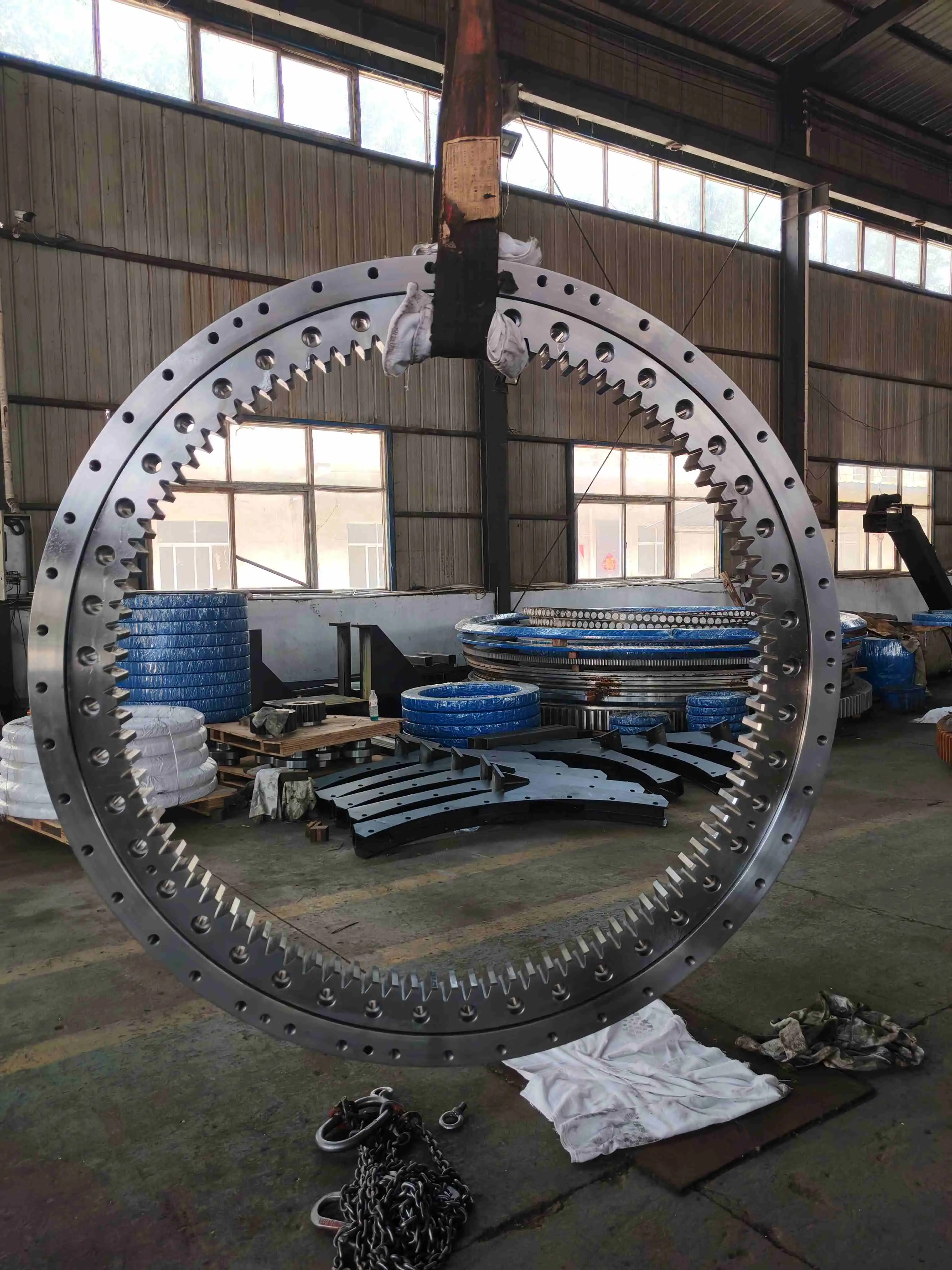
The most common designs are the single row ball slewing bearings. It contains two seat rings and a single row of steel balls with four-point contact against the raceway, so it can take axial force, radial force, and tilting moment combined in a tiny cross-section. This creates a small, low-weight construction that is straightforward to build. It is a popular excavator slewing bearing and a solid solution for mini excavators, truck cranes, small and medium cranes, aerial work platforms, and solar tracking systems. External gear (011/012), internal gear (013/014), and gearless (010) variants are available.
Cross roller and three-row roller designs may accommodate heavier loads but need more room and weight, and provide more capacity. Double-row ball. All these structures are manufactured by Heng Guan Bearing in precision grades P0, P6, P5, and P4, so you may tailor the design to your operating circumstances. Here is a brief comparison chart below.
| Design | Strength | Typical Use |
|---|---|---|
| Single row ball | Compact, light, versatile | Excavators, small cranes |
| Double row ball | Higher axial capacity | Mobile and harbor cranes |
| Cross roller | High rigidity and accuracy | Precision lifting equipment |
| Three-row roller | Highest load capacity | Port and ship cranes |
For the single-row ball slewing bearing, the typical size and configuration ranges are shown below. Custom sizes are available, and thin-section Series Q designs suit low-profile crane installations where vertical space is limited.
| Parameter | Specification Range |
|---|---|
| Inner diameter | 50 mm – 2000 mm |
| Outer diameter | 70 mm – 2200 mm |
| Height (cross-section) | 30 mm – 150 mm |
| Gear module | M2 – M12 (customizable) |
| Bolt hole diameter | M8 – M48 |
| Series options | 011/012 (external gear), 013/014 (internal gear), 010 (gearless) |
| Ring material | 42CrMo or 50Mn forged alloy steel |
| Rolling elements | GCr15SiMn high-purity bearing steel |
| Raceway hardness | 55–62 HRC (induction hardened) |
| Seals | NBR or fluororubber |
Single row ball slewing bearing
How Do Axial Loads, Radial Forces, and Tilting Moments Affect Bearing Selection?
Every slewing bearing must handle 3 loads at the same time, and each one dictates the size and type you require. Axial load pushes along the axis of rotation and decides how many balls or rollers have to take the weight. Radial force pushes sideways and tests the raceway and the mounting structure. The tilting moment, from the boom and its load, most typically has the most impact on a crane and hence often dictates the bearing diameter.
A single row ball slewing bearing handles all three loads together within its rated range, which is why it also suits the excavator slewing bearing. For a free load check, send your data to mia@hgb-bearing.com, and Heng Guan Bearing will compare it with the capacity curves. If original drawings are unavailable, Heng Guan Bearing can also verify mounting hole patterns and gear parameters against your existing bearing for drop-in compatibility.
| Load | Direction | Selection Impact |
|---|---|---|
| Axial load | Along rotation axis | Sets rolling element count |
| Radial force | Sideways | Affects raceway and frame design |
| Tilting moment | Overturning | Often decides bearing diameter |
How Can Material Quality, Lubrication, and Maintenance Extend Slewing Bearing Service Life?
Good materials are the basis of lengthy service life. The rings are manufactured from 50Mn or 42CrMo steel and induction hardened on the raceways to 55–62 HRC to withstand fatigue and stress. Smooth movement is assured by quality GCr15SiMn balls and cages. Fresh grease then develops a protective coating which reduces friction and wear; therefore, apply it to the raceway and the gear teeth at regular intervals. Small modifications are simple to remedy early on, so check bolt tightness, test the seals, and listen for odd sounds.
These behaviors are also applicable to a single-row ball slewing bearing on a crane or an excavator slewing bearing on a digger. With proper maintenance, Heng Guan Bearing's slewing bearing may operate successfully for many years.
| Factor | Good Practice | Benefit |
|---|---|---|
| Materials | 50Mn or 42CrMo rings, hardened raceways | Resists fatigue and shock |
| Lubrication | Grease raceways and gear teeth at regular intervals | Lowers friction and wear |
| Bolts | Check tightness regularly | Keeps loading even |
| Seals | Inspect for cracks and leakage | Keeps dust, mud, and moisture out |
Conclusion
When selecting a slewing bearing for heavy-duty cranes, accurate load calculation, selection of the suitable design, and proper bearing maintenance are important. A single-row ball slewing bearing is suitable for various cranes and excavators. Heng Guan Bearing can help in every stage from initial calculation to final delivery.
FAQ
Q: What loads should I calculate first?
A: Calculate axial load, radial force, and tilting moment, including dynamic effects such as starting, braking, and wind.
Q: Why choose a single row ball slewing bearing?
A: It is compact, lightweight, and easy to install for many cranes, and it handles combined loads through four-point contact.
Q: Can it be used as an excavator slewing bearing?
A: Yes, this design is widely used on excavators, and OEM-compatible replacements are available with verified dimensional matching.
Q: Which materials are common for rings?
A: 50Mn and 42CrMo steel are common choices, with induction-hardened raceways.
Q: Does Heng Guan Bearing offer customization?
A: Yes, personalized designs are made for specific working conditions. In-stock products ship in 7–15 days, and custom orders typically take 4–6 weeks.
Contact Heng Guan Bearing Today for Your Crane Slewing Bearing
Looking for the right slewing bearing for your crane or excavator? Luoyang Heng Guan Bearing Technology Co., Ltd. holds ISO 9001 certification and supports every project with engineering expertise:
- Load calculation and bearing selection support
- Customized designs, sizes, and gear options
- OEM replacement matching and on-site measurement when drawings are unavailable
- Installation guidance and a competitive quotation
Contact Us for professional advice. Email Mia at mia@hgb-bearing.com with your load data, and our team will recommend the best solution for your project.
References
1. Harris, T. A., & Kotzalas, M. N. Rolling Bearing Analysis, 5th ed. CRC Press, 2006.
2. ISO 281:2007. Rolling Bearings: Dynamic Load Ratings and Rating Life. International Organization for Standardization.
3. Budynas, R. G., & Nisbett, J. K. Shigley's Mechanical Engineering Design, 11th ed. McGraw-Hill, 2020.
4. Johnson, K. L. Contact Mechanics. Cambridge University Press, 1985.
5. Stachowiak, G. W., & Batchelor, A. W. Engineering Tribology, 4th ed. Butterworth-Heinemann, 2013.
6. Bhushan, B. Introduction to Tribology, 2nd ed. Wiley, 2013.

WHAT OUR CUSTOMERS SAY
Here is the customer's evaluation of us