




Is a Cross Roller Slewing Ring Bearing Suitable for Crane and Radar Systems?
Cross roller slewing ring bearings may be used in crane and radar systems. Yes, in most circumstances. At Heng Guan Bearing, we find this compact bearing type preferred for both applications because of its ability to carry axial force, radial force, and tilting moment in a single solid construction. If you’re creating a rotating antenna platform or a lifting boom, knowing how this slewing bearing functions can help you make confident decisions. Find out where it fits best, what technical aspects are important, and what to examine before purchase.
What Makes Cross Roller Slewing Bearings Ideal for Radar Systems?
Radar platforms need smooth rotation, precise positioning, and a narrow installation profile, and this is where a cross roller slewing ring bearing is ideal. Instead of many bearing arrangements to manage tilting, just one bearing position is used. This makes the turntable small but not less rigid.
How the Roller Layout Handles Combined Loads
Cylindrical rollers are positioned at every 2nd 90° angle between V-shaped raceways. Thus, axial, radial, and moment loads are all taken via one bearing point simultaneously. A single-row construction has a substantially smaller footprint with reduced tilting deflection compared with a standard multi-row slewing bearing.
Rigidity, Precision and Smooth Rotation for Antenna Platforms
Precision-ground raceways and controlled runout assist an antenna in maintaining its pointing direction during continuous scanning. Heng Guan Bearing offers accuracy grades P0, P6, P5 and P4. P0 is suitable for general operation, while P5 and P4 are selected where minimum runout and low rotating noise are most important.
Compact Section, Flexible Gear Layouts
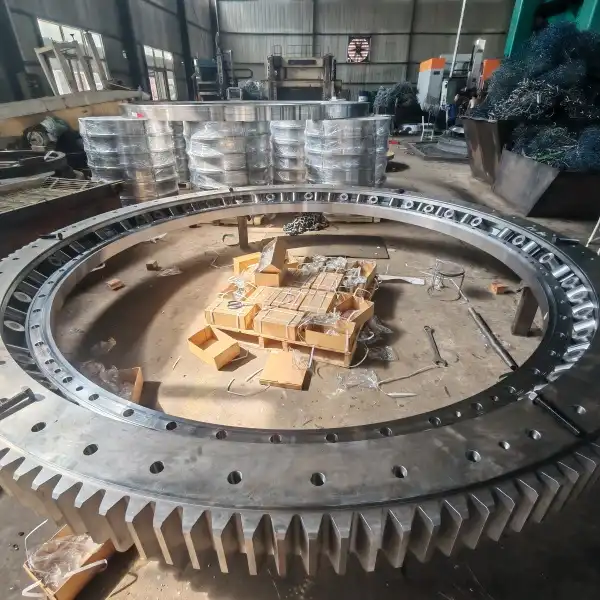
The narrow cross section reduces installation space and weight on the rotator platform. The drive may be adapted to the design of the turntable using external gear, internal gear, and gearless layouts.
Can a Slewing Bearing Meet Crane Load and Rigidity Requirements?
Yes, a good selection of slewing bearings may match the strict criteria of a crane. Cranes deal with large vertical loads, wind-caused tilting moments, and repeated start-stop motions. The line contact between rollers and raceways provides a huge load-carrying surface for a cross roller slewing ring bearing. This produces a high stiffness to maintain the boom or jib in a stable position during load variations.
Matching the Structure to the Duty
If stiffness and a small envelope are paramount, the cross roller design is the ideal choice. For heavy-duty applications, Luoyang Heng Guan Bearing Technology Co., Ltd. also has single-row four-point contact ball, double-row ball, and three-row roller slewing bearing designs, so the structure may adapt to the actual load scenario. In heavy load conditions, port, mining, and construction machines commonly shift to three-row roller types.
Sizes, Gear Teeth and Customization
The diameters of Heng Guan slewing bearings vary from 20mm to 10000mm. We may work from your 3D designs or duplicate an existing item. All are possible: bespoke gear teeth, mounting holes, hardened raceways, and non-standard dimensions.
Cross Roller Slewing Ring Bearing Selection: Key Technical Factors
The first step in choosing the correct cross roller slewing ring bearing is to understand the operating circumstances. Calculate the axial load, radial load, and overturning moment and apply an appropriate safety factor. Next, check the diameter, mounting interface, and gear type. The table below shows the usual technical specifications of our cross roller series.
| Parameter | Typical Specification |
|---|---|
| Outer ring diameter | 80 – 2000 mm |
| Inner ring diameter | 60 – 1850 mm |
| Height range | 10 – 80 mm |
| Precision grades | P0, P6, P5, P4 |
| Ring material | 42CrMo, 50Mn alloy steel |
| Rolling elements | GCr15SiMn high-purity bearing steel |
| Cage material | Brass, steel or engineering plastic |
| Seal type | Nitrile rubber or fluororubber |
| Operating temperature | -30 °C to +120 °C (standard seals) |
| Load capacity | Combined axial, radial and moment loads |
| Mounting method | Clamping rings or bolt-on flange |
| Gear type | External, internal or gearless |
| Standards | ISO, DIN, GB; RoHS compliant |
If you would like a second opinion on your slewing bearing, send your drawing and load data to mia@hgb-bearing.com, and the engineers at Heng Guan Bearing will recommend a tailored solution.
Load, Precision and Gear Type
Check the load values with a safety factor first. Then choose the accuracy grade (P0, P6, P5, or P4) and decide between external gear, internal gear, or gearless.
Environment and Service Life
Temperature, dust, and moisture influence the choice of seal and lubricant. Rotation speed and expected service life then set the lubrication plan.
How to Choose a Reliable Slewing Bearing for Cranes and Radar Systems?
The reliability of a crane or radar slewing bearing is as much a function of the supplier’s capabilities as it is of the product requirements. The consistent quality of the raceway directly impacts the smoothness of rotation and the service life.
Supplier Capability and Quality Control
Look for in-house design, CNC machining, heat treating and grinding equipment, and comprehensive testing. Heng Guan Bearing is manufactured using ISO 9001-approved processes. Each bearing is inspected using coordinate measuring equipment and vibration and noise testing before shipping, and batch traceability records are retained.
Documents to Request Before Ordering
Request material certifications, heat treatment information, inspection reports, and engineering drawings. Order samples before ordering in bulk.
Installation and Maintenance Support
A good partner should also be able to assist you with installation and lubrication. The main features are clean, level mounting surfaces, bolts tightened in a star pattern to the required torque, and a lubrication plan that fits your working circumstances. They help your system work effectively for years to come.
Conclusion
The cross roller slewing ring bearing has a compact design and excellent stiffness and combined load capacity for crane and radar systems. Choose a reliable slewing bearing, verify the load, accuracy, gear type, environment, and supplier strength. Heng Guan Bearing is ready to help with your project.
FAQ
1. Can one cross roller slewing ring bearing carry combined loads?
Yes. Its rollers are arranged at alternating 90-degree angles, so it handles axial, radial, and tilting moment loads at the same time.
2. What accuracy grades are available?
Heng Guan Bearing offers P0, P6, P5, and P4 grades. P0 suits general applications, P6 and P5 meet higher precision needs, and P4 is recommended where minimal runout is required.
3. What diameter range can be supplied?
Slewing bearings from 20 mm to 10000 mm are available. The cross roller series typically covers outer diameters of 80–2000 mm.
4. Are gear options available?
Yes, external gear, internal gear, and gearless versions can be supplied.
5. Can the bearing be customized?
Yes. Dimensions, mounting holes, and gear parameters can be tailored to your drawing.
Ready to Upgrade Your Crane or Radar Project? Contact Us Today
Heng Guan Bearing is a professional slewing bearing manufacturer, committed to quality products and attentive service. Send your drawings, load data, and application details to mia@hgb-bearing.com, and our team will help you choose the right solution. Contact Us today and get your tailored quotation.
References
1. Harris, T. A., & Kotzalas, M. N. (2006). Rolling Bearing Analysis: Essential Concepts of Bearing Technology. CRC Press.
2. Skolnik, M. I. (2001). Introduction to Radar Systems. McGraw-Hill.
3. International Organization for Standardization. (2007). ISO 281: Rolling Bearings – Dynamic Load Ratings and Rating Life.
4. International Organization for Standardization. (2006). ISO 76: Rolling Bearings – Static Load Ratings.
5. Budynas, R. G., & Nisbett, J. K. (2014). Shigley’s Mechanical Engineering Design. McGraw-Hill Education.
6. Hamrock, B. J., Schmid, S. R., & Jacobson, B. O. (2004). Fundamentals of Machine Elements. McGraw-Hill.

WHAT OUR CUSTOMERS SAY
Here is the customer's evaluation of us