



How to Select a Reliable Gantry Crane Slewing Ring Supplier
If you want to find a reliable supplier for your Gantry Crane Slewing Ring, you should look at their technical skills, quality certifications, ability to make changes, and years of experience in the industry. A reliable supplier of Gantry Crane Slewing Rings should show that they follow ISO standards, offer customized engineering support, communicate openly throughout the procurement process, and offer strong service after the sale. Purchasing managers can get parts that are reliable for a long time, precisely controlled motion, and cost-effective for heavy lifting jobs by giving preference to suppliers whose product ranges cover sizes from 50 mm to 10,000 mm and who are experts in high-strength materials like 42CrMo alloy steel.
Understanding Gantry Crane Slewing Rings and Their Role in Industrial Operations
What Is a Gantry Crane Slewing Ring and How Does It Function?
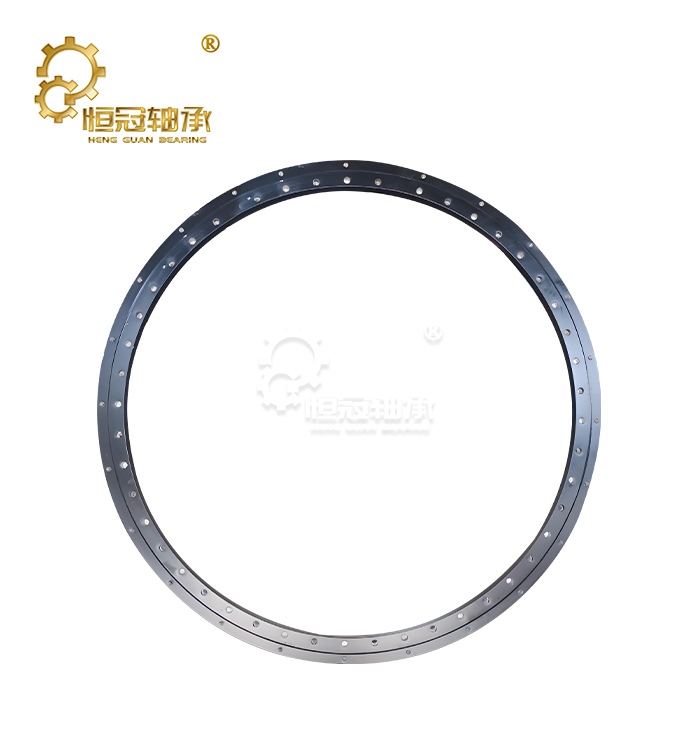
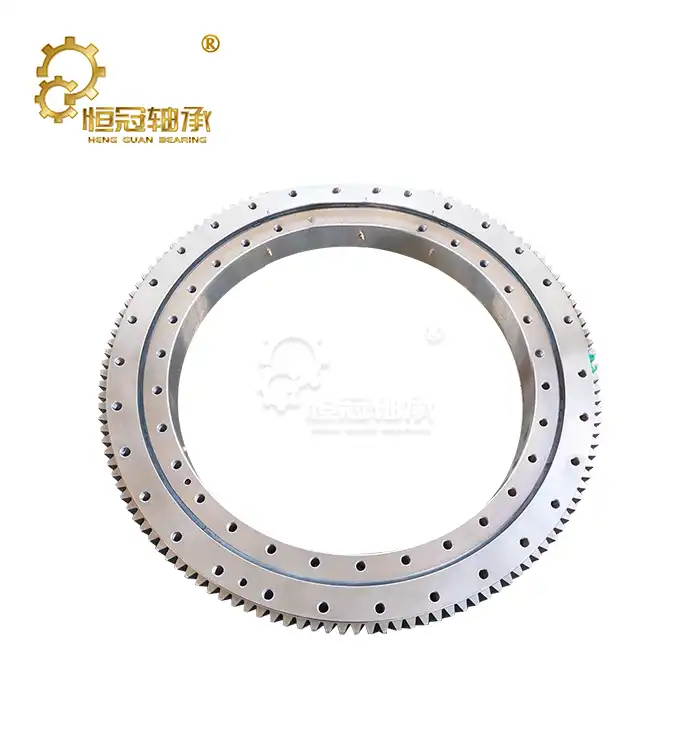
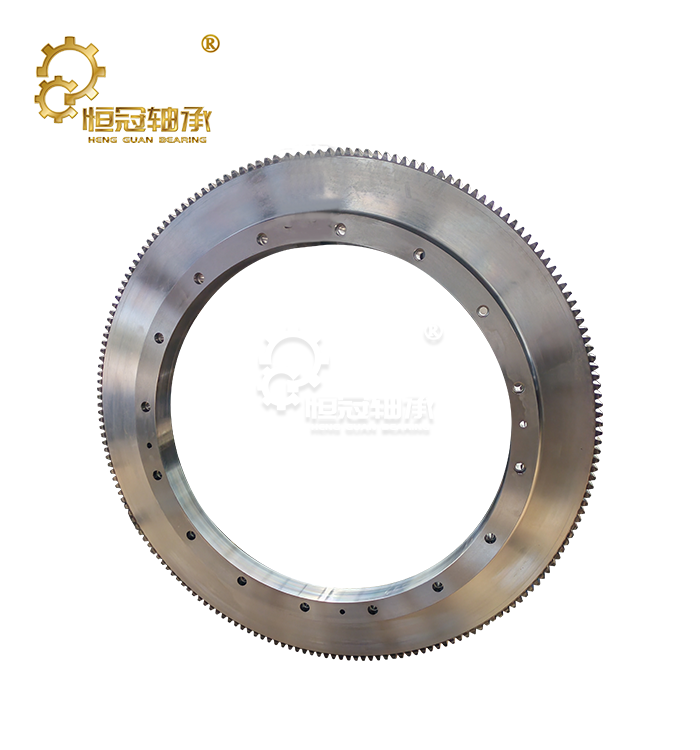
A Gantry Crane Slewing Ring bearing is an important rotating part that lets gantry cranes turn 360 degrees and handle high axial, radial, and moment loads all at the same time. In this special large-diameter bearing, the rolling elements, raceways, mounting holes, and sealing systems are all built into a small package that is made for heavy-duty industrial lifting. Crane slewing bearings are different from regular bearings because they spread operational stresses across multiple load paths. This keeps the structure strong during complex load positioning maneuvers on construction sites, in shipyards, and at ports. Inner and outer rings made of high-strength alloy steels, precision-ground raceways, hardened rolling elements (balls or rollers), and engineered seals that keep out dirt and dust are the main parts. When a gantry crane is turning, the slewing ring bearing connects the moving part (the superstructure) to the fixed part (the base). This lets the superstructure spin smoothly, even when the load is uneven. Having this feature is very important for machines that move shipping containers, bridge girders, or mining materials, as accurate positioning has a direct effect on how well they work and how safe the workplace is.
Main Types of Slewing Rings: Structural Configurations and Technical Specifications
Three main structural configurations make up the slewing bearing market. Each one is best for a certain type of load and limited space:
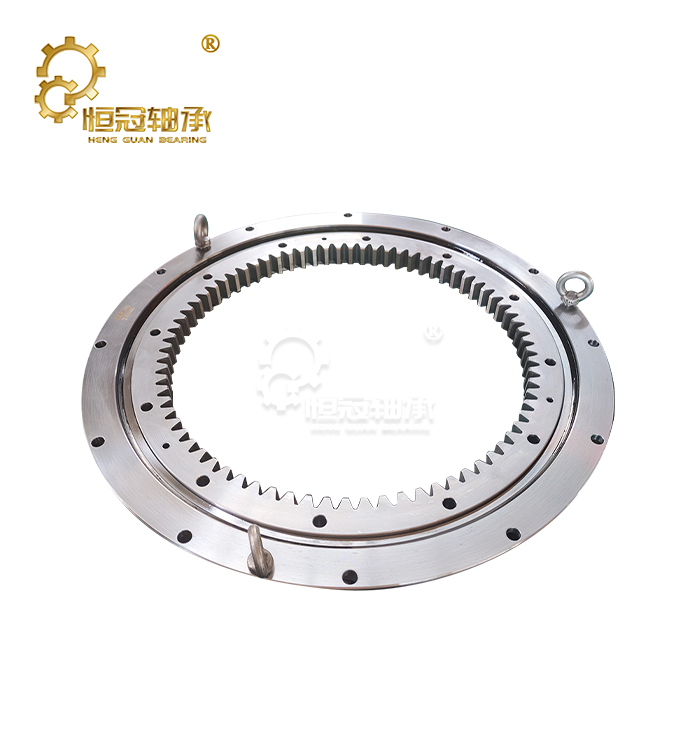
- Single-row four-point contact ball slewing bearings feature a compact cross-section, making them perfect for uses with moderate combined loads. A single row of balls can support axial forces in both directions, as well as radial and tilting moment loads, thanks to the four-point contact geometry. This makes the design ideal for mobile cranes and lighter gantry systems that don't have a lot of room for installation.
- Double-row ball slewing rings can hold a lot more weight compared to single-row designs because they have separate raceways for axial and radial load paths. This setup works well for medium-duty gantry cranes that are used in factories or distribution centers with a lot of rotations, where extra durability is needed without adding too much weight.
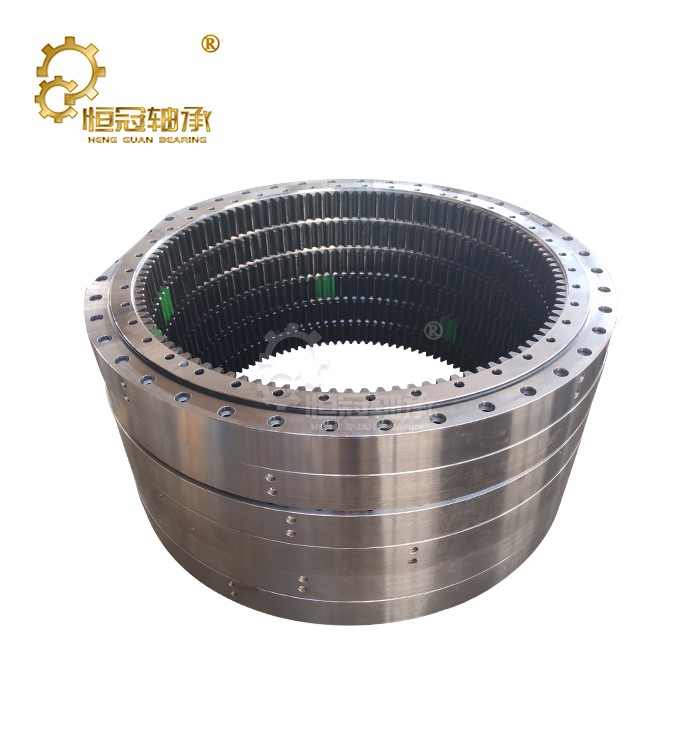
- Three-row roller slewing bearings represent the premium solution for heavy-duty lifting equipment. In our three-row roller design, there is a row of cylinder-shaped rollers for radial loads and two rows of axial rollers set up at the best contact angles. This design works well with very strong combinations of axial, radial, and moment loads, which are important for big gantry cranes in steel mills, shipyards, and construction sites. While the 42CrMo alloy steel rings make the structure very rigid, the GCr15SiMn bearing steel rolling elements make sure that the structure can rotate smoothly even when it's loaded with more than a hundred tons of weight.
Important technical details for judging performance are the load capacity ratings (axial, radial, and tilting moment), the hardness of the raceways (usually HRC 55–62 for long service life), the precision grades (P0, P6, P5, P4), how well they seal, and the size tolerances. The choice of material has a big impact on how long something lasts. For example, premium alloys like 42CrMo and 50Mn are better at resisting fatigue in harsh mining and metallurgical environments than regular carbon steels.
Maintenance Practices for Optimal Slewing Ring Lifespan
The total cost of ownership and operational uptime are directly linked to proactive maintenance protocols. Regularly applying the right kind of grease at the right times is the most important thing you can do to keep things from breaking. This stops metals from touching, gets rid of frictional heat, and cleans out the raceways. We suggest setting up lubrication schedules based on operating hours and the harshness of the environment. For example, outdoor gantry cranes on dusty construction sites need to be serviced more often than those in climate-controlled manufacturing facilities. Checking for cracks or displacement in the seals should be done visually, checking the torque on the bolts with calibrated wrenches, looking at the condition of the raceways through a borescope if possible, and hearing or touching any strange noises or vibrations during rotation. Following these maintenance steps will help your crane's slewing ring keep its precise motion control and structural integrity for as long as it's supposed to, which is usually between 20,000 and 50,000 hours of normal use.
Key Criteria for Selecting a Gantry Crane Slewing Ring Supplier
Evaluating Supplier Credibility: Certifications, Reputation, and Customer Testimonials
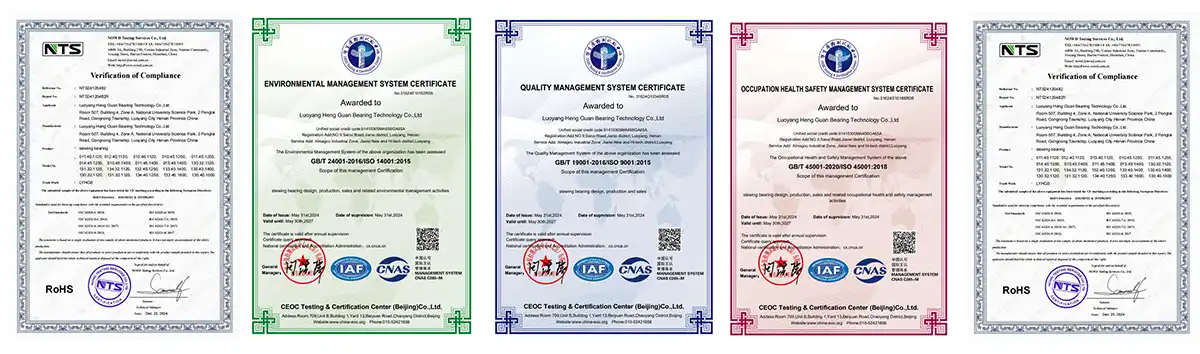
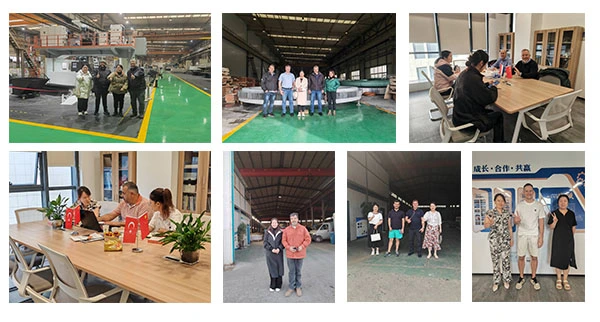
Credibility of the supplier is the key to building strong B2B partnerships in the procurement of precision components. Being certified with ISO9001 shows that you are dedicated to quality management systems that cover the planning, creation, and testing stages. This widely used standard makes sure that suppliers follow written procedures for tracking materials, checking dimensions, and handling nonconformances. These are important things to keep in mind when buying safety-important parts like slewing rings for lifting equipment. Besides certifications, a supplier's reputation in the industry can tell you a lot about how reliable they are. Manufacturers who have been making bearings for decades have improved their metalworking techniques, heat treatment methods, and cutting abilities through cycles of continuous improvement. In the past 20 years, we've worked with clients in more than 50 countries, giving us experience with a wide range of needs, from wind turbine yaw drives to aerospace rotary platforms. When compared to suppliers who haven't been tested and don't know much about the subject, this track record lowers the risk of procurement for a Gantry Crane Slewing Ring. Verified customer testimonials give real information about how well a supplier does throughout the whole procurement process. Purchasing managers should ask for references from people in their own industry. For example, companies that make mining equipment have different problems to solve than companies that make medical devices. For supplier evaluation scorecards, testimonials about how quickly technical questions are answered, how well deliveries are timed, china portal crane slewing bearing and how well field support works are useful pieces of information.
Product Range: Standard Versus Customized Slewing Ring Solutions
Being able to offer both standard catalog items and custom-engineered solutions shows that the supplier is flexible, which is important for big projects. Commonly sized slewing bearings, like our 862×730×145mm three-row roller design, make it easier to buy things quickly and at a lower cost per unit. This makes them ideal for equipment manufacturers with existing crane platforms that need replacement parts or mass production. Customization tools are essential for meeting the specific needs of an application. Non-standard, custom-shaped bearings can be used on uneven mounting surfaces, where space is limited, or where specific load distribution needs must be met. With a size range that goes from 50 mm to 10,000 mm and a choice of materials from 50Mn to 42CrMo alloys, our engineering teams can find the best bearing specifications for their specific needs. This includes precision grades (P4, P5, and P6), seal configurations for marine settings, and gear teeth that are built in for direct drive systems. Suppliers that offer personalized optimization design services are between ready-made parts and solutions that are made just for you. Together with clients, our engineering team looks at load spectra, duty cycles, and environmental factors. Then, they suggest changes to standard designs that make them work better without having to pay for full custom tooling. This approach of consulting is especially helpful for OEMs that are changing the designs of their products or for maintenance providers that are upgrading old equipment.
After-Sales Support, Warranty Policies, and Technical Assistance Services
The infrastructure for after-sales support is what sets exceptional suppliers apart from transactional ones. Warranty policies that cover material defects, nonconformance with dimensions, and premature wear protect consumers financially and show that the manufacturer trusts the quality of the product. When our slewing rings break in the field, we offer clear warranty terms that cover root cause analysis, replacement timelines, and on-site technical help. Technical support services are valuable for a lot longer than just the transaction itself. Having access to application engineers for help with mounting, troubleshooting, and performance optimization lets procurement managers and maintenance teams get the most out of their equipment. Responsive communication channels, like email (mia@hgb-bearing.com), the phone, or video consultation, make sure that important issues are dealt with quickly. This is especially important for international clients who have to deal with different time zones. Your staff will be able to properly maintain these precision parts with the help of training programs that cover installation procedures, lubrication schedules, and inspection techniques. Suppliers who invest in educating their customers make it less likely that products will break down early due to improper handling or poor maintenance. This lowers your total cost of ownership and increases the value of your long-term partnership.
Comparing Gantry Crane Slewing Rings: Supplier Differentiators and Market Options
Slewing Rings Versus Standard Bearings: Functional Advantages in Lifting Applications
Knowing how slewing rings and regular bearings work differently helps you understand why specialized parts cost more and work less well than other parts. Standard ball or roller bearings are great at supporting loads that are only radial or axial along a single axis. They can be used in motor Shafts, conveyor rollers, or systems that move things in a straight line. Because they are small and have standard sizes, they can be mass-produced and used with other parts without breaking the bank. On the other hand, a Gantry Crane Slewing Ring can handle loads acting in multiple directions at the same time. These include axial thrust from lifted cargo, radial forces from boom extension or wind loading, and tilting moments from loads being placed in an eccentric way. To handle this much weight on more than one axis, the bearings need bigger rolling elements, wider raceways, and integrated mounting options that aren't available in most bearing catalogs. This way of engineering can be seen in the three-row roller structure: separate rows for different types of loads keep the overall height low, which lets the structure rotate under combined stress states that would be too much for most bearings. Slewing rings are also different because they have built-in mounting features. Precision-drilled bolt holes in both the inner and outer rings make it possible to attach them directly to crane structures without using extra mounting hardware. This makes installation easier and makes the structure more rigid. This integration makes the assembly simpler and gets rid of the weak spots that come with adapter plate systems.
Durability and Load Capacity Metrics Across Leading Suppliers
Careful reading of technical data sheets is needed to compare specifications for durability and load capacity. Ratings for static load capacity show the maximum weight that can be put on something when it is not moving. Ratings for dynamic load capacity show how much weight can be put on something while it is rotating. People who work in procurement should check to see if the published ratings take into account combined loading. For example, a bearing rated for 500 kN axial capacity may only be able to support a lot less when it is subjected to radial forces and tilting moments at the same time. The composition of a material has a direct effect on its load capacity and service life. For ring construction, the 42CrMo high-strength alloy steel we offer has a tensile strength of over 1000 MPa and great fatigue resistance, making it better than standard carbon steels in harsh mining and metallurgical settings. When under cyclic stress, the GCr15SiMn bearing steel rolling elements keep their hardness (HRC 60–65) and dimensional stability. This stops the plastic deformation that leads to early raceway failure. Surface treatment methods, such as induction hardening, nitriding, or carbonitriding, make things more resistant to wear and extend the life of contact fatigue. Suppliers that use advanced heat treatment methods show that they care more about durability than about making things as cheaply as possible. Before it is shipped, we put every bearing through a series of strict quality control tests, such as ultrasonic flaw detection, coordinate measuring machine measurements, and rotational torque checks.
Logistical Considerations: Bulk Orders, Lead Times, and International Shipping
To manage a global supply chain, you need suppliers who can handle a wide range of logistical needs. With volume pricing and the ability to place bulk orders, OEMs can get low unit costs for series production while keeping their inventory levels low. We can make a wide range of products, from single prototype units for research and development to large batches for annual maintenance contracts. Lead times change depending on how complicated the product is and how much customization is needed. Catalog slewing bearings with standard sizes usually ship within two to four weeks. Custom-engineered solutions, on the other hand, may take eight to twelve weeks if they need special tools or materials that aren't standard. By being open and honest about production schedules, material sourcing, and quality gate milestones, procurement managers can make sure that part deliveries are in line with project deadlines and avoid having to pay expensive expediting fees. When you buy from global suppliers, you need to know a lot about international shipping. Experienced manufacturers know what paperwork is needed for export, how to package items so they don't get damaged during ocean freight, and how to handle customs clearance. Our export operations team works with clients in Asia, the Americas, Europe, and other parts of the world to make sure they follow china portal crane slewing bearing all the rules and coordinate their shipping, so procurement teams can focus on the main parts of their projects instead of worrying about shipping issues.
Procurement Best Practices: How to Source and Order Gantry Crane Slewing Rings
Developing Detailed Technical Specifications with Engineering Teams
For effective procurement to start, detailed technical specifications must be created together by the purchasing and engineering departments. Write down information about how the machine works, like its maximum axial load, peak radial force, tilting moments (both continuous and intermittent), rotational speed, duty cycle classification, and expected service life. With these details, suppliers can suggest the right bearing types and precision grades for your Gantry Crane Slewing Ring application. The environment has a big effect on the choice of material and the design of the seal. Outdoor gantry cranes that are exposed to extreme temperatures, moisture, saltwater spray, or rough dust need stronger corrosion protection and sealing systems than indoor installations that are kept at a constant temperature and humidity. List the temperature ranges, levels of contamination (based on ISO cleanliness standards), and any chemicals that will be present during the operation. Specifications for the mounting interface make sure that it can work with existing crane structures. Give the diameters of the bolt circles, the number and sizes of the holes, the mounting surface flatness tolerances, and any space limitations that affect the dimensions of the bearing envelope. Dimensional drawings or 3D CAD models clear up any confusion and lower the chance of expensive fit-up problems happening during installation. Before approving quotes, our engineering team looks over the customer's specifications to find ways to make things better.
Preparing Comprehensive RFQs and Conducting Sample Evaluations
Asking for Quotes (RFQ) letters should include technical details, the number of items that will be ordered, when they need to be delivered, the quality of the documents that need to be sent, and how much weight each evaluation criterion should have. Make it clear if the price should reflect a one-time purchase or a multi-year supply agreement. Committing to a large order often leads to better prices. Ask for detailed breakdowns that separate the costs of materials, labor, testing, and shipping so that you can easily compare prices from different suppliers. Sample evaluation protocols check the quality of the product before placing large orders. Ask for sample bearings that are made with the same materials and manufacturing methods that will be used in the production units. Do not accept samples that were made differently, and do not show what can be done in a series. Check the sizes using calibrated measuring tools, make sure the materials are what they say they are by having them tested by a third-party lab, and, if possible, do functional tests under simulated load conditions. During sample evaluation, you should pay close attention to the finish on the raceway, the roundness of the rolling elements, and the integrity of the seals. Check the rotational torque across a full 360-degree circle to find differences that could mean there are problems with the manufacturing. All the results should be written down in formal inspection reports that are sent to suppliers. Before sending out purchase orders, it's important to set clear quality standards and accountability measures.
Negotiation Strategies: Balancing Cost Efficiency with Service Guarantees
Unit cost reduction and long-term partnership value must be balanced in a Gantry Crane Slewing Ring through good negotiation. It is still important to have competitive prices, but focusing only on the lowest price often leads to lower quality, poor technical support, or unreliable delivery performance. Negotiations should be based on the total cost of ownership, which includes things like expected service life, warranty coverage, availability of technical support, and lead times for replacement parts. Making volume commitments can help you get better prices and make sure that suppliers can meet your needs. Offer multiyear contracts with varying levels of volume that will encourage both sides to keep working together. Include in the contract terms that deal with how prices can change based on indices of raw materials. This will protect you from volatile commodity markets and keep costs stable so you can plan your budget. Service level agreements, or SLAs, make performance expectations official. They include things like on-time delivery, quick technical support, and clear ways to handle quality problems. Set up penalties for missing delivery dates and rewards for finishing early. This will make sure that the incentives for your suppliers are in line with the milestones of your project. Structured agreements turn tense negotiations into cooperative problem-solving, building relationships that can withstand the inevitable problems in the supply chain and technical issues.
Case Studies and Success Stories: Trusted Suppliers in Action
Real-World Integration: Port Gantry Crane Modernization Project
A big port authority in North America asked our team to help them find new Gantry Crane Slewing Ring bearings for old gantry cranes that handle intermodal containers. The old bearings had corrosion damage from being in saltwater and not having good seals, which caused unplanned downtime of 120 hours per crane per year. Our engineers asked for three-row roller slewing bearings made from 42CrMo alloy steel with better coatings that resist corrosion and better labyrinth seal designs. The custom solution included changes to the dimensions to fit the legacy mounting interfaces and new sealing technology that wasn't available when the original equipment was made 30 years ago. Thorough tests proved that the bearing could handle axial loads of 500 kN and lateral wind forces that were higher than what was intended. After installing the bearings, the port authority reported no unplanned failures over the next 18 months of monitoring. This meant that the investment was recouped through lower maintenance costs and downtime. As this project shows, experienced suppliers can solve difficult reliability problems by combining technical know-how with hands-on experience in the field. Because we were flexible during the design validation phase and provided multiple iterations in short time frames, the port authority was able to do modernization during planned maintenance windows without having to extend the length of the outages.
Testimonials from Procurement Managers: Supplier Responsiveness and Problem-Solving
A European company that makes mining equipment talked about how they found custom slewing bearings for use in self-driving haul trucks. "The technical complexity of integrating rotation capability into our electric drive axle required a supplier willing to invest engineering resources without guaranteed order volumes. Heng Guan's application engineering team collaborated through multiple design cycles, providing FEA analysis and prototype iterations that proved the concept's viability. Their willingness to partner during the development phase—rather than simply quoting catalog products—differentiated them from competitors focused solely on transactional sales."An American construction equipment OEM emphasized the value of consistent communication: "Managing global supply chains demands suppliers who proactively communicate production status rather than waiting for us to chase updates. Throughout our initial order of specialized crane slewing rings, we received weekly progress reports with photos documenting manufacturing milestones. When raw material delivery delays threatened our production schedule, they expedited heat treatment processing and arranged air freight at their expense to meet our deadline. That level of commitment to customer success builds trust that extends far beyond individual purchase orders."There are recurring themes in these testimonials that show what makes a great supplier stand out: technical collaboration that goes beyond quote tasks, proactive communication that fills in information gaps, and customer-centered problem-solving when problems arise out of the blue. When it comes to finding hard-to-find parts, procurement teams can really use partners who consistently show these traits throughout the whole engagement lifecycle.
Conclusion
To find a trustworthy supplier for a Gantry Crane Slewing Ring, you need to carefully look at several factors, including the supplier's technical abilities (including both standard and custom solutions), their quality certifications (which show they follow strict process guidelines), their proven industry experience (shown by a wide range of application portfolios), and their after-sales support infrastructure (which guarantees long-term partnership value). Give more weight to suppliers who offer a wide range of products, from small single-row designs to heavy-duty three-row roller configurations. These products should be made from high-quality materials, such as 42CrMo alloy steel and GCr15SiMn bearing steel. Check that the company is ISO-compliant, ask for customer references from companies in the same industry as you, and set clear communication rules for handling technical questions and delivery milestones. If engineering teams and purchasing professionals follow these best practices, they can get high-performance crane slewing bearings that work reliably, last longer, and have the lowest total cost of ownership for heavy lifting jobs.
|
|
FAQ
1. What is the expected lifespan of a gantry crane slewing ring under normal operating conditions?
Service life is usually between 20,000 and 50,000 hours, but this depends on how much work is being done, how well it is maintained, and the environment. When used within their rated capacities in controlled environments and properly maintained, three-row roller slewing bearings can last for more than 30 years. However, in harsh mining environments where they are frequently overloaded, they may need to be replaced every 5 to 7 years, even if they are the same design.
2. How can I verify supplier authenticity and product quality before placing large orders?
Request proof of ISO9001 certification, do facility audits when possible, get sample bearings for independent testing of dimensions and materials, and talk to current customers in your industry to get honest feedback. Genuine suppliers welcome openness and offer thorough records of the production process, such as material certifications, heat treatment records, and dimensional inspection reports for every Gantry Crane Slewing Ring.
3. What industry standards should I request during supplier evaluation?
Check that the product meets the requirements of ISO 76 (for static load ratings) and ISO 281 (for dynamic load ratings), as well as any relevant regional standards, like the European Machinery Directive for markets in the EU or ANSI/ABMA standards for uses in North America. Make sure that suppliers follow ISO9001 quality management systems, and ask for third-party certification when parts of lifting equipment are used in safety-critical ways.
Partner with Heng Guan: Your Trusted Gantry Crane Slewing Ring Manufacturer
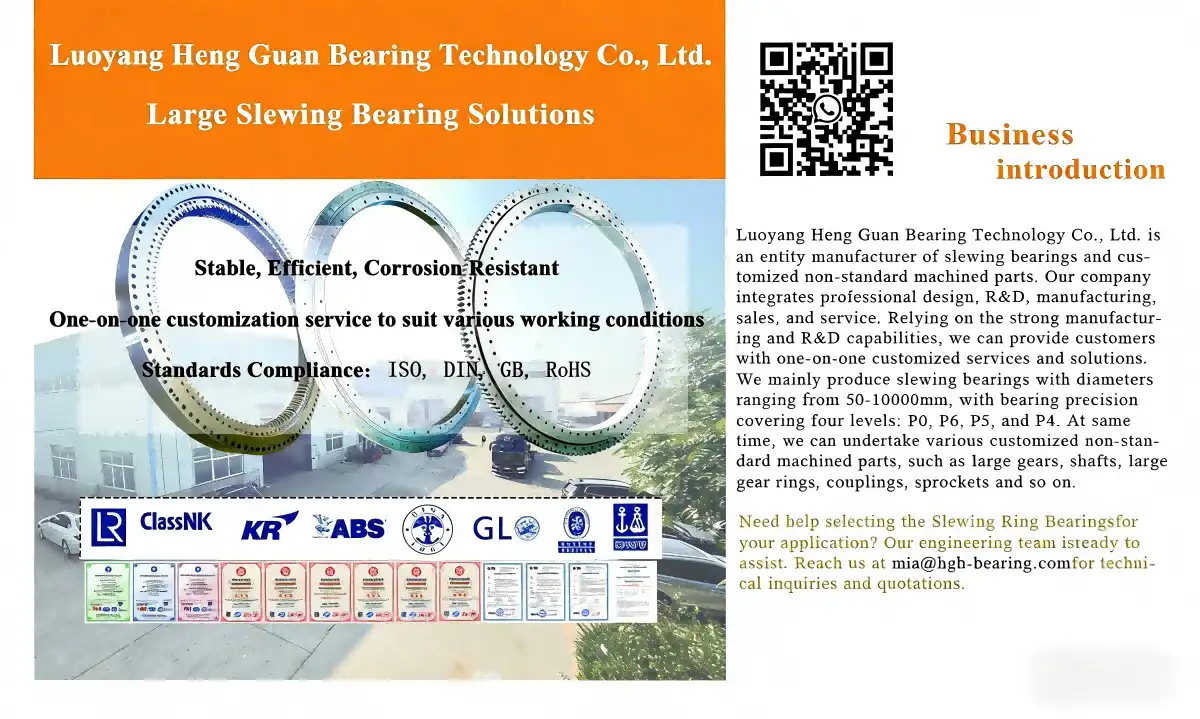
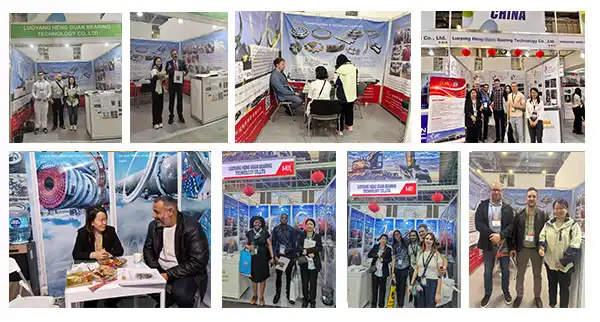
Heng Guan Bearing Technology has been making slewing rings for over 20 years and can make them in diameters ranging from 50mm to 10,000mm. Our dedicated team of more than 50 engineers provides personalized optimization design and flexible production that meets the exact needs of construction companies, equipment maintenance providers, and heavy industry OEMs around the world. Our high-quality three-row roller slewing bearings are made from premium 42CrMo alloy steel and GCr15SiMn bearing steel using processes that are ISO9001 certified. Whether you need standard catalog solutions or fully customized special-shaped bearings, we make the whole process of buying from us easy by communicating clearly, offering competitive prices, and providing quick technical support. Email our team at mia@hgb-bearing.com to talk about your needs and get a detailed quote for your next gantry crane project. Choose Heng Guan as your Gantry Crane Slewing Ring supplier to experience the dependability, accuracy, and focus on partnerships that have earned them trust from clients in over 50 countries.
References
1. American Bearing Manufacturers Association (ABMA). Standard 11: Load Ratings and Fatigue Life for Ball Bearings. 2019.
2. International Organization for Standardization. ISO 76:2006 - Rolling Bearings - Static Load Ratings. Geneva: ISO, 2006.
3. Machinery's Handbook, 31st Edition. Section on Anti-Friction Bearings and Slewing Rings. Industrial Press Inc., 2020.
4. Harris, Tedric A., and Kotzalas, Michael N. Rolling Bearing Analysis: Essential Concepts of Bearing Technology, 5th Edition. CRC Press, 2006.
5. European Federation of Materials Handling. FEM 1.001: Rules for the Design of Hoisting Appliances - Slewing Bearings. 2018.
6. Wensing, J.A. On the Dynamics of Ball Bearings. PhD Dissertation, University of Twente, Netherlands, 1998.

WHAT OUR CUSTOMERS SAY
Here is the customer's evaluation of us
_1767784942887.webp)