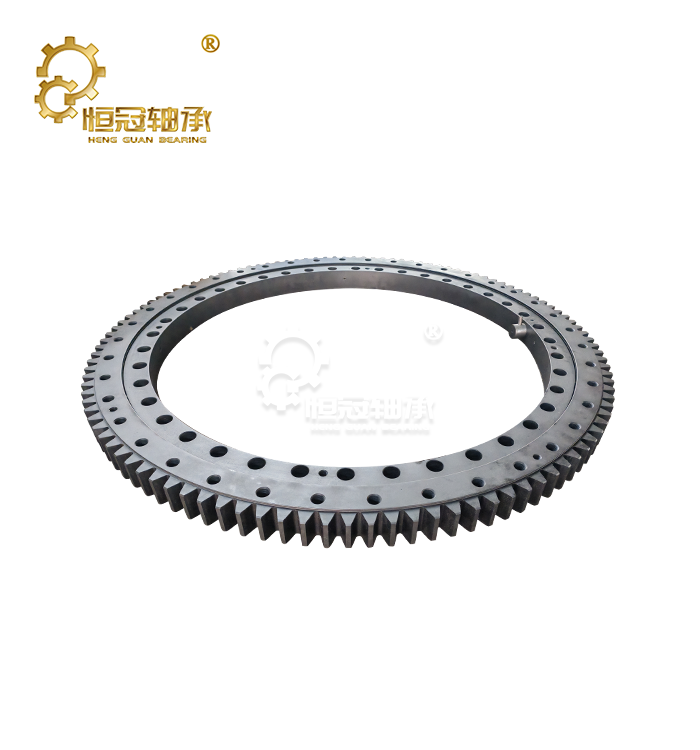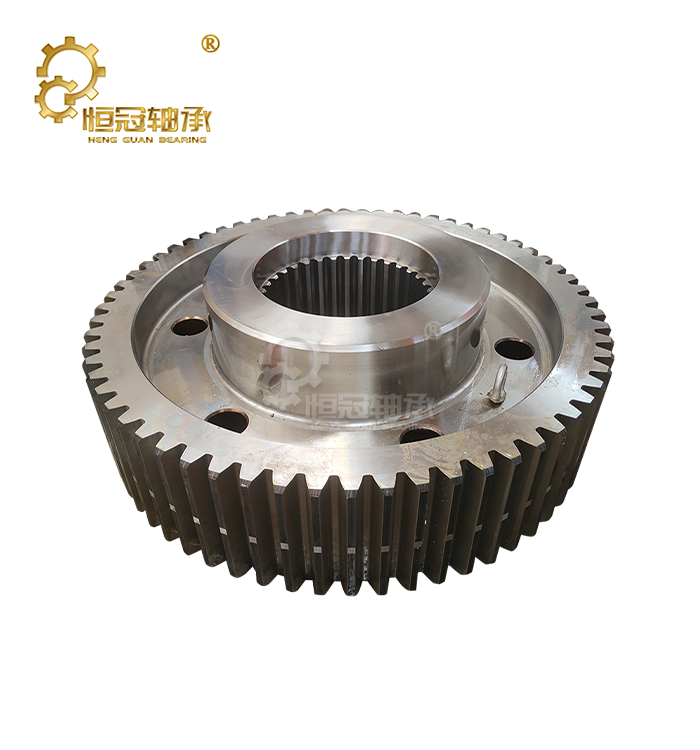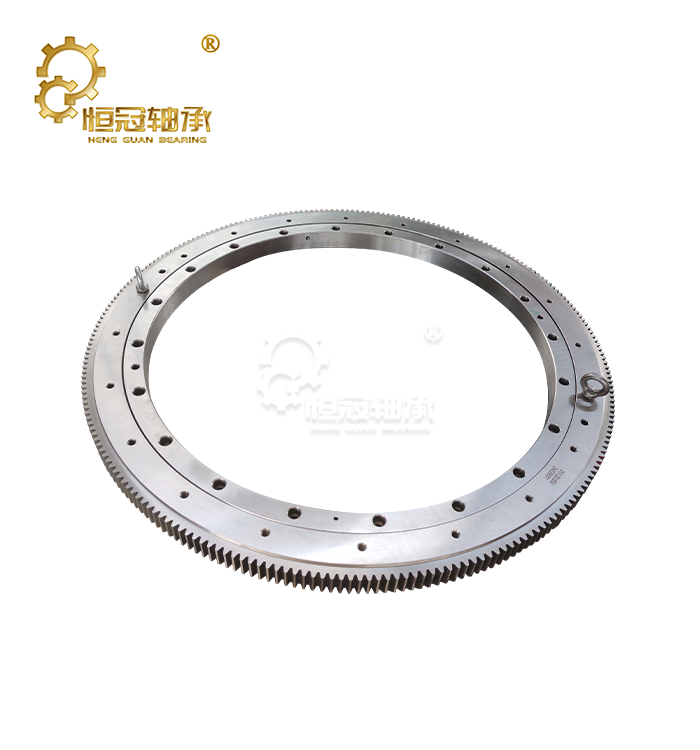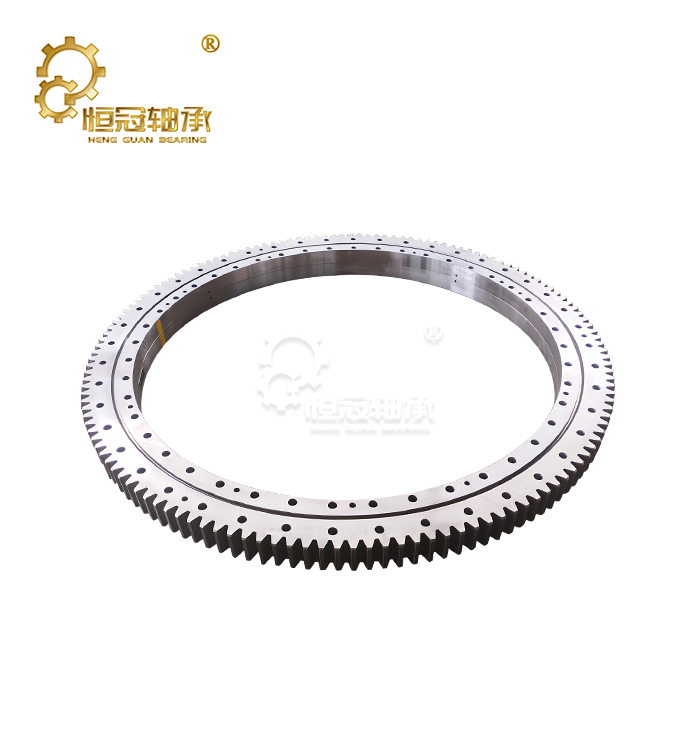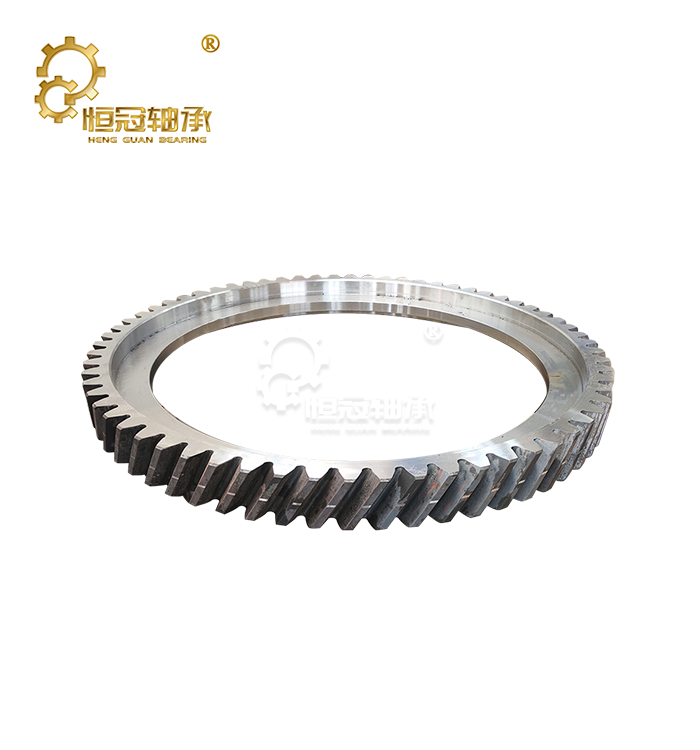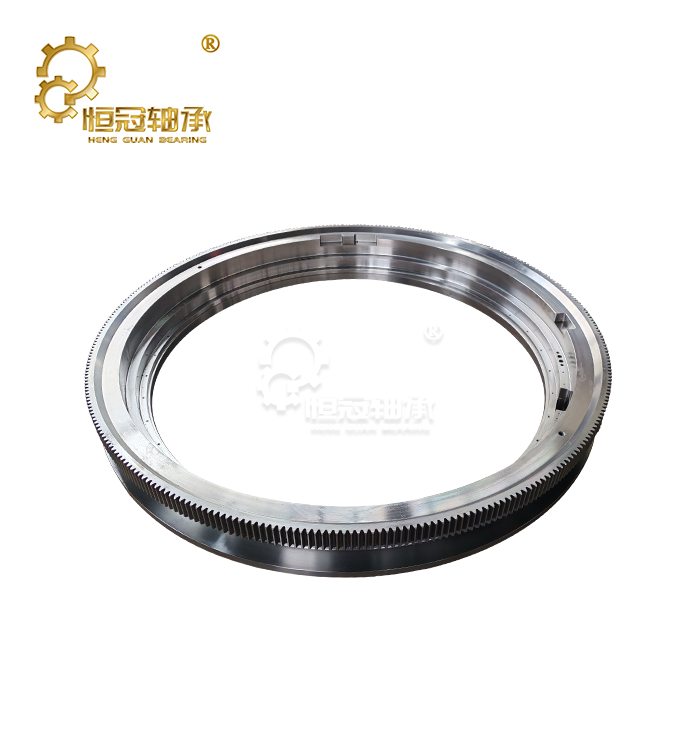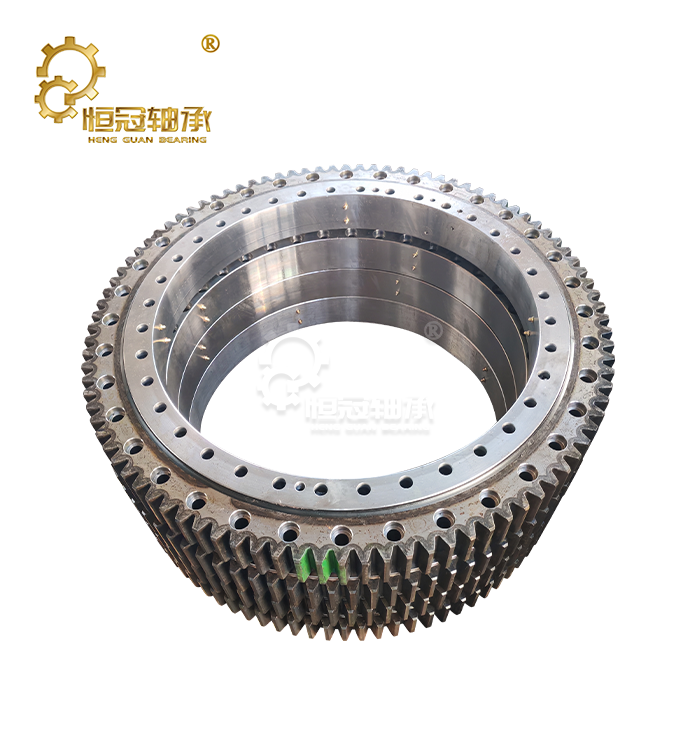




How to choose a crane slewing ring for heavy lifting?
Selecting a Crane Slewing Ring is a key decision for heavy lifting equipment, because the bearing directly influences load safety, rotation stability and service life. Unlike typical bearings, crane slewing rings have to sustain complicated loads created by lifting operations such as axial loads, radial loads and overturning moments from the movement of the boom and hanging loads.
Choosing the right slewing ring involves more than simply a comparison of fundamental load ratings for crane manufacturers, contractors, and maintenance teams. When choosing, consideration must be given to the working circumstances, the mounting size, the bearing design, the quality of the material, the lubrication needs, and the production capability of the supplier. The appropriate crane slewing ring will help avoid unscheduled downtime, improve equipment reliability, and save long-term maintenance costs.
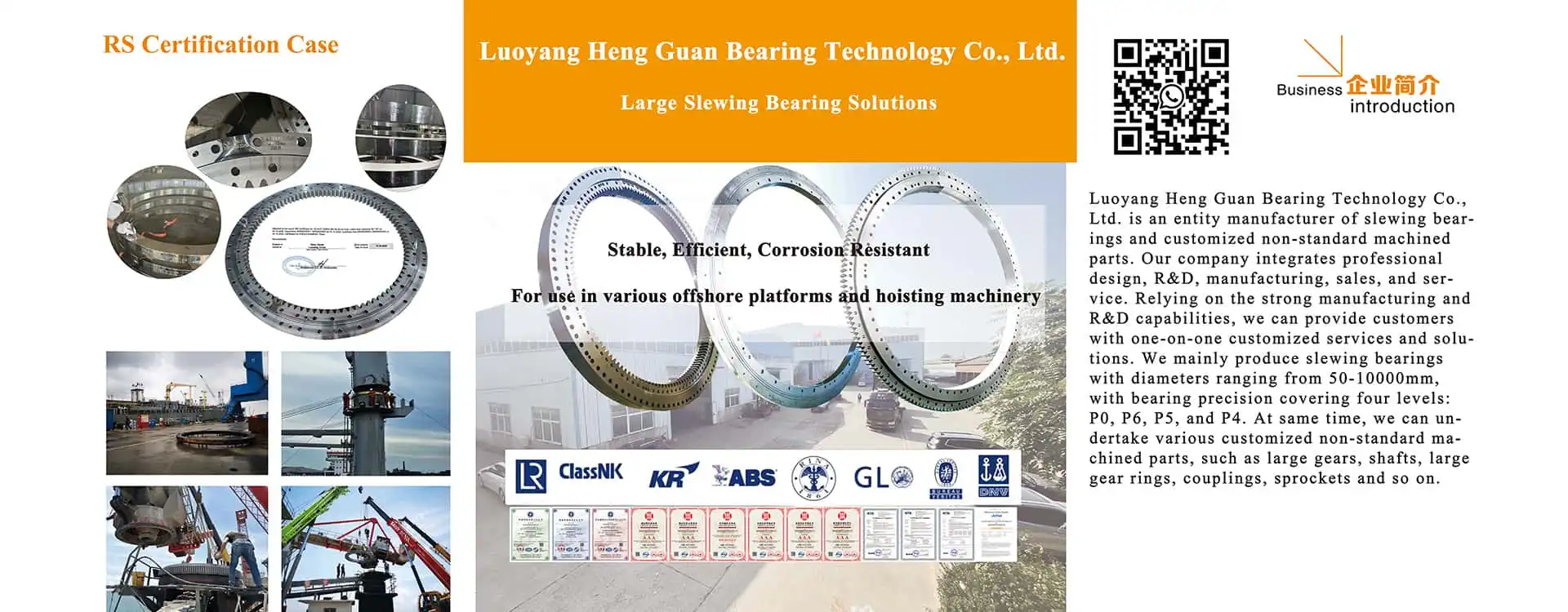
Heng Guan offers custom slewing bearing solutions for a wide range of heavy-duty applications, including tower cranes, port cranes, mining equipment, and industrial lifting systems. Engineers assist with customers in selecting bearing designs that meet the performance requirements of their equipment using working circumstances and technical criteria.
Why Crane Slewing Ring Selection Matters in Heavy Lifting Applications?
The equipment for heavy lifting is exposed to constantly changing loads. The forces in the crane structure for lifting [9] vary with the payload weight, boom angle, slewing speed, and ambient conditions. Improper selection of a slewing ring might result in excessive raceway stress, abnormal wear, higher operating torque, or premature failure.
Most bearing problems do not result from manufacturing errors but from improper choice at the initial design stage. For example, selecting a bearing only solely on the maximum lifting capacity, without considering the dynamic impact load, can lead to insufficient load margins in actual use.
A smart selection strategy should consider 3 critical areas:
- Real operational load circumstances
- Compatibility between the bearing and the crane structure
- Environmental Factors Affecting Bearing Life
This knowledge helps buyers avoid expensive replacement work and downtime for unnecessary equipment.
Understanding Combined Loads on Crane Slewing Rings
Axial, Radial, and Moment Loads in Crane Operations
Often, crane slewing rings are loaded in a mixed way, unlike many rotating machine elements that are loaded in one way or the other.
The weight of the hoisted object and the crane structure generate axial loads. Radial loads are created by horizontal forces on the crane system such as wind pressure as well as acceleration and braking when slewing. This is the point where the load is pulled away from the center of the bearing. Especially when the boom is stretched to a bigger working radius.
While the bearing is resisting these stresses, it must keep the rolling elements in continuous contact with the raceways. But too little bearing capacity may cause higher contact pressure and damage raceway surfaces and hence decrease fatigue life.
Engineers generally assess the following:
- for heavy-duty applications
- Heaviest weight carried
- Working radius changes
- swivel speed
- Operation Frequency
- Impact and Shock Conditions
Such parameters offer a more realistic depiction of the true forces acting on the crane slewing ring.
The Importance of Safety Factors in Heavy Lifting
There are very few cases of heavy lifting that are 100% predictable. Short-term peaks of stress above normal conditions of work are caused by abrupt changes in load, action of wind, irregular running, and emergency braking.
Professional bearing selection usually takes into account an appropriate safety factor. The margin needed is:
- Crane class.
- Duty cycle 2.
- Conditions of Work
- Consequences of failing
For instance, a port crane, which is in continuous operation, may require a different safety margin than a small construction crane, which is operated just on occasion. A proper safety factor is utilized to prevent premature fatigue and improve operating reliability.
Considering Operating Environment and Service Conditions
How Do Environmental Conditions Affect Bearing Performance?
Does Environmental Condition Affect Bearing Performance?
A crane slewing ring might be working in relatively different settings depending on the application.
Construction cranes generally have to deal with the following:
- Concrete dust
- Exposure to Rain
- Changes in temperature
- Outside pollution
The mining equipment may be:
- Abrasive particles
- Shaking violently.
- Impact loading
- Access denied for maintenance
Port cranes must contend with:
- Salt Spray Corrosion
- Moist
- Long hours of work
These considerations influence material selection, sealing designs, and lubrication requirements. A bearing intended for a clean factory environment may not have the same longevity in a coastal or mining environment.
Matching Seal and Lubrication Design to Working Conditions
A sealing system is one of the most important factors influencing the service life of a slewing ring. Effective seals prevent dust, water, and other contaminants from entering the raceway system while providing appropriate lubrication at the same time.
Different applications may require different sealing solutions such as the following:
- Typical seal designs for general building applications
- Better sealing for damp or dusty environments
- Special protection solutions for corrosive offshore situations
Lubrication choice is also highly important. Often the grease lubrication is used due to the ease of maintenance and the reliable protection. However, the grease type, lubrication frequency, and automatic lubrication systems should be chosen considering the operating temperature, load conditions, and ease of maintenance.
Causes of bad lubrication methods are as follows:
- More friction.
- “Worn raceways”
- Higher operating temperature
- Reduced bearing life
A well-thought-out lubrication plan will help to keep the rotation smooth and avoid maintenance.
Key Factors to Evaluate Before Choosing a Crane Slewing Ring
Load Capacity and Safety Factor Requirements
Load capacity is the first technical factor buyers should evaluate when selecting a crane slewing ring. However, the decision should not be based only on catalog values.
Manufacturers typically provide load ratings based on specific testing conditions. Actual crane operation may involve additional forces caused by acceleration, impact, wind, and uneven loading.
When reviewing load capacity, buyers should check the following:
- Static load rating
- Dynamic load rating
- Moment load capacity
- Allowable tilting moment
- Recommended safety factor
For example, a crane frequently operating near maximum capacity requires a stronger bearing configuration than equipment working under light or intermittent loads.
Three-row roller slewing bearings are often selected for extremely heavy applications because their separated raceways distribute different load directions more effectively. In contrast, single-row ball designs may provide sufficient performance for smaller cranes where space and cost are major considerations.
Mounting Dimensions and Gear Compatibility
Mechanical compatibility is another essential part of crane slewing ring selection. Even a bearing with excellent load performance cannot operate correctly if it does not match the crane structure.
Important dimensional factors include:
- Inner diameter
- Outer diameter
- Overall height
- Bolt circle diameter
- Mounting hole arrangement
- Installation clearance
The mounting surfaces must also meet required flatness specifications. Uneven mounting surfaces can create additional stress on the bearing structure and reduce service life.
Gear configuration should also be considered when selecting a slewing ring with drive teeth. External gears and internal gears are used for different crane designs, and the gear module, pressure angle, and accuracy grade must match the driving system.
Incorrect gear matching may result in:
- Excessive noise
- Uneven tooth contact
- Accelerated wear
- Reduced transmission efficiency
Therefore, dimensional inspection and interface verification should be completed before final procurement.
Material Selection and Heat Treatment Quality
Why Bearing Material Matters for Heavy Lifting Reliability?
The material quality of a crane slewing ring directly affects its resistance to fatigue, wear, and environmental damage. Because crane applications often involve repeated loading cycles, the raceway and rolling elements must maintain stable mechanical properties over long periods of operation.
Most heavy-duty slewing rings use high-quality bearing steels such as GCr15 or equivalent materials. These steels provide excellent hardness, wear resistance, and rolling contact fatigue performance after proper heat treatment.
However, material selection alone does not guarantee reliable performance. The manufacturing process is equally important. Poor steel quality, inconsistent heat treatment, or insufficient surface hardness can create hidden weaknesses that may lead to premature failure.
Key quality factors include the following:
- Steel cleanliness and internal structure
- Raceway hardness consistency
- Heat treatment depth
- Surface finishing accuracy
- Resistance to impact loading
For cranes operating in offshore, marine, or chemically aggressive environments, additional protection may be required. Corrosion-resistant coatings, specialized surface treatments, or customized sealing solutions can improve durability under harsh conditions.
Accuracy Grade and Rotation Performance
How Does Precision Affect Crane Operation?
Although heavy lifting applications are mainly focused on load capacity, rotational accuracy also influences crane performance. A slewing ring with poor accuracy may cause uneven rotation, increased vibration, and additional stress on connected components.
Accuracy requirements depend on the crane type and operating purpose.
For general construction cranes, standard accuracy grades are often sufficient. However, applications requiring precise positioning, such as automated lifting systems or specialized industrial cranes, may require higher precision grades.
Important accuracy parameters include:
- Raceway dimensional tolerance
- Axial runout
- Radial runout
- Gear accuracy
- Rotation smoothness
Higher precision does increase manufacturing costs, but it can provide benefits such as:
- Lower vibration
- Improved load distribution
- Reduced wear on drive components
- More accurate positioning
When selecting a crane slewing ring, buyers should balance precision requirements with actual operating needs instead of choosing the highest accuracy grade unnecessarily.
Different Types of Crane Slewing Rings and Their Applications
Different crane designs require different slewing ring structures. Understanding the advantages of each type helps buyers select a bearing that matches their lifting requirements.
Single-Row Ball Slewing Rings
Single-row ball slewing rings are among the most common designs used in light and medium-duty crane applications.
This structure uses one row of rolling balls with four-point contact raceways. The design allows the bearing to support axial loads, radial loads, and moment loads within a compact structure.
Advantages include:
- Compact dimensions
- Lower starting torque
- Cost-effective design
- Easy installation
Typical applications include the following:
- Small tower cranes
- Mobile cranes
- Light-duty lifting equipment
However, single-row designs have limitations when facing extremely high moment loads or continuous heavy-duty operation. For applications involving large loads and frequent operation, other bearing structures may provide better durability.
Double Row Ball Slewing Rings
Double-row ball slewing rings provide higher load capacity compared with single-row designs because they use two rows of rolling elements.
The additional rolling contact area improves the following:
- Load distribution
- Structural stiffness
- Moment resistance
This design is suitable for cranes that require improved stability under changing loads.
Common applications include:
- Medium-size tower cranes
- Gantry cranes
- Industrial lifting systems
Double-row configurations are especially useful when the crane frequently handles off-center loads or operates with extended boom lengths.
Three Row Roller Slewing Rings
Three-row roller slewing rings are designed for the most demanding heavy lifting applications.
Unlike ball-type designs, roller configurations separate different load directions through multiple raceways. This allows each roller row to handle specific forces more efficiently.
Advantages include:
- Extremely high load capacity
- Excellent moment resistance
- Strong structural rigidity
- Better performance under shock loading
Typical applications include the following:
- Mining excavators
- Large port cranes
- Heavy-duty offshore lifting equipment
For machines operating continuously under severe conditions, three-row roller designs often provide the durability required to reduce unexpected downtime.
Cross Roller Slewing Rings
Cross roller slewing rings use cylindrical rollers arranged at alternating angles within the raceway. This structure provides high rigidity and excellent rotational accuracy.
They are suitable for applications where both precision and compact design are important.
Typical uses include the following:
- Industrial robots
- Precision positioning equipment
- Compact lifting systems
Compared with larger heavy-duty roller designs, cross roller bearings focus more on accuracy and smooth rotation rather than maximum load capacity.
A Practical Selection Process for Heavy-Duty Crane Applications
Step 1: Analyze Actual Working Conditions
The first step is understanding how the crane operates in real conditions.
Buyers should collect information, including
- Maximum lifting weight
- Maximum working radius
- Operating frequency
- Slewing speed
- Environmental exposure
- Expected service life
A bearing selected only according to the crane nameplate capacity may not provide sufficient performance because actual working conditions often include dynamic loads.
A complete operating profile allows engineers to calculate the correct load requirements and select a suitable bearing structure.
Step 2: Verify Manufacturer Capability and Quality Control
Choosing the right supplier is as important as choosing the correct bearing model.
A qualified crane slewing ring manufacturer should have the following:
- Professional machining equipment
- Heat treatment capability
- Quality inspection systems
- Material traceability
- Technical engineering support
Buyers should review:
- Manufacturing experience
- Production capacity
- Testing methods
- Quality certificates
- Previous application experience
A supplier with strong engineering capability can help identify potential design issues before production and provide more reliable long-term support.
Step 3: Review Technical Documentation Carefully
Before purchasing, customers should request complete technical documents, including:
- Product drawings
- Load capacity charts
- Installation instructions
- Maintenance recommendations
- Inspection reports
Technical documents help confirm whether the bearing matches the crane design and operating requirements.
Buyers should also verify that supplier data is based on recognized calculation methods rather than unrealistic assumptions.
Conclusion
Choosing the correct crane slewing ring for heavy lifting requires careful evaluation of load conditions, structural compatibility, material quality, precision requirements, and operating environment. A suitable bearing must handle combined axial, radial, and moment loads while maintaining stable rotation throughout its service life.
Understanding the differences between single-row ball, double-row ball, three-row roller, and cross-roller designs allows buyers to select the most appropriate solution for different crane applications. A systematic selection process, from analyzing working conditions to verifying supplier capability, helps reduce operational risks and unexpected maintenance costs.
Working with an experienced manufacturer such as Heng Guan provides access to engineering support, customized solutions, and reliable slewing bearing products designed for demanding lifting environments. With the right crane slewing ring selection, heavy lifting equipment can achieve safer operation, improved efficiency, and longer service life.
|
|
FAQ
1. What factors most significantly affect crane slewing ring service life?
Service life is mostly determined by three factors that are all connected: the amount of load compared to the rated capacity, the level of contamination in the environment, and the quality of maintenance. Running near the maximum rated loads all the time speeds up the damage that wears away at raceways and rolling elements. When shock loads or operating conditions are higher than what was specified in the design, even properly specified bearings have shorter lives. Pollution from the environment is also very bad; abrasive particles that get into the raceway cause three-body wear, which quickly removes material from precision surfaces. Poor maintenance makes these problems worse because not enough lubrication causes more friction and heat, and lets the seal wear down, which lets dirt in.
2. How often should slewing bearings undergo inspection and maintenance?
The frequency of inspections should match the severity of the environment and the level of operation. Heavy-duty applications, like mining equipment that works in dirty places, need thorough inspections every month. Moderate-duty construction equipment used in normal conditions might need to be inspected every three months instead of every six months. As part of every inspection, the level of noise, vibration, and visible seal condition should be checked. Different types of grease, how well they seal, and the conditions of use affect how often they need to be oiled. Start with the manufacturer's suggestions and make changes based on what you see. Automatic lubrication systems make maintenance easier because they re-grease things consistently without having to do it by hand.
3. When should we repair versus replace a worn slewing bearing?
Most of the time, replacing something is more reliable and saves more money than trying to fix it. Damage to the raceway from contamination or overload creates wear patterns that can't be fixed without completely regrinding the raceway, which requires special tools that aren't often found outside of bearing factories. Damage to the seal means that contaminants can keep getting in even after the seal is replaced because the worn running surfaces of the seal can't do their job. Find the cost of replacement, which includes labor for installation and downtime for the crane. Then, compare that to the cost of repair, which includes the shorter life and less reliability of repaired parts. Most industrial operations decide that replacement is a better long-term investment, especially when the replacement can be planned during routine maintenance instead of having to be done quickly after a catastrophic failure.
Get Expert Slewing Bearing Solutions from Heng Guan
Choosing the right Crane Slewing Ring manufacturer will determine whether your heavy lifting equipment lasts for years without breaking down or becomes a pain to keep up with. Heng Guan offers slewing bearing solutions that improve your operational performance by combining technical know-how, top-notch manufacturing, and dedication to customer satisfaction. Our engineering team is ready to look over your specific application needs and suggest configurations that will work best for your loading conditions and environmental problems.
We want purchasing managers, OEM clients, and engineering teams to see what makes Heng Guan different. Email our technical experts at mia@hgb-bearing.com to talk about the needs of your project and get detailed technical advice. We'll look at your operational parameters, suggest the best bearing configurations, and give you full quotes with details on specifications, lead times, and technical support. Heng Guan gives your business the quality and dependability it needs, whether you need standard catalog items or solutions that are specially designed for you. Work with a reliable Crane Slewing Ring supplier that wants you to succeed.
References
1. American Gear Manufacturers Association. (2020). AGMA 6123-C06: Design Manual for Enclosed Epicyclic Metric Module Gear Drives. Alexandria, VA: AGMA Publications.
2. Harris, T.A. & Kotzalas, M.N. (2006). Advanced Concepts of Bearing Technology: Rolling Bearing Analysis, Fifth Edition. Boca Raton, FL: CRC Press.
3. International Organization for Standardization. (2014). ISO 199:2014 - Rolling Bearings - Thrust Bearings - Geometrical Product Specifications and Tolerance Values. Geneva: ISO Publications.
4. Machinery's Handbook Editorial Staff. (2020). Machinery's Handbook 31st Edition: Guide to Machinery and Metalworking Calculations. New York: Industrial Press.
5. Schaeffler Technologies AG & Co. (2019). Rolling Bearings: Catalogue HR 1 - Technical Product Information for Slewing Rings. Herzogenaurach, Germany: Schaeffler Engineering Publications.
6. Wensing, J.A. (2017). On the Dynamics of Ball Bearings: Modeling and Experimental Analysis of Contact Forces and Vibrations in Rotating Machinery. Ph.D. Dissertation, University of Twente, Netherlands.

WHAT OUR CUSTOMERS SAY
Here is the customer's evaluation of us
_1767713770881.webp)