




How Material and Design Affect Heavy-Duty Slewing Bearing Lifespan
A slewing bearing can operate for years under demanding conditions, but its service life depends on much more than bearing size or rated load. Material selection, heat treatment, raceway geometry, ring stiffness, sealing, mounting accuracy, lubrication, and the actual load spectrum all influence how the bearing performs in service. For cranes, excavators, mining equipment, offshore machinery, and other large rotating systems, these factors need to be considered together. A heavy-duty slewing bearing that is correctly matched to its application can distribute axial loads, radial loads, and overturning moments more effectively while reducing the risk of premature fatigue, deformation, and contamination-related damage. The key point is that there is no single material or structural configuration that automatically provides the longest service life. The appropriate solution depends on the equipment, operating conditions, expected loads, duty cycle, and maintenance requirements.
Why Slewing Bearing Life Depends on More Than Load Capacity?
Understanding the Role of a Slewing Bearing in Heavy Equipment
Slewing bearings are large-diameter components that sustain and transmit loads between stationary and rotating structures, unlike many standard bearings, which are installed on rotating Shafts. They are often employed in applications where a machine must have regulated rotation while carrying significant axial and radial loads with an overturning moment.
For example, when the boom is extended or when the load being lifted is moved, the crane can exert a large moment on the bearing. The upper structure of an excavator provides various loading conditions during rotation, especially with the combination of digging forces and irregular ground conditions.
This means that a bearing selection based merely on its nominal diameter or static load rating is insufficient. Engineers also need to evaluate how the loads fluctuate when in operation and if the bearing will be able to maintain appropriate contact conditions across the duty cycle.
The Main Factors That Influence Service Life
Several interacting variables affect bearing life:
load size and direction;
number and length of load cycles;
speed and type of operation;
design of raceway and rolling elements;
quality of material and heat treatment;
ring stiffness and mounting conditions;
quality and replenishment of lubrication;
sealing and contamination control;
temperature and corrosion exposure;
accuracy of manufacture and assembly.
For example, a bearing used indoors under reasonably clean conditions may have a significantly different service environment than one mounted on mining machinery. Dust, wetness, vibration, shock loading, and inconsistent maintenance might modify the real working conditions.
Thus, the service life should be considered in light of the overall application, not just based on the material grade.
How Does Material Selection Support Long-Term Bearing Performance?
Ring Materials and Their Mechanical Properties
The inner and outer rings of big slewing bearings are often made of alloy or medium carbon bearing steels selected according to the desired combination of strength, hardenability, toughness, fatigue resistance, and machinability.
An example of an alloy steel that could be considered for demanding applications is 42CrMo. Chromium and molybdenum are hardening elements and allow the material to reach adequate mechanical properties by the heat-treatment process with suitability. This could be crucial for the production of enormous rings with large cross sections.
Other grades of steel, like 50Mn and bearing steels for special applications, may also be applicable depending on the design requirements. So the optimal option is not only a matter of selecting the “strongest” steel. Engineers have to consider all mechanical and manufacturing needs.
Also, for a big bearing, the material quality must be constant throughout the component. Differences in hardness, microstructure, inclusions, or heat-treatment results can influence fatigue performance and dimensional stability.
Rolling Elements and Contact Fatigue
Concentrated contact stress applies to rolling elements. Balls and rollers constantly pass through the loaded areas of the raceway; hence, the material must be able to endure repeated contact without severe plastic deformation, surface damage, or fatigue.
In large bearing applications, rolling elements can be made of bearing-grade steels such as GCr15SiMn depending on the design and manufacture standard. The cleanliness of the steel and the management of the heat treatment are particularly crucial since non-metallic impurities or metallurgical flaws might serve as sites where fatigue damage originates.
The surface hardness must be appropriate for the contact conditions, and the underlying material must have sufficient toughness to bear operational loads and occasional shock. The ideal answer is not always an extremely hard surface without any supporting material.
Why Heat Treatment Is Critical?
Most of the final mechanical performance of the bearing steel is determined by the heat treatment. Depending on material and design, procedures like quenching and tempering, induction hardening, or carburizing can be applied to achieve the desired combination of surface hardness and core toughness.
In the case of raceways, the aim is usually to produce a surface that can withstand contact fatigue and wear while providing adequate support below the hardened area. The exact procedure relies on the steel grade, ring size, the desired hardness profile, the effective hardening depth, and the manufacturing process.
Process control has special importance for large rings. Excessive deformation, uneven hardness, or residual stresses might change the raceway geometry, therefore changing the load distribution in service.
Therefore, it is useful for the OEM buyer to ask the manufacturer about heat-treatment methods, hardness criteria, inspection procedures, and material traceability for a heavy-duty slewing bearing, rather than evaluating a bearing merely by its steel grade.
How Bearing Design Changes Load Distribution?
Raceway Geometry and Contact Conditions
The load transfer between the rolling elements and the bearing rings is closely linked to the raceway geometries. Due to differing load pathways, four-point contact ball bearings, crossing roller arrangements and three-row roller arrangements have differing capabilities and limitations.
The shape of the four-point contact ball bearing allows the bearing to accommodate combinations of axial, radial and moment loading. The actual contact situation depends on the direction and quantity of the load imparted.
Roller designs can carry greater loads, as rollers have a higher effective area of contact than the point contact balls. The three-row roller bearings separate the main load paths by various raceways, so that the design can deal with the axial, radial and moment loads with different structures.
The correct setting depends on the application. A crane for small construction and smooth turn must be solved differently from a mining machine subjected to large loads and repetitive shock.
Ring Stiffness and Structural Support
The bearing itself is just one aspect of the load-transfer mechanism. The supporting structure, mounting flange, fasteners and the equipment frame also influence the bearing load.
If the mounting structure is overly elastic, the bearing ring may distort under load. Such a deformation may alter the contact pattern within the raceway so that certain of the rolling parts bear a disproportionate share of the load.
Thus, engineers can utilise finite element analysis to examine ring deformation and mounting-interface behaviour for large-diameter bearings. The goal is not to create the ring as thick as it can be. Too much material means weight and cost, while not enough rigidity can lead to undesirable load distribution.
A properly constructed mounting surface and a properly defined bolt arrangement are equally critical. The bearing should be mounted on a suitably rigid and well constructed structure to retain the appropriate geometry during operation.
Internal and External Gear Design
Many of the slewing bearings incorporate a gear which engages with a pinion to provide rotation. In these applications, gear geometry is included in the overall bearing design.
Important factors include the geometry of the teeth, the accuracy of the pitch, the runout, the hardness, the lubrication, the backlash and the alignment of the gear and bearing system.
Poor gear alignment can result in increased localised tooth loading, vibration, noise and wear. Thus the accuracy of the gear has to be taken together with the accuracy of the raceway of the bearing.
For big OEM projects, manufacturers with CNC gear-machining capability, inspection equipment, and defined quality-control methods can provide better control over the finished assembly.
Sealing and Lubrication: Protecting the Bearing From Its Environment
Seals Reduce Contamination Risk
Even a bearing that has been correctly heat treated and properly built might be damaged prematurely if abrasive particles or water are present on the raceway.
Mining and quarrying equipment may be subject to fine dust and abrasive particles and maritime and offshore equipment might be exposed to salt spray, dampness and corrosive atmospheres. The sealing criteria should consequently be adapted to the actual operating environment.
Seal materials and profiles shall be compatible with operating temperature, lubrication, chemicals and the predicted movement of the application. Depending on design, nitrile rubber, fluoroelastomer or other suitable materials may be selected.
A decent seal design does not remove the requirement for maintenance. It decreases the rate of contaminants reaching sensitive internal surfaces and helps keep the essential lubrication.
Lubrication Must Match the Operating Conditions
Lubrication decreases friction and protects interacting surfaces from excessive wear. Grease is often used for big slewing bearings, because it can be kept in the raceway and is reasonably convenient for many slow-speed, high-load applications.
However, the selection of the lubricant must consider the load, speed, temperature, exposure to water, pollution and intervals for relubrication. Just because a lubricant is promoted for heavy machinery does not mean it is compatible with every bearing design.
Insufficient lubrication may result in overheating, wear, corrosion and damage to the raceways. The maintenance plan should define the type of lubricant, the quantity, the replenishment period, and the inspection requirements for important equipment, including the heavy-duty slewing bearing.
Choosing the Right Configuration for the Application
Match the Bearing to the Complete Load Spectrum
A useful bearing specification begins with actual operating data rather than a preferred bearing type.
Engineers and OEMs should normally provide:
maximum axial load;
maximum radial load;
overturning moment;
rotation speed;
acceleration and deceleration conditions;
duty cycle;
expected number of operating hours;
load direction and variation;
operating temperature;
contamination and moisture exposure;
mounting dimensions;
gear requirements, where applicable.
This information allows the manufacturer to evaluate whether a ball or roller configuration is appropriate and whether the proposed internal geometry can meet the application requirements.
A bearing that performs well under steady loading may require a different design when the machine experiences frequent load reversals or impact loading.
Consider Shock Loads and Load Reversals
Static ratings do not fully describe every real operating condition. Excavators, crushers, mining equipment, and heavy cranes can experience short-duration shock loads that differ substantially from normal working loads.
Repeated load reversals can also influence raceway fatigue. Therefore, the manufacturer should understand not only the maximum load but also how often that load occurs and in which direction.
For demanding applications, providing a realistic load spectrum can help prevent oversizing or undersizing. Oversizing increases purchase price, weight, and potentially installation requirements, while undersizing can increase the risk of premature damage.
How to Evaluate a Heavy-Duty Slewing Bearing Manufacturer?
Look Beyond the Product Catalogue
A catalogue can provide useful dimensions and ratings, but it does not show the full manufacturing capability of a supplier.
For an OEM or replacement project, buyers should consider whether the manufacturer can control:
raw material sourcing and traceability;
forging or ring production;
CNC machining;
raceway machining and finishing;
heat treatment;
gear cutting;
dimensional inspection;
hardness testing;
assembly;
sealing installation;
final quality inspection.
For large-diameter products, the ability to measure components accurately is particularly important. Coordinate measuring equipment, appropriate inspection fixtures, and controlled manufacturing conditions can help maintain dimensional consistency.
Ask for Relevant Quality Documentation
Supplier evaluation should include documentation that relates directly to the bearing being purchased.
Depending on the project, useful documents may include material certificates, dimensional inspection reports, hardness results, heat-treatment records, non-destructive testing reports, load or functional test results, and product traceability records.
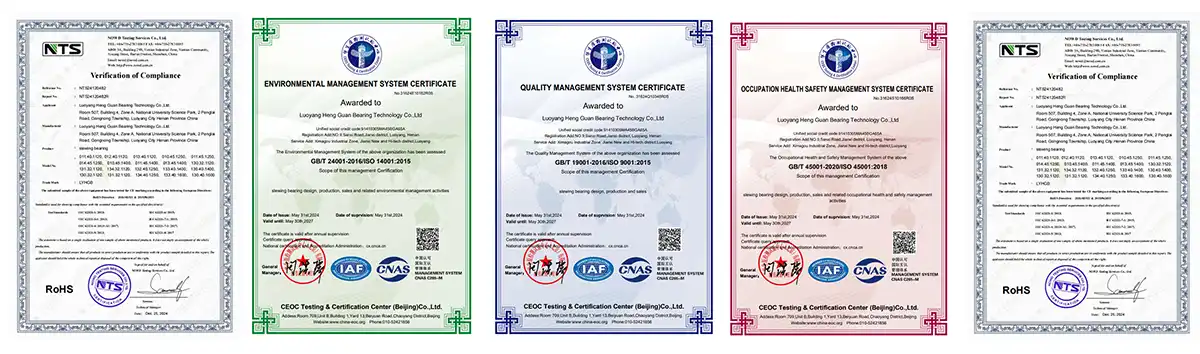
ISO 9001 certification can indicate that a manufacturer operates a documented quality-management system, but certification alone does not demonstrate that a specific bearing design is suitable for a particular machine.
For critical applications, it is more useful to combine certification with technical drawings, inspection records, material traceability, and clear acceptance criteria.
Conclusion
Material selection and structural design both play important roles in determining how long a heavy-duty slewing bearing can perform reliably. Suitable ring materials, controlled heat treatment, appropriate rolling-element materials, accurate raceway geometry, sufficient structural stiffness, effective sealing, and correct lubrication all contribute to reliable operation.
However, no single material or bearing configuration is ideal for every application. A crane, excavator, mining machine, offshore system, and industrial turntable can impose very different combinations of axial load, radial load, overturning moment, speed, shock, and environmental exposure.
For this reason, bearing selection should begin with the actual operating conditions and load spectrum. Material grade should then be evaluated together with heat treatment, raceway design, ring stiffness, sealing, gear requirements, and manufacturing quality.
For OEMs and industrial buyers, supplier capability is equally important. A manufacturer that can demonstrate material traceability, controlled heat treatment, precision machining, dimensional inspection, and application-specific engineering support can provide more useful assurance than a catalogue specification alone.
The goal is not simply to purchase a larger or stronger bearing. It is to select a bearing whose material, geometry, manufacturing quality, and operating conditions are properly matched so that the equipment can achieve the required reliability and service life.
|
|
FAQ
1. How does material selection affect maximum load capacity?
The basic load limit is set by the base material's yield strength, which tells us when the bearing bands deform plastically under pressure. 42CrMo alloy steel has a yield strength that is about 30% higher than that of normal carbon steels. This means that rings can be smaller and lighter while still holding the same amount of weight. The material of the rolling element affects its contact stress capacity. Elements with higher hardness can take the same load as those with lower hardness, but this has to be balanced against worries about brittleness in shock-loading applications.
2. What maintenance practices most effectively extend bearing lifespan?
Most premature failures can be avoided by lubricating bearings at the times recommended by the maker. In industrial settings, 40% of bearing problems are caused by poor lubrication. Second, keeping the seals in good shape is important. A visual check every three months can find damage early, when it's only a few hundred dollars to fix instead of thousands of dollars. Checking the bolt tightness after the first break-in period and every year after that stops the tightening that leads to fretting wear between the bearing and the mounting structure, a problem that can damage both parts.
Partner with a Trusted Heavy-Duty Slewing Bearing Manufacturer
It takes more than just looking through catalogs to choose parts for equipment that works in tough conditions. You need to work with sellers who understand your unique problems and work with you to find solutions. Luoyang Heng Guan Bearing Technology has been making slewing bearings for 20 years and has a wide range of technical skills. They can make bearings with diameters from 1,000 mm to 10,000 mm and accuracy grades from P0 to P4. Our 42CrMo and 50Mn alloy steel rings are carefully carburized and heated to give them better fatigue resistance. The GCr15SiMn rolling elements give them the wear qualities they need for a longer service life.
We provide planning and procurement teams in the building, mining, wind energy, heavy-duty slewing bearing, and heavy industry sectors with custom solutions that are made to fit their load profiles and working conditions. Our engineering team works directly with your requirements to make sure that the parts we send you fit perfectly with your equipment, whether you need a normal three-row roller setup or a custom design that works best with the way your equipment is installed.
Email our expert sales team at mia@hgb-bearing.com to talk about what you need for your application. We offer detailed engineering advice, unique design services, and a lot of information to help you make smart choices about where to get your materials. Heng Guan is a heavy-duty slewing bearing seller with clients in North America, Europe, and Asia. They work with customers to turn bearing specifications into operational reliability through precision production, material knowledge, and customer collaboration.
References
1. Harris, T.A. & Kotzalas, M.N. (2017). Advanced Concepts of Bearing Technology: Rolling Bearing Analysis. CRC Press, Boca Raton, FL.
2. Budynas, R.G. & Nisbett, J.K. (2020). Shigley's Mechanical Engineering Design, 11th Edition. McGraw-Hill Education, New York, NY.
3. ISO 281:2007. Rolling Bearings — Dynamic Load Ratings and Rating Life. International Organization for Standardization, Geneva, Switzerland.
4. Warda, B. & Chudzik, A. (2014). "Fatigue Life Prediction of the Radial Roller Bearing with the Correction of Roller Generators." International Journal of Mechanical Sciences, Vol. 89, pp. 299-310.
5. Glodež, S., Potočnik, R. & Flašker, J. (2012). "Computational Model for Determination of Dynamic Load Capacity of Large Three-Row Roller Slewing Bearings." Engineering Failure Analysis, Vol. 32, pp. 44-53.
6. Aguirrebeitia, J., Abasolo, M., Vallejo, J. & Ansola, R. (2012). "General Static Load-Carrying Capacity of Four-Contact-Point Slewing Bearings for Wind Turbine Generator Actuation Systems." Wind Energy, Vol. 16, No. 5, pp. 759-774.

WHAT OUR CUSTOMERS SAY
Here is the customer's evaluation of us