




OEM Slewing Bearing for Tower Crane Manufacturers
A slewing bearing for tower crane applications is a critical structural component that connects the rotating upper structure of a tower crane with its stationary support. It allows the crane to rotate around its vertical axis while carrying axial loads, radial loads, and overturning moments generated during lifting and slewing. For tower crane manufacturers, choosing a slewing bearing is not simply a matter of selecting a bearing by outside diameter. The bearing must match the crane's load spectrum, mounting structure, gear arrangement, operating speed, duty cycle, and service environment. Material selection, heat treatment, raceway geometry, bolt-hole accuracy, gear quality, sealing, and lubrication also influence the performance of the complete slewing system. OEM suppliers such as HGB Bearings can support this process by working from application data and engineering drawings rather than relying only on a catalogue model. Materials such as 42CrMo and 50Mn may be used for different bearing components depending on the design and required mechanical properties, while the final configuration should be determined from the specific operating requirements.
How Does a Tower Crane Slewing Bearing Work?
The slewing bearing is the rotating interface between the fixed and rotating parts of the crane. A large-diameter slewing ring is a compact assembly that combines raceways, rolling components, seals, mounting holes, and, if required, a gear ring, rather than the typical Shaft-and-bearing arrangement.
During operation, the bearing experiences more than one sort of force. The weight of the load causes an axial force. The crane structure and the position of the load cause radial forces and a large overturning moment. Loading situations can be further changed by wind loads and dynamic impacts.
Therefore, the bearing has to keep sufficient contact between its raceways and rolling parts under various load circumstances. The mounting connection is just as critical since even with the right bearing construction, unequal support or improper tightening of the bolts can produce load distribution issues.
Main Components of the Slewing Ring
A typical tower crane slewing bearing has a number of functional components:
Inner ring: Provides one of the main raceway surfaces and attaches to the appropriate crane framework.
Outer ring: Forms the other main raceway and mounting interface.
Rolling elements: Loads are transferred through the raceways by balls or rollers.
Raceways: Exactly machined surfaces that guide the rolling elements and determine the contact behavior.
Seals: To keep lubricant and dust, moisture, and other impurities out.
Gear ring: Integrated gearing can also be used to transmit slewing drive torque by means of an internal or external gear.
Mounting holes: These are the holes that link the bearing to the crane framework and should be in accordance with the OEM mounting drawing.
Bearings design differs in its specific arrangement. OEM manufacturers must therefore consider the whole bearing assembly and not a single component in isolation.
Selecting the Right Slewing Bearing Configuration
There is no one slewing bearing arrangement that will suit all tower cranes. The proper design depends on the loads, size, rotation requirements, and installation arrangement of the crane.
Single-Row Ball and Roller Designs
Single-row four-point contact ball slewing bearings are often chosen for applications where a relatively small bearing is needed and has the ability to handle combined stress. Their suitability relies on the actual axial load, radial load, overturning moment, and operating conditions.
Load-bearing qualities and stiffness may be different for roller-based devices. The three-row roller slewing bearing design separates the load channels between the different roller rows, and the design may accommodate significant combined loading. However, a three-row arrangement is not inherently the optimum choice for every tower crane.
For an OEM project it is more appropriate to compare applicable setups with the same operating data. This makes it easier to grasp the tradeoffs between bearing size, load capacity, stiffness, resistance to rotation, weight, and cost.
Internal Gear, External Gear, or Gearless Designs
Another major decision factor is the layout of the gears. Depending on the drive concept and the available installation space, the slewing systems of tower cranes can be equipped with internally or externally geared bearings.
OEM needs to confirm:
gear module & tooth geometry,
number of teeth,
pitch diameter,
gear accuracy requirements,
mounting orientation,
pinion arrangement,
needed backlash,
drive torque & operating speed.
The gear ring of the slewing drive is selected correctly to provide reliable power transmission. Therefore, the gear parameters should be considered along with the bearing design, not as a separate purchasing item.
What OEMs Should Check Before Ordering?
A bearing catalogue is useful for reference, but it’s not sufficient to tell if a particular slewing bearing is suitable for a tower crane.
Load and Operating Data
The primary operational characteristics should be given to the provider before proposing a bearing. Useful information is
maximum axial load;
radial load;
maximum overturning moment;
static and dynamic loading circumstances;
slewing speed;
operating cycle or duty class;
estimated working hours;
ambient temperature;
exposure to dust, rain,
salt or other pollutants;
installation orientation;
available mounting dimensions.
The average lifting load should be used with precautions, and the maximum or critical load condition should be considered. The loading of tower cranes can vary greatly depending on the position of the boom, the weight lifted, the wind conditions, and the operational movement.
The provider can compare the demanded bearing capacity and contact conditions with the OEM's demands.
Mounting Dimensions and Structural Compatibility
Even a correctly rated bearing can produce complications if the mounting interface of the bearing is not compatible with the crane construction.
The relevant dimensions shall consequently be indicated in the OEM designs, including:
Outside diameter, inside diameter Overall height of mounting-hole diameter Bolt-circle diameter Number and distribution of holes Flange dimensions, gear dimensions Permissible mounting tolerances
The supporting structure should also have enough stiffness and dimensional precision. If the mounting surface is not flat, the bearing may not be loaded evenly around the whole diameter. This can affect the raceway contact, bolt loadings, gear contact, and service performance of a slewing bearing for a tower crane.
Materials, Heat Treatment, and Manufacturing Quality
The material selection is directly related to the mechanical qualities that a large slewing bearing needs. Depending on design and component, alloy or medium carbon steels, e.g., 42CrMo and 50Mn, may be considered.
Raceways and Heat Treatment
The raceway is one of the heavily loaded sections of the bearing. The raceway is in direct contact with rolling elements; hence, the raceway surface condition and hardness should be managed during the manufacture.
The heat treatment should be selected based on the material, the geometry of the part, the desired hardness profile, and the planned application. For OEM purchases, it is good practice to ask for material certificates and the heat-treatment or inspection reports (needed by quality agreement).
The object is not only to employ a certain grade of steel. All processes, starting with forging or preparing the material and ending with machining, heat treatment, grinding, and inspection, should be able to create a part with uniform mechanical and dimensional qualities.
Dimensional and Functional Inspection
A professional OEM quality-control process should be employed to validate dimensions affecting installation and operation. Inspection may include, depending on the project:
bore diameter and height,
mounting hole position,
raceway dimensions,
radial and axial run-out,
gear dimensions and precision,
hardness,
surface condition,
seal condition,
rotation behavior,
lubrication condition.
The scope of inspection shall be exactly discussed and agreed upon with the OEM as per the product drawing and quality criteria.
Installation Practices for Tower Crane Slewing Bearings
The installation has a great influence on the performance of a slewing bearing. You cannot compensate for the wrong way of mounting with a high-quality bearing.
Prepare the Mounting Surface
The supporting surfaces should be cleaned and verified to the OEM tolerances specified before installation. Welding spatter, burrs, paint buildup, dirt, or other foreign material shall not affect the seating surface of the bearing.
The mounting structure should also be evaluated for distortion or severe deviation from flatness. If the support is not stiff enough or the support is not uniform enough, then the bearing may not be loaded uniformly when the bolts are tightened.
Follow the Correct Bolt Installation Procedure
Mounting bolts shall be of the requisite quality, size, quantity, and tightening parameters as described for the application. The sequence of tightenings must be managed so that the bearing is seated evenly.
For OEM projects the provider should give or validate the relevant installation instructions instead of using a generic torque value. The bolt preload requirements are different according to the specific bearing, bolt arrangement, joint design, and crane construction.
After installation, the assembly should be tested for easy rotation, unexpected resistance, unusual noise, excessive play, and proper meshing of gears before putting the crane into regular operation.
Maintenance and Inspection Requirements
The maintenance program should be established according to the bearing design and actual operating circumstances. There is no fixed inspection period for all tower cranes.
Lubrication and Seal Inspection
Lubrication is important because the rolling contacts and raceways need an appropriate lubrication film so as to reduce friction and to protect the contact surfaces.
The maintenance procedure should include the appropriate grease or lubricant, sites of lubrication, method of application, and frequency of inspection. These needs can vary with operating temperature, speed of rotation, load, contaminants, and service environment.
Seals should also be checked from time to time. Water and pollutants can get into the bearing, and oil can escape when the seals are damaged or degraded.
Monitor Changes in Bearing and Gear Behavior
Maintenance personnel should pay attention to changes rather than waiting for obvious failure. Useful observations include:
unusual noise during slewing;
increased vibration;
abnormal rotation resistance;
excessive clearance;
gear backlash changes;
visible raceway or gear damage;
lubricant contamination;
loose mounting bolts;
seal damage.
If a new abnormal condition appears, the bearing should be inspected together with the mounting structure, lubrication system, gear drive, and surrounding components. A single symptom does not necessarily identify the root cause.
How to Evaluate an OEM Slewing Bearing Supplier?
For tower crane manufacturers, supplier evaluation should cover more than the quoted unit price.
Manufacturing and Quality Capabilities
A potential supplier should be able to demonstrate control over the processes that influence bearing performance. OEM buyers can ask about:
available bearing sizes;
machining capabilities;
heat-treatment processes;
raceway manufacturing;
gear machining;
dimensional inspection;
material traceability;
quality documentation;
production capacity;
drawing management;
sample approval procedures.
It is also useful to determine whether the supplier can maintain consistent quality between prototype, initial production, and repeat orders.
Engineering and Customization Support
OEM projects often require dimensions or features that differ from standard catalogue configurations. A capable supplier should be able to review technical drawings and discuss practical alternatives.
Potential customization areas include:
outside and inside diameters;
bearing height;
mounting-hole pattern;
gear arrangement;
gear dimensions;
seal configuration;
lubrication ports;
material selection;
special mounting requirements.
Instead of asking only whether a supplier can “customize,” OEM buyers should ask how the supplier manages drawing confirmation, engineering changes, inspection approval, and production traceability for a slewing bearing for a tower crane.
Procurement Considerations for Tower Crane Manufacturers
The lowest purchase price does not necessarily represent the lowest overall cost. A bearing that requires frequent replacement or creates installation problems can increase downtime, labor, transportation, and service costs.
Lead Time and Production Planning
Lead time depends on bearing size, design complexity, material availability, machining requirements, heat treatment, inspection, and production scheduling. Standard and customized products may therefore have different delivery requirements.
OEM buyers should confirm the expected lead time before placing an order and clarify whether the quoted schedule includes engineering approval, sample production, inspection, and final packaging.
For recurring orders, suppliers should also be evaluated on their ability to maintain consistent specifications from batch to batch.
Documentation for OEM Approval
Before approving a new supplier, it is useful to establish a documentation package that matches the project's requirements. Depending on the application, this may include:
- approved product drawings;
- material certificates;
- dimensional inspection reports;
- hardness or heat-treatment records;
- gear inspection data;
- product specifications;
- lubrication recommendations;
- installation instructions;
- packaging information;
- certificate of conformity where applicable.
Clear documentation makes incoming inspection and quality traceability easier for the crane manufacturer.
Why OEM-Focused Bearing Selection Matters?
For a tower crane manufacturer, the slewing bearing is part of a larger mechanical system. Its performance depends not only on the bearing itself but also on the mounting structure, bolts, gear drive, lubrication, operating loads, and maintenance practices.
An OEM-focused supplier should therefore be able to discuss the complete application rather than simply recommend the largest available bearing.
The most practical selection process is to provide the supplier with the crane's load data, mounting drawing, slewing requirements, environmental conditions, and expected duty cycle. The supplier can then compare suitable bearing configurations and identify the design that best fits the application.
This approach also helps prevent common purchasing mistakes, such as selecting a bearing based only on diameter, comparing suppliers solely by price, or assuming that a heavier bearing will automatically provide better performance.
Conclusion
Choosing an OEM slewing bearing for tower crane applications requires more than matching a catalogue number to the crane's mounting diameter. The bearing must be evaluated against axial and radial loads, overturning moment, slewing speed, duty cycle, gear requirements, mounting conditions, lubrication, and operating environment.
For tower crane manufacturers, the most reliable procurement process starts with accurate application data and a clear engineering drawing. Bearing configuration, material, heat treatment, raceway design, gear arrangement, sealing, and mounting dimensions should then be reviewed as one complete system.
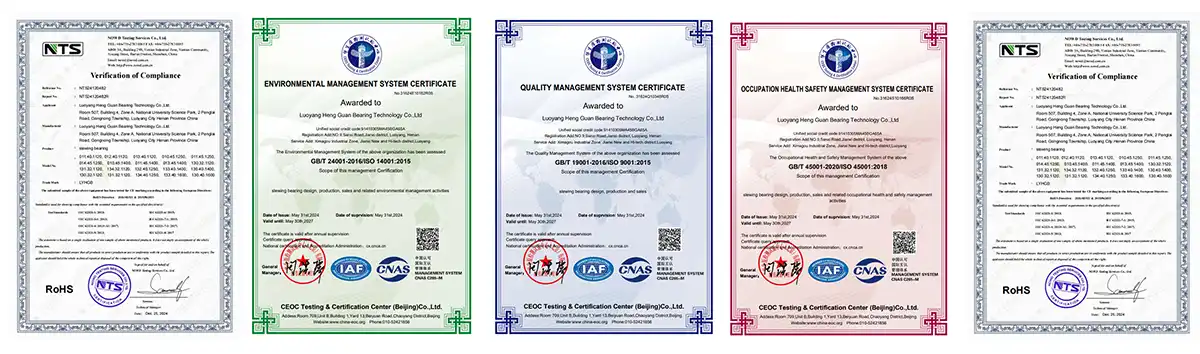
Supplier capability is equally important. A qualified OEM bearing manufacturer should be able to provide consistent manufacturing, dimensional inspection, technical documentation, customization support, and practical installation and maintenance guidance.
When requesting a quotation, OEM buyers should provide the required bearing dimensions, bolt pattern, gear configuration, load conditions, slewing speed, operating environment, and expected duty cycle. With these details, the supplier can evaluate the application more accurately and recommend a slewing bearing that is compatible with the tower crane's mechanical and operational requirements.
|
|
FAQ
1. What maintenance intervals are recommended for tower crane slewing bearings?
Maintenance times rely on how the system is being used, but for normal situations, we suggest checks every 500 to 1000 hours of use. Environments that are dirty or need a lot of work may need more frequent care. Every 200 to 500 hours, the bearings should be oiled, and they should be checked completely once a year or after 2000 hours of use.
2. How do you determine the appropriate load capacity for specific tower crane applications?
To figure out the load capacity, you have to look at the crane's shape, wind loads, and how it moves during operation. To make sure there are enough safety gaps, we figure out the total axial, radial, and moment loads. Our technical team helps with load calculations so that the best bearings can be chosen for each application.
3. Can slewing bearings be customized for specialized tower crane configurations?
We offer a wide range of customization choices, such as changing the mounting measurements, making the gears fit in different ways, and using different materials. For tough environments, custom sealing options are available, and precise grades can be requested in specific situations. Our tech team works with OEM makers to come up with the best options.
4. What factors influence slewing bearing service life in tower crane applications?
Service life relies on the type of load, the environment, the level of upkeep, and how well it was installed. Bearings last a lot longer if they are properly oiled, cleaned, and inspected frequently. To get the most out of your equipment, it's important to stay within the load limits and keep it properly aligned.
Partner with Heng Guan for Premium Tower Crane Slewing Bearing Solutions
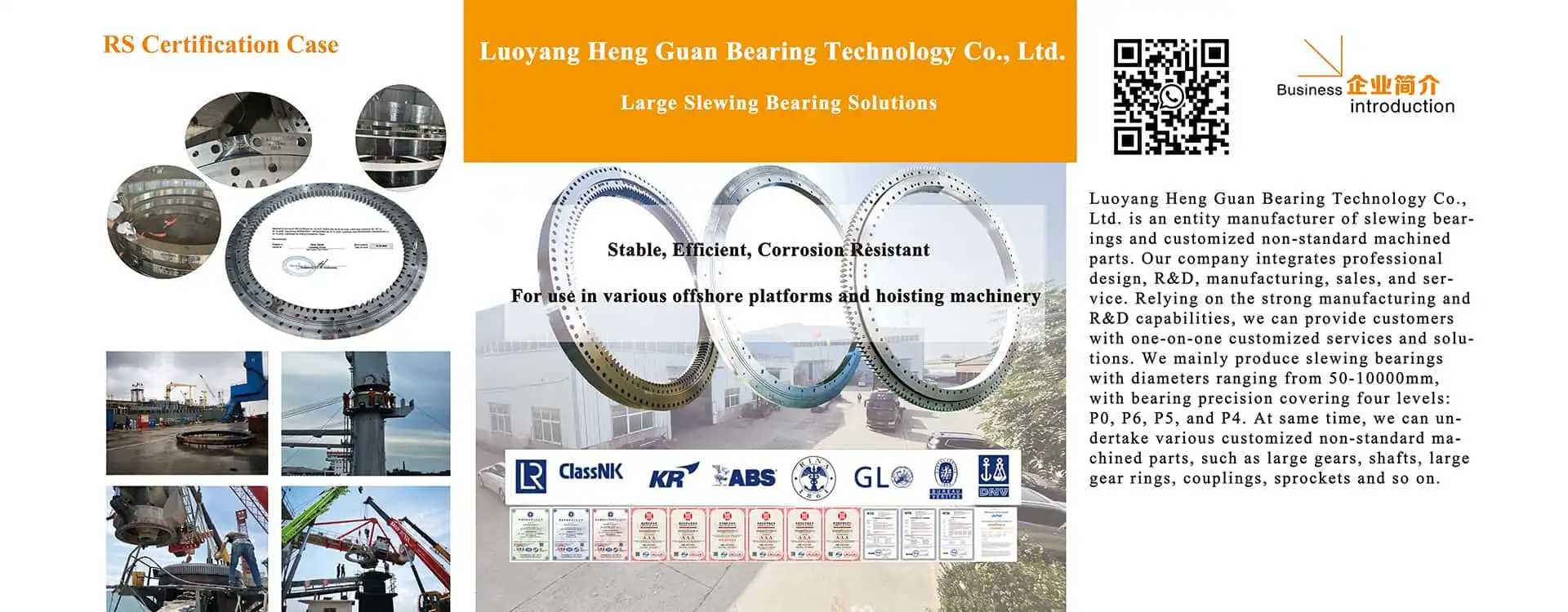
The slewing bearing for tower crane solutions is engineered for demanding construction and industrial applications. Our advanced manufacturing capabilities produce bearings ranging from 20mm to 10,000mm in diameter with precision grades from P0 to P4, ensuring optimal performance for diverse tower crane requirements. Located in Luoyang's renowned bearing manufacturing hub, we combine decades of engineering expertise with state-of-the-art production facilities to deliver superior quality and reliability. Our experienced team provides comprehensive technical support, from initial bearing selection through installation guidance and ongoing maintenance consultation. Contact our specialists at mia@hgb-bearing.com to discuss your specific requirements and receive detailed quotations for premium slewing bearings for tower crane supplier partnerships that enhance your equipment performance and operational efficiency.
References
1. Chen, L. (2023). "Advanced Materials and Heat Treatment Processes in Heavy-Duty Slewing Bearing Manufacturing." International Journal of Bearing Technology, 45(3), 78-92.
2. Rodriguez, M. & Kim, S. (2022). "Load Distribution Analysis in Triple-Row Roller Slewing Bearings for Construction Equipment." Mechanical Engineering Research Quarterly, 38(7), 156-171.
3. Thompson, R. (2023). "Maintenance Strategies and Service Life Optimization for Tower Crane Slewing Bearings." Construction Equipment Engineering Review, 29(4), 203-218.
4. Zhang, W., et al. (2022). "Comparative Study of Precision Grades in OEM Slewing Bearing Applications." Precision Manufacturing International, 51(2), 89-104.
5. Anderson, J. & Mueller, K. (2023). "Installation Best Practices and Quality Assurance Protocols for Large-Diameter Slewing Bearings." Heavy Industry Engineering Handbook, 15(8), 445-461.
6. Liu, H. (2022). "Economic Analysis of OEM versus Generic Slewing Bearing Solutions in Tower Crane Applications." Industrial Procurement Quarterly, 33(6), 267-282.

WHAT OUR CUSTOMERS SAY
Here is the customer's evaluation of us