




How Do You Maintain a Port Crane Slewing Bearing Properly?
Every hour a port crane is out of service costs a terminal money, and salt air, heavy loads, and round-the-clock shifts make the slewing bearing one of the hardest-working parts on the quay. Typical frustrations include: grease that washes out or breaks down in humid coastal air; seals that let seawater and sand reach the raceways; and maintenance routines that are skipped or poorly recorded until noise or vibration forces an unplanned stop. Proper maintenance keeps a port crane slewing bearing turning smoothly through all of it. This three-row roller bearing is the rotating joint that carries the crane's superstructure, so a steady routine protects safety and uptime. In this guide, Heng Guan Bearing covers lubrication timing, grease selection, inspection points, and preventive strategies that help your equipment last longer.
How Often Should You Lubricate a Port Crane Slewing Bearing?
Lubrication frequency depends on how hard the crane works. A port crane slewing bearing running continuous shifts in a humid coastal environment benefits from a shorter interval than one in light, occasional use. As a general approach, follow the lubrication schedule supplied with your bearing, which typically includes a quarterly lubrication check and replenishment, and adjust it according to temperature, load, and the condition of the grease you see at the seals. When adding grease, rotate the bearing slowly so the lubricant spreads evenly over the raceways, and continue until a thin bead of fresh grease appears at the seal. Heng Guan Bearing designs every China crane slewing bearing with grease channels that make this step simple. Keeping a written log of dates and quantities helps your team stay consistent and spot changes early.
| Operating Condition | Lubrication Approach |
|---|---|
| Continuous shifts in humid coastal air | Shorten the interval and check seal condition more often |
| Light or occasional use | Follow the standard schedule supplied with the bearing |
| High temperature or heavy moment loads | Check grease condition at the seals and replenish early |
| Grease looks dark, dry, or contaminated | Purge and replace with fresh grease of the specified type |
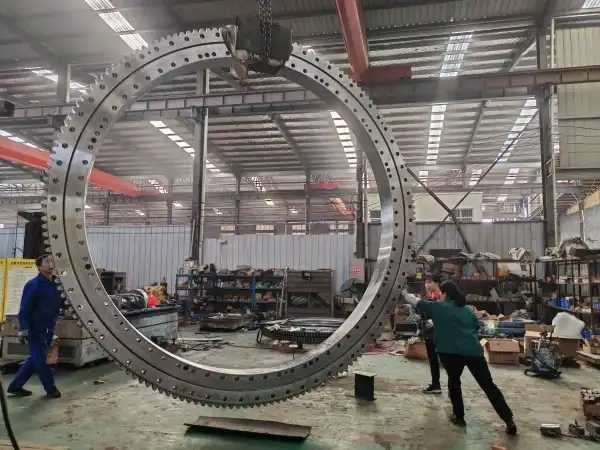
Choosing the Right Grease for Marine and Heavy-Duty Operating Conditions
Grease is the working fluid of a slewing bearing, so selecting it with care pays off. For marine and heavy-duty use, look for lithium-complex or similar grease with extreme-pressure additives, good water resistance, and strong anti-corrosion performance. These properties keep a protective film on the raceways even when salt spray and heavy moment loads are present. Our sealing systems use imported nitrile rubber or fluororubber designed for port environments, which work together with the right grease to keep moisture out. When choosing for your port crane slewing bearing, confirm temperature range, base oil viscosity, and compatibility with the grease already inside, and use only recommended lubricants. The table below summarizes the key grease qualities, followed by the key technical parameters of our bearing.
| Grease Property | Why It Matters |
|---|---|
| Extreme-pressure additives | Protect raceways under heavy load |
| Water resistance | Holds up against spray and humidity |
| Anti-corrosion | Protects steel in marine air |
| Suitable viscosity | Maintains film across temperatures |
Technical Specifications
| Parameter | Specification |
|---|---|
| Bearing Type | Three-row roller slewing bearing |
| Size Range | 4238mm x 270mm (custom sizes available) |
| Load Capacity | Ultra-high load rating for port applications |
| Base Material | 42CrMo, 50Mn special alloy steel |
| Rolling Elements | GCr15SiMn high-purity bearing steel |
| Seal Material | Imported nitrile rubber / fluororubber |
| Precision Grades | P0, P6, P5, P4 available |
| Temperature Range | -40°C to +120°C |
| Lubrication | Grease or oil lubrication options |
| Mounting | Bolt-on design with precision-machined holes |
Not sure which grease or maintenance interval suits your crane? If you need a recommendation for your china crane slewing bearing, send your working conditions to mia@hgb-bearing.com, and our engineers will gladly help.
Port Crane Slewing Bearing Inspection: Checking Seals, Bolts, and Raceway Wear
Regular inspection turns small observations into early action. Start with the seals, looking for firm seating, flexibility, and clean contact, and keep sealing systems clean and intact against seawater, sand, and dust. Next, check the mounting bolts for correct torque, since stable preload keeps load distribution even; after installation, re-torque the bolts following the first hours of operation and follow the manufacturer's torque specifications.
Then examine the raceways and gear teeth for smooth finish, consistent contact patterns, and any signs of corrosion. Listen during slewing for unusual noise, and feel for vibration or uneven rotation. A well-made port crane slewing bearing, built from 42CrMo or 50Mn alloy steel with GCr15SiMn rolling elements and precision-machined raceways, rewards this routine with years of dependable service. The table below offers a simple checklist.
| Inspection Point | What to Look For |
|---|---|
| Seals | Firm seating, intact lips |
| Mounting bolts | Correct torque, no looseness |
| Raceways | Smooth, evenly finished surface |
| Gear teeth | Even contact pattern |
Preventive Maintenance Strategies to Extend Bearing Service Life and Reduce Downtime
A preventive plan brings all these steps together. Set fixed intervals for lubrication, bolt checks, and visual inspection, and record the results so trends become visible over time. Schedule larger checks during planned port downtime rather than waiting for a problem. Keep spare seals and grease on hand, monitor working temperatures regularly, and train operators to report unusual sounds promptly. Choose a China crane slewing bearing supplier that offers installation guidance, reverse engineering, and lifecycle support, because expert advice shortens every decision.
Heng Guan Bearing offers custom oversized configurations, marine-grade corrosion protection, and inspection reports to support your plan, with standard sizes typically shipping in 2-4 weeks and custom bearings in 6-8 weeks. With a consistent routine, each port crane slewing bearing delivers longer service life, fewer interruptions, and better value across the whole equipment lifecycle.
| Interval | Action Required |
|---|---|
| First hours of operation | Re-torque mounting bolts to the specified values. |
| Monthly | Visual inspection for wear or damage; check seals for cracks or displacement. |
| Quarterly | Lubrication check and replenishment; verify bolt torque. |
| Annually | Comprehensive bearing assessment, including raceway and gear tooth condition. |
| Any time | Immediate attention to unusual noise or vibration. |
Conclusion
Maintaining a port crane slewing bearing means timely lubrication, the right marine grease, regular inspection, and a clear preventive plan. These habits extend service life and reduce downtime. Heng Guan Bearing supports you at every stage. Contact Luoyang Heng Guan today for a tailored China crane slewing bearing solution.
FAQ
Q: What type of bearing suits port cranes?
A: A three-row roller slewing bearing is the standard choice for heavy-duty port cranes, container gantry cranes, stackers, and reclaimers. Single-row four-point contact and double-row ball designs are also available for lighter duty.
Q: What materials are used?
A: 42CrMo and 50Mn alloy steels for the rings, with GCr15SiMn high-purity bearing steel for the rolling elements.
Q: Which seals work for marine use?
A: Imported nitrile rubber and fluororubber seals, supported by marine-grade corrosion-resistant treatment.
Q: When should bolts be re-torqued?
A: After the first hours of operation, then at regular intervals as part of your quarterly inspection.
Q: Can sizes be customized?
A: Yes, including oversized configurations. Our standard offering starts at 4238 mm x 270 mm, and special sizes are available for custom design.
How Luoyang Heng Guan Solves Your Port Crane Slewing Bearing Maintenance Challenges
At Luoyang Heng Guan Bearing Technology Co., Ltd., as a China port crane slewing bearing supplier with more than 20 years of experience, we combine engineering expertise, manufacturing capability, and technical support to deliver bearings that minimize downtime and maximize reliability:
- Three-row roller bearings from 4238 mm x 270 mm, P0-P4 precision, with custom oversized options
- Marine-grade corrosion-resistant treatment and multi-layer sealing against seawater, sand, and dust
- ISO 9001 certified production with CNC machining, heat treatment, and full inspection
- Engineering team available for installation guidance, maintenance planning, and on-site consultation
Ready to extend your bearing life? Contact Us at mia@hgb-bearing.com today with your crane model and working conditions to receive expert maintenance advice and a tailored quotation.
References
1. Harris, T. A., & Kotzalas, M. N. Rolling Bearing Analysis. CRC Press.
2. Booser, E. R. CRC Handbook of Lubrication and Tribology. CRC Press.
3. ISO 281: Rolling Bearings – Dynamic Load Ratings and Rating Life. International Organization for Standardization.
4. ISO 15243: Rolling Bearings – Damage and Failures – Terms, Characteristics and Causes. International Organization for Standardization.
5. Hushan, B. Introduction to Tribology. Wiley.
6. FEM 1.001: Rules for the Design of Hoisting Appliances. European Materials Handling Federation.

WHAT OUR CUSTOMERS SAY
Here is the customer's evaluation of us