




How to Inspect PC1250 Excavator Bearings Before Purchase?
An ultra-large mining excavator stopping and spinning every hour costs a mine money, and an early-failing swing bearing is one of the most costly repairs on the machine. Common sources of irritation are: bearings that wear out before the specified service life; replacements that come with incorrect dimensions or without inspection records; and vendors who cannot tell you how the raceways were hardened or what steel was used. Buying PC1250 Excavator Bearings is a significant investment; a rigorous inspection before buying protects your money and your uptime. These three-row roller slewing bearings are used in ultra-large mining excavators, such as the Komatsu PC1250, and handle severe loads. In this book, Heng Guan Bearing presents a realistic inspection process comprising wear signs, clearance, visual inspections, and functional tests.
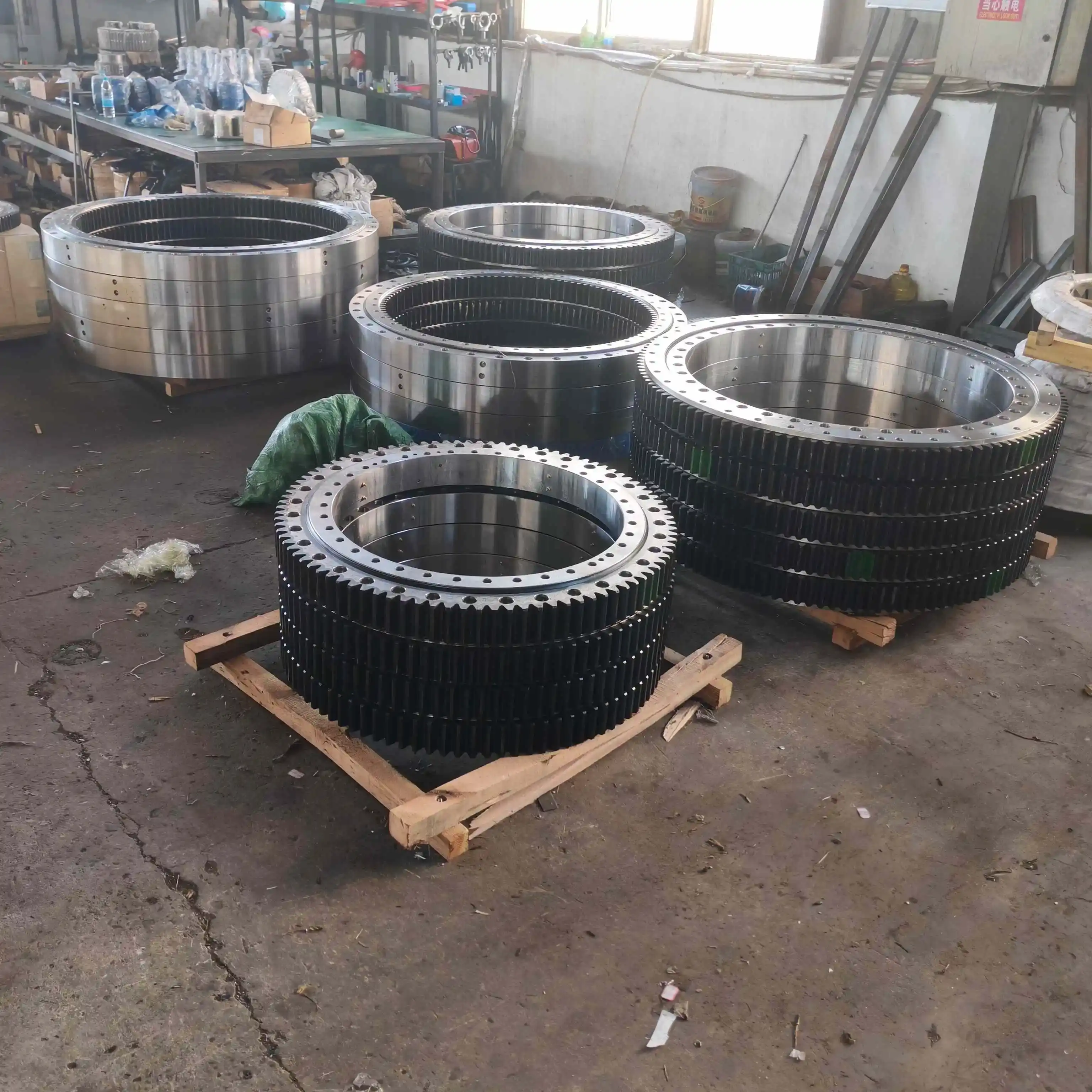
What Are the Common Signs of Wear in PC1250 Excavator Bearings?
Wear reveals itself early, and a skilled eye may detect it before a bearing is ordered or fitted. Watch for rough or uneven rotation, odd slewing sounds, fine metal in the grease, and glossy or dull spots on the raceway surface. The contact pattern on gear teeth must be even without chips. Ask how they hardened the raceways and what they hardened the raceways with while you are checking the PC1250 excavator bearings from various PC1250 excavator bearings vendors. Heng Guan Bearing PC1250 Excavator Bearings are manufactured from high-strength 42CrMo or 50Mn alloy steel and have an outer diameter between 2200 mm and 3200 mm. These reference values enable you to decide if a bearing is suitable for severe mining usage.
| Sign | What It May Indicate |
|---|---|
| Rough or uneven rotation | Raceway damage or uneven load distribution |
| Unusual noise during slewing | Lubrication loss or early raceway wear |
| Fine metal particles in grease | Rolling elements or raceways wearing |
| Chipped or unevenly worn gear teeth | Poor mesh or excessive backlash |
Technical Specifications
| Parameter | Specification |
|---|---|
| Outer Diameter | 2200mm - 3200mm |
| Inner Bore Diameter | 1800mm - 2800mm and above |
| Cross-Section Height | 150mm - 300mm |
| Structure | Three-row roller: two horizontal rows carry axial loads and overturning moments; one vertical row carries radial loads |
| Ring Material | High-strength 50Mn or 42CrMo alloy steel |
| Rolling Elements | High-precision GCr15 bearing steel |
| Seal Strips | Oil-resistant, wear-resistant nitrile rubber (NBR) |
| Raceway Hardening | Deep-hardened raceways, 8-12 mm |
| Integrated Gear | CNC form-ground, ISO Grade 6 accuracy |
| Precision Grades | P0, P6, P5, P4 |
| Suitable Machines | Komatsu PC1250, Caterpillar 6090 and equivalent ultra-large mining excavators |
How to Measure Swing Bearing Clearance and Detect Excessive Play?
Clearance is the relationship of the rolling elements to the raceways. Mount a dial indicator on the fixed ring, with its tip on the rotating ring, apply a regulated load, and read the axial movement. Repeat at numerous points around the circle. Compare your readings with the illustration or the manufacturer's limit. If it is low all the way around, it means the bearing is properly manufactured. If it jumps suddenly at one spot, it should be examined more closely. Reliable PC1250 excavator bearing manufacturers may provide clearance data and inspection records on request. If you need assistance in interpreting readings, send them to mia@hgb-bearing.com, and our engineers will gladly review them. The table below lists the main measurement checks.
| Measurement | Tool | What to Confirm |
|---|---|---|
| Axial clearance | Dial indicator | Even readings around the ring |
| Radial play | Dial indicator | Within drawing limit |
| Gear backlash | Feeler gauge | Uniform across full rotation |
Visual Inspection of Bearing Races, Seals, Lubrication, and Mounting Bolts
Quality is frequently first seen with a thorough visual assessment. No instrument required. Check races for smooth, consistent finishes, free of pitting, scoring, or corrosion. Verify that the seals are firmly seated and in continuous contact. Appropriate seals, for example, the nitrile rubber (NBR) strips used on our rings, exclude dust and moisture from the raceways. Check that lubricant is clean, uniformly spread, and of the correct kind. Finally, be sure to check that the mounting bolt hole locations are correct and use the correct grade and torque for the bolts. Our PC1250 Excavator Bearings may be put in a wooden box, frame, or composite wooden crate and iron frame packaging, so they are in excellent condition when they are inspected. Retorque all bolts after eight hours of use following installation. The visual checklist is summarized in the table below.
| Component | Good Condition |
|---|---|
| Races | Smooth, uniform finish |
| Seals | Firmly seated, intact |
| Lubrication | Clean, even grease film |
| Mounting bolts | Correct grade and torque |
What Operating Tests Can Reveal Hidden Bearing Damage?
Some attributes only show themselves when the bearing is spun under stress. Run a trial under lower load for the first working hours and then spin the bearing through complete 360-degree travel, listening for abnormal sounds and feeling for vibration. Monitor the temperature and observe for changes in the smoothness of slewing as the load rises during operation. Accurate raceways and the three-row roller design provide balanced load distribution for stable and quiet running. Strong PC1250 excavator bearings suppliers will also provide installation instructions and after-sales support, so you will never be left to troubleshoot alone. Take a quick reading of the first running hours; this is a helpful foundation for future maintenance and helps to ensure that your PC1250 Excavator Bearings are behaving as planned.
| Maintenance Task | Recommended Frequency |
|---|---|
| Seal strip inspection | Every 250 operating hours |
| Lubrication check | Every 500 operating hours |
| Gear mesh and noise check | Every 1,000 operating hours |
| Full slewing ring assessment | Annually |
Conclusion
PC1250 Excavator Bearings Inspection entails assessing symptoms of wear, clearance, visual condition, and operational behavior combined. A diligent practice allows you to purchase with confidence and maintain your excavator's working efficiency. Heng Guan Bearing provides technical assistance throughout. Contact Luoyang Heng Guan for reliable PC1250 Excavator Bearings now.
FAQ
Q: What material is used for PC1250 Excavator Bearings?
A: Rings are made from high-strength 42CrMo or 50Mn alloy steel, with GCr15 bearing steel for the rolling elements.
Q: What is the outer diameter range?
A: 2200 mm to 3200 mm, with inner bore diameters from 1800 mm and above and cross-section heights of 150-300 mm.
Q: What structure do they use?
A: A three-row roller slewing design, with two horizontal rows handling axial loads and overturning moments and one vertical row handling radial loads.
Q: Which machines are they suited for?
A: Komatsu PC1250, Caterpillar 6090, and similar ultra-large mining excavators.
Q: When should bolts be re-torqued?
A: After the first eight hours of operation.
How Luoyang Heng Guan Solves Your PC1250 Excavator Bearing Sourcing Challenges
At Luoyang Heng Guan Bearing Technology Co., Ltd., as one of the PC1250 excavator bearing manufacturers serving mining customers worldwide, we combine engineering expertise, manufacturing capability, and technical support to deliver bearings that minimize downtime and maximize reliability:
- Outer diameters from 2200 mm to 3200 mm, P0-P4 precision, with reverse engineering for PC1250 excavator bearing replacement planning
- ISO 9001-certified production with coordinate measuring machine verification, vibration testing, and full traceability documentation
- Engineering team available for installation guidance, technical consultation, and custom bearing development
- Customers in more than 50 countries, with substantial inventory maintained for faster delivery of replacements
Ready to buy with confidence? Contact Us at mia@hgb-bearing.com today with your PC1250 excavator bearings model details or drawings to receive expert guidance and a tailored quotation.
References
1. Harris, T. A., & Kotzalas, M. N. Rolling Bearing Analysis. CRC Press.
2. Budynas, R. G., & Nisbett, J. K. Shigley's Mechanical Engineering Design. McGraw-Hill Education.
3. ISO 281: Rolling Bearings – Dynamic Load Ratings and Rating Life. International Organization for Standardization.
4. ISO 15243: Rolling Bearings – Damage and Failures – Terms, Characteristics and Causes. International Organization for Standardization.
5. Oberg, E., et al. Machinery's Handbook. Industrial Press.
6. Bhushan, B. Introduction to Tribology. Wiley.

WHAT OUR CUSTOMERS SAY
Here is the customer's evaluation of us