




Double-row Four-point Contact Ball Slewing Bearings Well Fostered Wind Turbines
Wind turbines depend on large mechanical components that can support heavy loads while allowing controlled movement under changing operating conditions. Among these components, the Double Row Ball Slewing Bearing is used in applications where axial loads, radial loads, and overturning moments act simultaneously. Its two-row rolling-element design offers a viable solution for demanding slewing applications such as pitch and yaw systems. For wind turbine designers and operators, bearing selection requires more than just selecting the right diameter. Raceway geometry, rolling-element size, material, heat treatment, sealing, gear arrangement, mounting dimensions, lubrication, operating loads and all affect performance. Properly selected bearings can ensure reliable blade or nacelle movement and assist keep the turbine in the appropriate position throughout its service life.
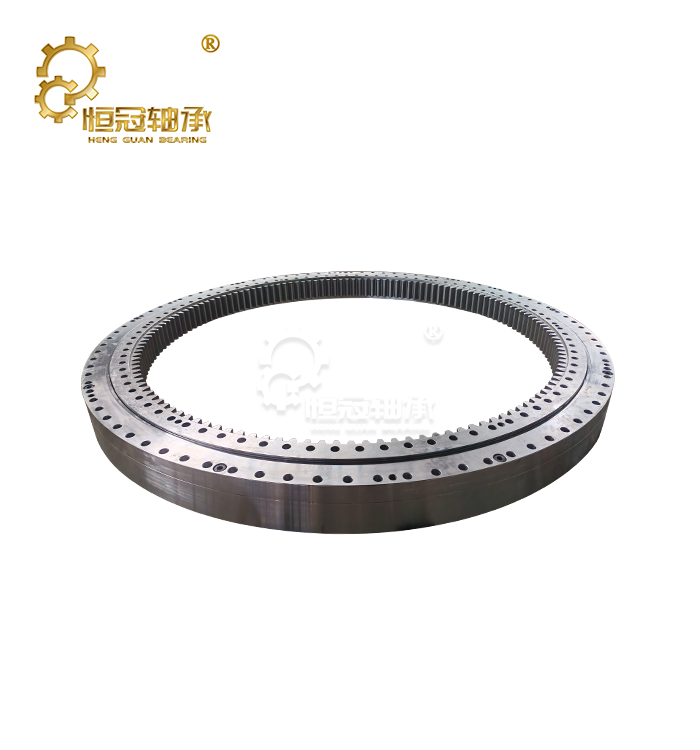
How Do Double-Row Four-Point Contact Slewing Bearings Work?
Understanding the Bearing Structure
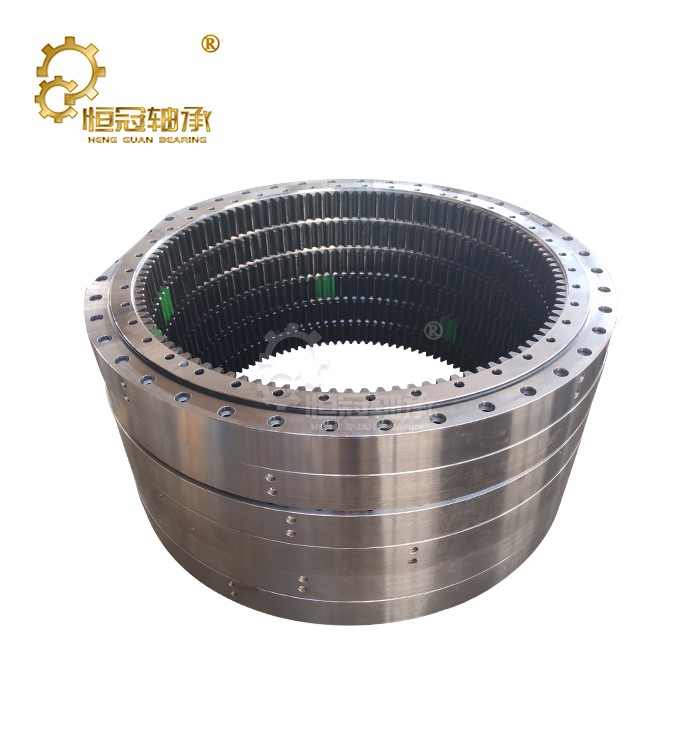
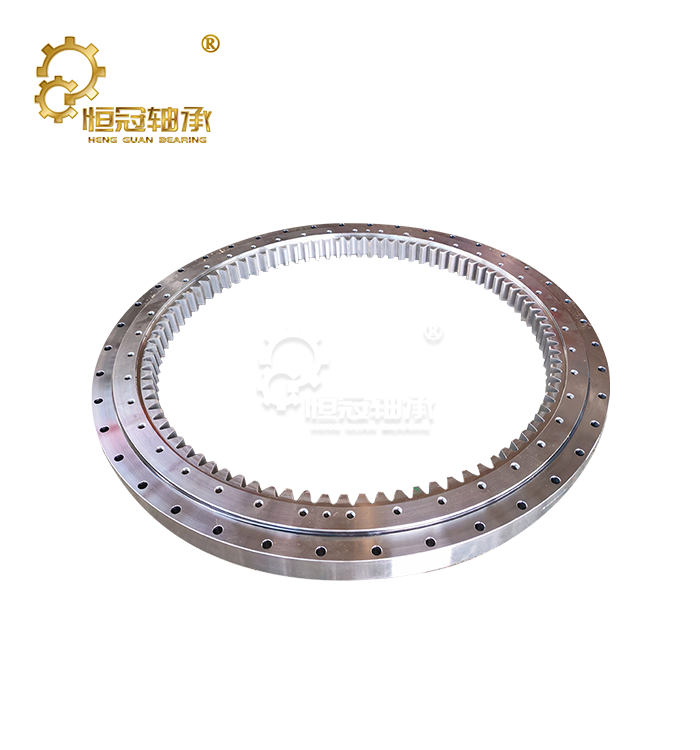
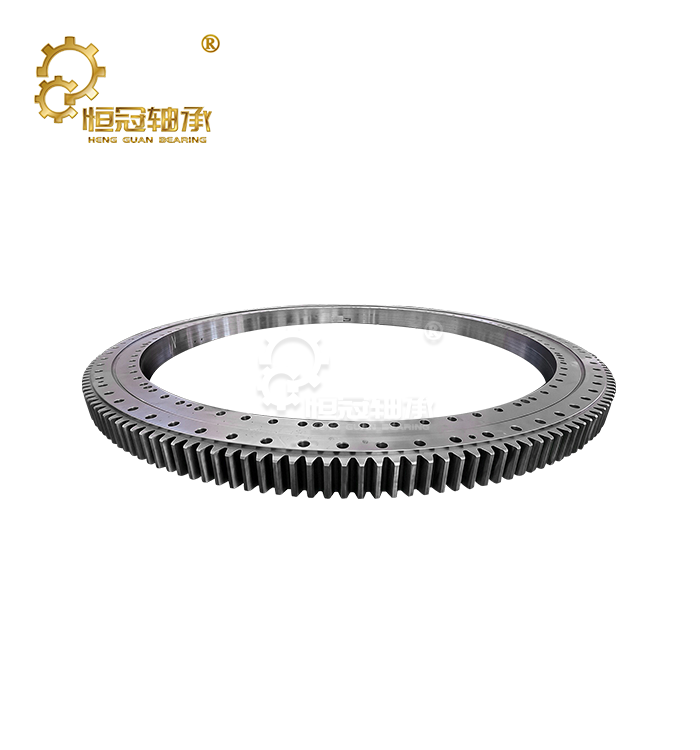
A double-row slewing bearing has two rows of rolling elements between its rings. Depending on the design, the rolling parts and raceway shape are designed to carry combined loads acting on the bearing. Four-point contact geometry allows various contact locations between the balls and raceways, enabling the bearing to handle a variety of combinations of axial, radial, and moment loads.
This setup is especially beneficial for wind turbines where the bearing isn't loaded in one straightforward loading direction. The loads via the bearing can be affected by wind pressure, rotor weight, blade motion, accelerations, braking, and emergency shutdown conditions.
The rings are usually made of bearing or alloy steels chosen for their strength, toughness, machinability, and fatigue resistance. The numerous components of the slewing bearing can be manufactured from materials such as 42CrMo or 50Mn, depending on the design and manufacturing requirements. Heat treatment is also required to obtain proper hardness and structural qualities of raceways for repetitive rolling contact.
Key Specifications Engineers Should Review
The bearing diameter is just one aspect of the requirement. Engineers should look at the full dimensions and operating envelope prior to picking a model.
Significant parameters may include:
- Inner Diameter & Outer Diameter
- Height of bearing
Raceway diameter:
- Number and diameter of balls
- Axial Load Carrying Capacity
- Axial Load Capacity
- Capacity to topple or tilt moment
- Rotation or Oscillation Velocity
- Clearance, internal
- Pattern of holes for mounting
- Gear module and number of teeth, if applicable
- Seal design and material
- Lubrication technique
- Operating temperature
- Requirements for corrosion prevention
The installation space available in wind turbine applications is limited by the hub or nacelle structure. A bearing must consequently carry the desired weight without exceeding the allowed envelope.
The rolling elements can be manufactured from high-quality bearing steel. Seals are provided for temperature, moisture, dust, and maritime exposure. Elastomer materials such as NBR and FKM are potential candidates for sealing applications, but the final material selection should be compatible with the operating environment and the lubricant.
Why Is Four-Point Contact Geometry Relevant?
The fundamental advantage of the four-point contact geometry is its capacity to carry combined loads in a relatively compact bearing system. Wind turbine bearings are exposed to combined axial force, radial force, and overturning moment. Consequently, the internal geometry shall be designed according to the real load spectrum rather than a single nominal load.
For example, in pitch applications, the bearing supports the rotation of the blades around the pitch axis. The bearing must be able to move in a regulated manner and still respond to varying aerodynamic forces. In yaw applications the bearing carries the nacelle rotation relative to the tower and must accommodate the loads imposed by the rotor and wind.
Real contact conditions rely on bearing geometry, load magnitude, clearance, mounting accuracy, and operating conditions. Hence, the selection of bearings should be based on technical calculations and not on the basis of the external dimensions.
Why Do Wind Turbines Use Double-Row Slewing Bearings?
Handling Combined Loads in Variable Wind Conditions
The conditions in which wind turbines are working are always changing. The wind speed and direction change, and the rotor produces aerodynamic forces, which are a function of blade rotation. Hence, the bearing system has to withstand repeated change of load and movement.
A double-row arrangement allows load sharing between two rows of rolling elements, allowing the bearing to accommodate combined loading. This is useful when the bearing has to carry the weight of the rotating assembly as well as external moment loading.
For offshore turbines, the environment presents extra obstacles. Exposed mechanical components are susceptible to salt-laden air, humidity, temperature fluctuations, and airborne pollutants. Hence, sealing and corrosion protection are critical aspects of the overall bearing design.
The bearing itself is only part of the reliability picture. Service performance is affected by mounting surface accuracy, bolt preload, lubrication, gear alignment, sealing, and maintenance practices.
Pitch and Yaw Applications
Both pitch and yaw systems can use slewing bearings, but they are mechanically different.
In a pitch, each blade can revolve about its longitudinal axis. The pitch system controls the blade angle to manage the aerodynamic loading and the working of the turbine. Since the blade assembly can produce large moment loads, the pitch bearing should be set according to the blade mass, rotor configuration, aerodynamic forces, and control needs.
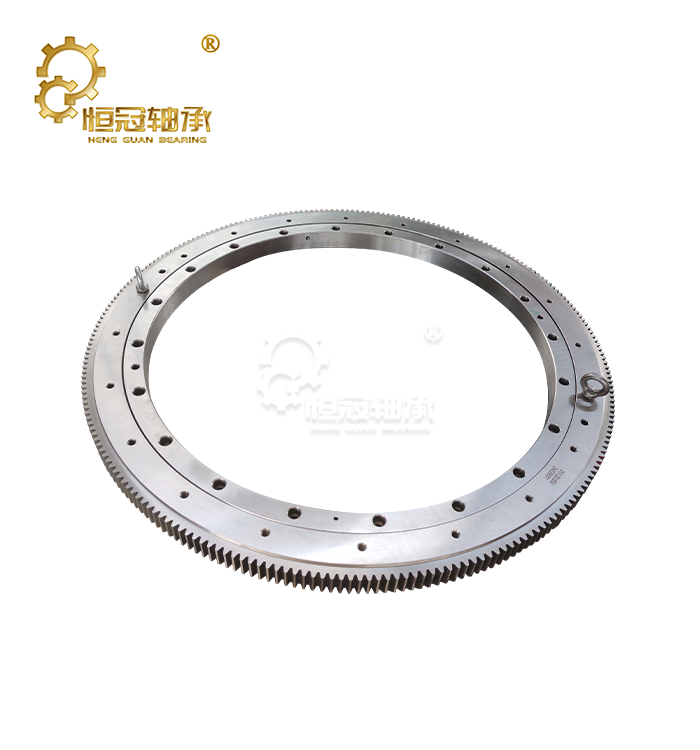
In contrast, a yaw bearing permits the nacelle and rotor assembly to spin relative to the tower. The bearing is generally part of a yaw drive system. Depending on the turbine architecture, an external gear can be machined or included in the bearing ring to convey the required driving torque.
These cases show why the bearing specification should be set in conjunction with the mechanical and control needs of the turbine.
Sealing and Environmental Protection
Seals in a slewing bearing have two main functions: retention of the lubricant and limitation of entry of impurities. A slewing bearing is lubricated in the raceways.
Inland wind turbines in dusty environments require seals that keep particles out. Resistance to moisture and exposure to salt is of particular concern in offshore locations. The correct seal material and geometry will depend on the temperature range expected, lubrication and environmental exposure, and bearing movement.
Corrosion protection for Double Row Ball Slewing Bearing can also include surface treatment, protective coatings, material selection, and suitable storage and transit techniques. These measures should be viewed as part of the bearing package rather than as distinct issues.
How to Select a Double-Row Ball Slewing Bearing for a Wind Turbine?
Start With the Complete Load Spectrum
The first step in selection should be a load analysis. Engineers normally need more information than the maximum static load because wind turbines experience changing loads during startup, normal operation, braking, shutdown, and extreme wind events.
The calculation may include:
- Axial loads
- Radial loads
- Overturning moments
- Static and dynamic load conditions
- Rotation or oscillation characteristics
- Operating temperature
- Expected service cycles
- Mounting conditions
- Emergency or peak loading conditions
The bearing manufacturer can then use these parameters to evaluate the appropriate double-row ball slewing bearing size, internal geometry, rolling-element configuration, and material selection.
Safety factors should also be established according to the application and applicable engineering requirements. Rather than applying one universal factor to every wind turbine, the design margin should reflect the actual loading conditions and consequences of bearing failure.
Check Mounting and Interface Dimensions
Even a bearing with adequate theoretical load capacity may not be suitable if its mounting interface does not match the turbine structure.
Engineers should verify the following dimensions:
- Inner and outer diameters
- Bearing height
- Bolt-hole diameter
- Bolt-hole quantity
- Pitch-circle diameter
- Mounting-face requirements
- Gear position and module
- Shaft or hub interface
- Available installation space
Mounting surfaces should be sufficiently accurate to prevent unnecessary deformation of the bearing rings after installation. Bolt tightening should also follow the specified procedure because incorrect preload can affect the load distribution within the bearing.
For OEM projects, the bearing supplier should review the interface drawings before production rather than relying solely on a standard catalog model.
Consider Internal Clearance and Operating Movement
Internal clearance should not be treated as an arbitrary specification. It affects how loads are distributed between the rolling elements and raceways.
Wind turbine pitch systems may also involve oscillating movement rather than continuous high-speed rotation. This difference matters when evaluating lubrication, wear, raceway loading, and fatigue performance.
For this reason, the supplier should understand the actual movement pattern, load cycle, speed, and operating temperature before recommending a bearing. A design that performs well in continuous rotation may require different considerations when used in low-angle oscillation.
What to Look for in a Slewing-Bearing Manufacturer?
Manufacturing and Quality Control
For a large wind turbine bearing, manufacturing capability directly affects the consistency of the final product. The supplier should have suitable equipment for ring machining, raceway processing, heat treatment, gear manufacturing, grinding, assembly, and inspection.
A professional quality system should cover raw material control, process inspection, dimensional verification, heat-treatment control, raceway inspection, gear inspection, sealing, assembly, and final testing.
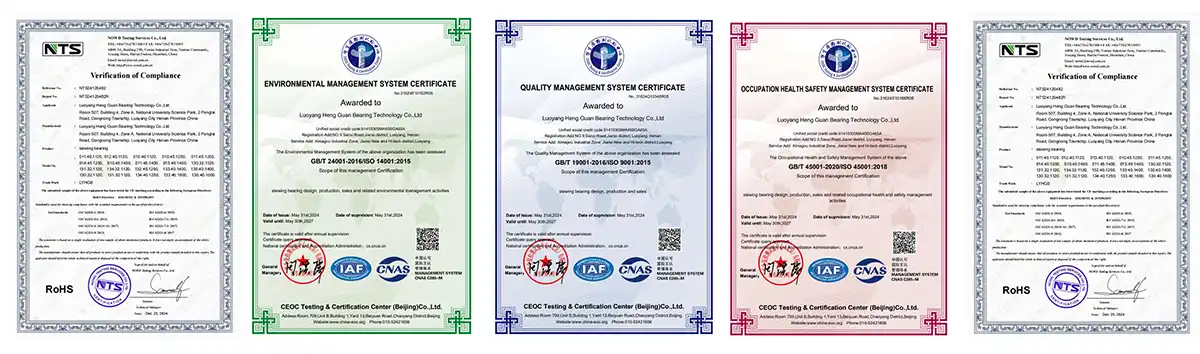
ISO 9001 certification can demonstrate that a manufacturer's quality management system follows a structured framework. However, certification should be considered alongside actual manufacturing capability and product-specific inspection procedures.
Customers should also request appropriate quality documentation, such as material certificates, dimensional inspection records, heat-treatment records, and other documents specified in the purchase contract.
OEM Customization Capabilities
Wind turbine manufacturers often work with application-specific dimensions rather than a one-size-fits-all bearing.
Customization may involve:
- Bearing diameter
- Ring thickness
- Mounting-hole pattern
- Raceway geometry
- Ball configuration
- Gear module
- Gear position
- Seal design
- Lubrication ports
- Corrosion protection
- Internal clearance
A supplier with engineering and manufacturing capabilities can review drawings and operating data before production. This is especially useful when replacing an existing bearing or developing a new turbine platform.
For replacement projects, reverse engineering can also help when original drawings are unavailable. Measurements, samples, existing interfaces, and operating information can be evaluated to develop a replacement design.
Total Cost of Ownership
The purchase price is only one part of the cost of a wind turbine bearing.
Procurement teams should consider:
- Initial bearing price
- Transportation
- Installation
- Lubrication requirements
- Inspection frequency
- Expected maintenance workload
- Replacement difficulty
- Downtime risk
- Availability of spare units
- Technical support
A lower-cost bearing may not provide the best overall value if its specification does not match the application. Conversely, a higher-priced design is not automatically better. The objective should be to select a bearing whose performance, manufacturing quality, documentation, and service support match the actual turbine requirements.

Maintenance Practices That Support Bearing Reliability
Inspect Seals, Bolts, and Raceways
Maintenance requirements for Double Row Ball Slewing Bearings should follow the bearing manufacturer's recommendations and the actual operating environment.
During routine inspections, technicians can check for:
- Damaged or displaced seals
- Grease leakage
- Contamination
- Unusual noise
- Abnormal vibration
- Mounting-bolt loosening
- Gear tooth damage
- Raceway damage
- Corrosion
- Abnormal temperature
Inspection intervals should be adjusted according to turbine design, operating hours, environmental exposure, and previous inspection results. A coastal or offshore installation may require closer attention to corrosion and sealing than a protected inland installation.
Manage Lubrication Correctly
Lubrication reduces direct metal-to-metal contact between the rolling elements and raceways and helps control friction and wear.
The grease must be compatible with the bearing, sealing materials, temperature range, and operating conditions. Different greases should not automatically be mixed simply because they have similar appearances or base oil characteristics. Compatibility should be confirmed before changing lubricant types.
Relubrication intervals should also be based on the bearing manufacturer's instructions and actual operating conditions rather than applying a universal hour-based schedule.
When grease is added, technicians should follow the designated lubrication points and procedures. For bearings with oscillating movement, lubricant distribution can be more challenging than in continuously rotating applications, so maintenance personnel should pay attention to the actual movement pattern and raceway condition.
Monitor Early Signs of Failure
Common warning signs include increasing vibration, abnormal noise, temperature changes, lubricant contamination, leakage, excessive backlash, and visible gear wear.
Brinelling or raceway indentation can occur when bearings are subjected to excessive static loads, shock loads, or vibration. Corrosion can develop when moisture reaches unprotected surfaces. Raceway fatigue may appear after prolonged cyclic loading.
Condition monitoring can provide additional information. Depending on the turbine monitoring system, vibration, temperature, torque, and other operating parameters can be tracked over time. A trend-based approach is often more useful than reacting only after a visible failure occurs.
Future Development of Slewing Bearings for Wind Energy
Materials and Surface Engineering
As turbine capacity increases, bearing materials and heat-treatment processes continue to receive attention. Raceway fatigue resistance, toughness, dimensional stability, and corrosion resistance are important considerations for large bearings.
Surface treatments and coatings may also be used for specific applications. Nitriding, carburizing, and other treatments can modify surface properties when the process is appropriate for the selected material and component design.
For offshore applications, corrosion protection deserves particular attention because salt and moisture can affect exposed bearing surfaces, gears, fasteners, and adjacent structures.
Condition Monitoring and Predictive Maintenance
Digital monitoring is becoming increasingly relevant to large rotating equipment. Sensors can collect information such as temperature and vibration, while turbine control systems can provide operating data that help engineers identify changes in bearing behavior.
The value of this approach comes from comparing current data with historical operating conditions. A gradual increase in vibration or temperature may indicate that a bearing requires inspection before the problem becomes more severe.
For OEMs and wind farm operators, integrating bearing condition data with the turbine's existing monitoring system can help improve maintenance planning and reduce unnecessary inspections.
Bearings for Larger Turbine Platforms
Wind turbines continue to move toward higher-rated capacities and larger rotor diameters. As turbine dimensions increase, bearing designers face higher loads and greater requirements for structural stiffness, fatigue resistance, sealing, and manufacturing accuracy.
Future designs are likely to focus on optimizing raceway geometry, rolling-element configuration, gear integration, materials, and manufacturing processes.
Finite element analysis and other engineering tools can be used during development to evaluate stress distribution and deformation before a prototype is manufactured. For customized wind turbine bearings, combining engineering simulation with manufacturing and inspection experience can help reduce design risks.
Conclusion
Double row ball slewing bearing units are important parts for wind turbines that work reliably in a wide range of circumstances. They are more stable, better at distributing load, and easier to maintain, all of which make operations more efficient and save money. As wind energy continues to grow as a source of power around the world, bearing technology will change to keep up with higher performance standards while keeping the dependability that users need. When choosing the right bearing, you need to carefully think about the load requirements, the skills of the provider, and the long-term maintenance strategies. These are all choices that will have a big effect on the performance of the turbine and the project's costs for decades to come.
|
|
FAQ
1. What is the typical lifespan of a Double Row Ball Slewing Bearing in wind turbines?
If you keep these bearings in good shape and use them in the right way, they should last between 80,000 and 100,000 hours in wind turbine service. The actual length depends on how much load is put on it, the surroundings, and how well it is maintained. Offshore installations in acidic environments may not last as long as installations in inland areas, but the environment is less affected if the right seals are used and upkeep procedures are followed.
2. How do double-row bearings compare to single-row designs?
When it comes to load capacity, double-row layouts are about 40% better than single-row configurations of the same size. The dual track design also makes them 35% better at keeping things from turning over, which makes them better for uses with big moment loads. Single-row bearings work well in light-duty situations where room is limited, and the load needs to be kept modest.
3. Can existing turbines be retrofitted with upgraded bearings?
It is possible to improve the performance of older turbine ships by modifying them. We offer full reverse-engineering services that let us make better replacement bearings that fit current mounting connections and use better materials or seal designs. This method increases the working life of the engine without making major structural changes.
Partner with a Trusted Double Row Ball Slewing Bearing Supplier
Heng Guan provides slewing bearing solutions for industrial and wind energy applications, with engineering support for both standard and customized designs. Our manufacturing process includes CNC machining, heat treatment, gear processing, grinding, assembly, and dimensional inspection.
For OEM projects, we can evaluate bearing dimensions, load requirements, mounting interfaces, gear specifications, sealing requirements, and environmental conditions before production. This engineering approach helps customers select a bearing based on the actual application rather than relying only on a standard catalog size.
When requesting a quotation for a Double Row Ball Slewing Bearing, providing the following information can help accelerate technical evaluation:
- Inner and outer diameter requirements
- Bearing height
- Axial load
- Radial load
- Overturning moment
- Rotation or oscillation conditions
- Mounting-hole dimensions
- Gear requirements
- Operating temperature
- Environmental conditions
- Lubrication requirements
Existing bearing drawings or samples, for replacement projects
With these details, the manufacturer can assess the application and recommend a suitable Double Row Ball Slewing Bearing configuration.For wind turbine OEMs, component manufacturers, and replacement-bearing buyers, working directly with an experienced slewing bearing manufacturer can also simplify technical communication, customization, quality documentation, and production coordination. Email our team at mia@hgb-bearing.com to talk about your wind turbine bearing needs and find out how our custom method can help your project succeed.
References
1. Harris, T.A. and Kotzalas, M.N. (2006). Advanced Concepts of Bearing Technology: Rolling Bearing Analysis, Fifth Edition. CRC Press, Boca Raton.
2. Burton, T., Jenkins, N., Sharpe, D., and Bossanyi, E. (2011). Wind Energy Handbook, Second Edition. John Wiley & Sons, Chichester.
3. Schaeffler Technologies AG & Co. (2019). Large Size Rolling Bearings for Wind Turbines: Design, Calculation and Service Life. Technical White Paper, Herzogenaurach.
4. American Wind Energy Association (2021). Wind Turbine Component Reliability: Best Practices for Operations and Maintenance. AWEA Standards and Practices Committee Report.
5. ISO 76:2006. Rolling bearings — Static load ratings. International Organization for Standardization, Geneva.
6. Germanischer Lloyd Industrial Services GmbH (2010). Guideline for the Certification of Wind Turbines: Section on Rotating Components and Bearing Systems. Hamburg, Germany.

WHAT OUR CUSTOMERS SAY
Here is the customer's evaluation of us
_1769754972666.webp)