




Single row ball slewing ring internal gear Manufacturer Guide
Choosing the wrong internal gear slewing ring is a costly mistake. Many buyers run into the same problems: bearings whose gear teeth wear out early, units that do not fit the drive layout and have to be reworked, and suppliers who cannot show material records or answer technical questions. Choosing the right single-row ball slewing ring internal gear is easier when you understand how it works, where it performs best, and who can build it well. At Heng Guan Bearing, we design and manufacture slewing bearings for customers around the world, including compact internal gear types for demanding machinery. This guide explains the working principle, key structural features, typical applications, and the points to check when selecting a manufacturer. Whether you are comparing a rollix internal gear slewing bearing with other options or starting a new design, read on for practical, easy-to-use advice.
How Does a Single Row Ball Slewing Ring with Internal Gear Work?
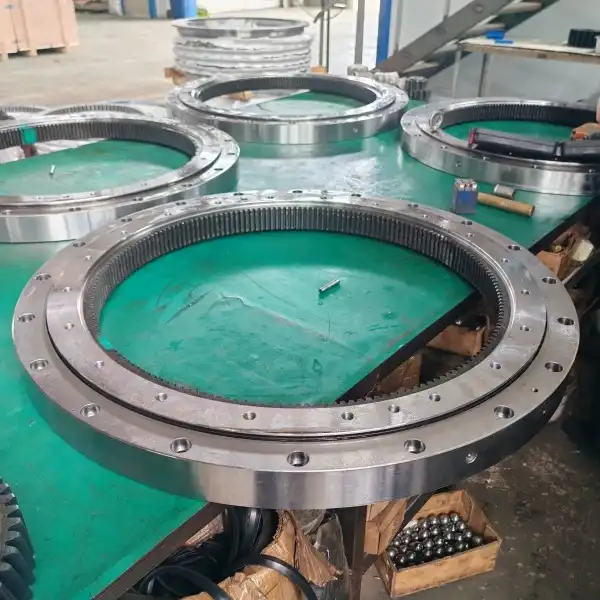
A single row ball slewing ring internal gear consists of two rings, with one row of steel balls running in precisely ground raceways between them. The balls make four-point contact with the raceways, so a single row can carry axial load, radial load, and tilting moment at the same time. The teeth are cut on the inner ring, which means the drive pinion sits inside the bearing and the gear is shielded by the outer ring. This compact layout saves space and protects the transmission. When engineers compare a rollix internal gear slewing bearing with other slewing bearing designs, they usually look at this same principle. Heng Guan Bearing machines each ring and gear carefully so rotation stays smooth and dependable.
| Component | Function |
|---|---|
| Outer ring | Carries the mounting flange and shields the internal gear |
| Inner ring with teeth | Meshes with the drive pinion inside the bearing |
| Row of steel balls | Four-point contact carries axial, radial, and moment loads |
| Spacers and seals | Keep balls apart, retain grease and block contamination |
Key Structural Features and Performance Advantages of Internal Gear Slewing Bearings
Internal gear slewing bearings offer a neat combination of strength, compactness and easy drive integration. In a single row ball slewing ring internal gear, the hardened raceways resist wear, while the four-point contact design delivers solid load capacity in a lightweight body. The enclosed gear is less exposed to dust and impact, which supports steady transmission. Our accuracy grades of P0, P6, P5 and P4 let you match precision to your equipment, and Heng Guan Bearing can customize dimensions, teeth, and mounting holes. Many buyers who study a rollix internal gear slewing bearing find similar benefits here. The table below summarizes the main strengths of this slewing bearing.
| Feature | Advantage |
|---|---|
| Four-point contact balls | Combined axial, radial and moment capacity |
| Internal gear on inner ring | Compact drive and protected teeth |
| Hardened raceways | Longer service life |
| Custom design options | Better fit for each machine |
The quality of the manufacturing process is what determines how long these benefits will continue to be effective in the field. The rings that we produce are forged from either 42CrMo or 50Mn alloy steel, depending on the requirement. In order to establish a balance between core toughness and wear resistance, the raceways are mechanically hardened by the process of CNC quenching, and the gear teeth are hardened using the process of induction hardening. The most significant pieces of technical information are compiled in the following list. If your machine needs a different module, tooth count or mounting pattern, send your drawings to mia@hgb-bearing.com, and our engineers will confirm the design with you.
| Parameter | Range / Value |
|---|---|
| Structure | Single-row four-point contact ball, internal gear |
| Diameter Range | 50 mm – 10,000 mm |
| Precision Grades | P0, P6, P5, P4 |
| Ring Material | 42CrMo, 50Mn forged alloy steel |
| Raceway Hardness | 55–62 HRC |
| Gear Tooth Hardness | HRC 45–50 (induction hardened) |
| Operating Temperature | -30°C to +80°C (standard) |
| Gear Options | Internal / external / no gear |
| Load Capacity | Custom calculated per design |
As a typical example, the table below shows the light-series internal gear slewing ring RKS.22.0641.
| Parameter | Value |
|---|---|
| Mean Raceway Diameter | 641 mm |
| Outside Diameter | 748 mm |
| Inside Diameter | 546 mm |
| Height | 56 mm ±1 mm |
| Ball Diameter | 20 mm |
| Gear Module / Teeth | m = 6 / z = 93, 20° pressure angle |
| Weight | 48 kg |
Which Applications Benefit Most from Single Row Ball Slewing Ring Internal Gear Designs?
Because the structure is compact and the gear is protected, a single row ball slewing ring internal gear suits equipment with limited space and a need for steady rotation. Typical uses include cranes, aerial work platforms, port and handling machinery, construction equipment, wind power systems, medical devices, and automation platforms. Mining and metallurgy settings also benefit when the enclosed gear helps resist contamination. Customers who normally source a rollix internal gear slewing bearing often ask us for similar solutions across these industries. Heng Guan Bearing supplies slewing bearings to new energy, lifting, port, environmental protection, and aerospace fields, and we adapt each design to its working conditions. Tell us how your machine rotates, and we will help you find the right fit.
| Industry | Typical Use |
|---|---|
| Cranes and lifting | Slewing of booms and platforms |
| Aerial work platforms | Compact, center-drive rotation |
| Port and handling machinery | Rotation under frequent starts and stops |
| Wind power and new energy | Yaw and positioning systems |
| Medical and automation | Quiet, precise rotary stages |
What Should Buyers Check When Choosing a Single Row Ball Slewing Ring Internal Gear Manufacturer?
A dependable manufacturer should show clear technical ability, quality control, and responsive service. Review drawings, material and heat treatment records, inspection reports and quality certificates, and confirm the accuracy grade you need. Ask whether the supplier can customize dimensions, gear parameters, and mounting details for your single row ball slewing ring internal gear. Heng Guan Bearing holds ISO 9001 certification, with CE and RoHS compliance, and backs each order with material traceability and inspection records. Comparing offers against a rollix internal gear slewing bearing specification can also help you set clear requirements. If you would like a second opinion, our team is glad to review your drawings and compare options with you. The checklist below can guide your evaluation of any slewing bearing supplier.
| Check Item | What to Confirm |
|---|---|
| Design ability | Custom drawings and gear data |
| Quality records | Material and inspection reports |
| Accuracy options | P0, P6, P5 or P4 |
| Service | Technical support and delivery time |
Conclusion
A single row ball slewing ring internal gear offers compact, protected, and reliable rotation for many industries, combining four-point contact load capacity with an enclosed drive layout that saves space and shields the teeth from dust and impact. By checking design ability, material and heat treatment records, accuracy grades, and after-sales service, buyers can choose with confidence and avoid costly rework, premature gear wear and unexpected downtime. Matching the right precision grade and mounting details for a slewing bearing to your machine from the start keeps rotation smooth and transmission steady over a long service life. Heng Guan Bearing is ready to support your project with customized designs, full inspection documentation, and practical engineering advice, from initial selection through drawing review, so your equipment keeps running efficiently, and your investment stays protected.
FAQ
Where is the gear located?
The teeth are on the inner ring. This places the drive pinion inside the bearing, so the gear is shielded by the outer ring, saving space and protecting the transmission from dust and impact.
What loads can it carry?
Axial, radial, and tilting moment loads together. The four-point contact ball design lets a single row carry combined loads, giving solid capacity in a compact, lightweight body.
Which accuracy grades are available?
Heng Guan Bearing offers P0, P6, P5, and P4. Higher grades such as P5 and P4 suit precision equipment needing tighter tolerances, while P0 and P6 cover most standard heavy-duty applications.
Can it be customized?
Yes. Dimensions, gear details, and mounting holes can be adapted to your drawings. Our engineers confirm the module, tooth count, and mounting pattern, and can reverse engineer from a sample if drawings are unavailable.
Which industries use it?
Cranes, wind power, ports, medical and automation equipment. The compact, protected internal gear layout also suits aerial work platforms, construction machinery, mining and metallurgy settings where contamination resistance matters.
Need an Internal Gear Slewing Bearing?
Choose Heng Guan Bearing for quality, customized slewing bearing solutions and professional service:
- Slewing bearings from 50 mm to 10,000 mm, P0 to P4 precision. Our range covers standard and custom designs, so you can source a single bearing or a complete project set from one certified supplier with consistent quality
- ISO 9001 certified production with custom sizing and material options. Every order is backed by traceable materials, documented heat treatment and inspection reports, giving purchasing and engineering teams confidence from quotation through delivery
- Engineering team available for selection, drawing review, and installation guidance. Share your drawings and requirements with our team, and we will reply with a clear proposal, helping your equipment rotate smoothly for years
Send your drawings and requirements to mia@hgb-bearing.com, and our team will reply with a clear proposal. Let us help your equipment rotate smoothly for years.
References
1. Harris, T. A., & Kotzalas, M. N. (2006). Essential Concepts of Bearing Technology. CRC Press.
2. Harris, T. A. (2001). Rolling Bearing Analysis. Wiley.
3. Hamrock, B. J., Schmid, S. R., & Jacobson, B. O. (2004). Fundamentals of Machine Elements. McGraw-Hill.
4. ISO 281:2007. Rolling Bearings: Dynamic Load Ratings and Rating Life. International Organization for Standardization.
5. Budynas, R. G., & Nisbett, J. K. (2020). Shigley’s Mechanical Engineering Design. McGraw-Hill.
6. Norton, R. L. (2013). Machine Design: An Integrated Approach. Pearson.

WHAT OUR CUSTOMERS SAY
Here is the customer's evaluation of us