




Why Is 013.75.3550 Slewing Bearing Used in Large Machinery?
Large machines need parts that can spin easily while supporting massive combined loads, and that’s what the 013.75.3550 Slewing Bearing is designed for. This bearing size meets the load capacity, accuracy, and durability needed for heavy equipment manufacturers, from port cranes to mining excavators. This guide is compiled by Heng Guan Bearing, a manufacturer at the specialized bearing processing base in Luoyang, to explain why this bearing is ideal for demanding applications, how it is constructed, and where it is best suited. If you’re specifying a slewing bearing for a big machine, this breakdown should help you understand why this part number continues cropping up in heavy-duty designs.
What Makes the 013.75.3550 Slewing Bearing Suitable for Heavy Loads?
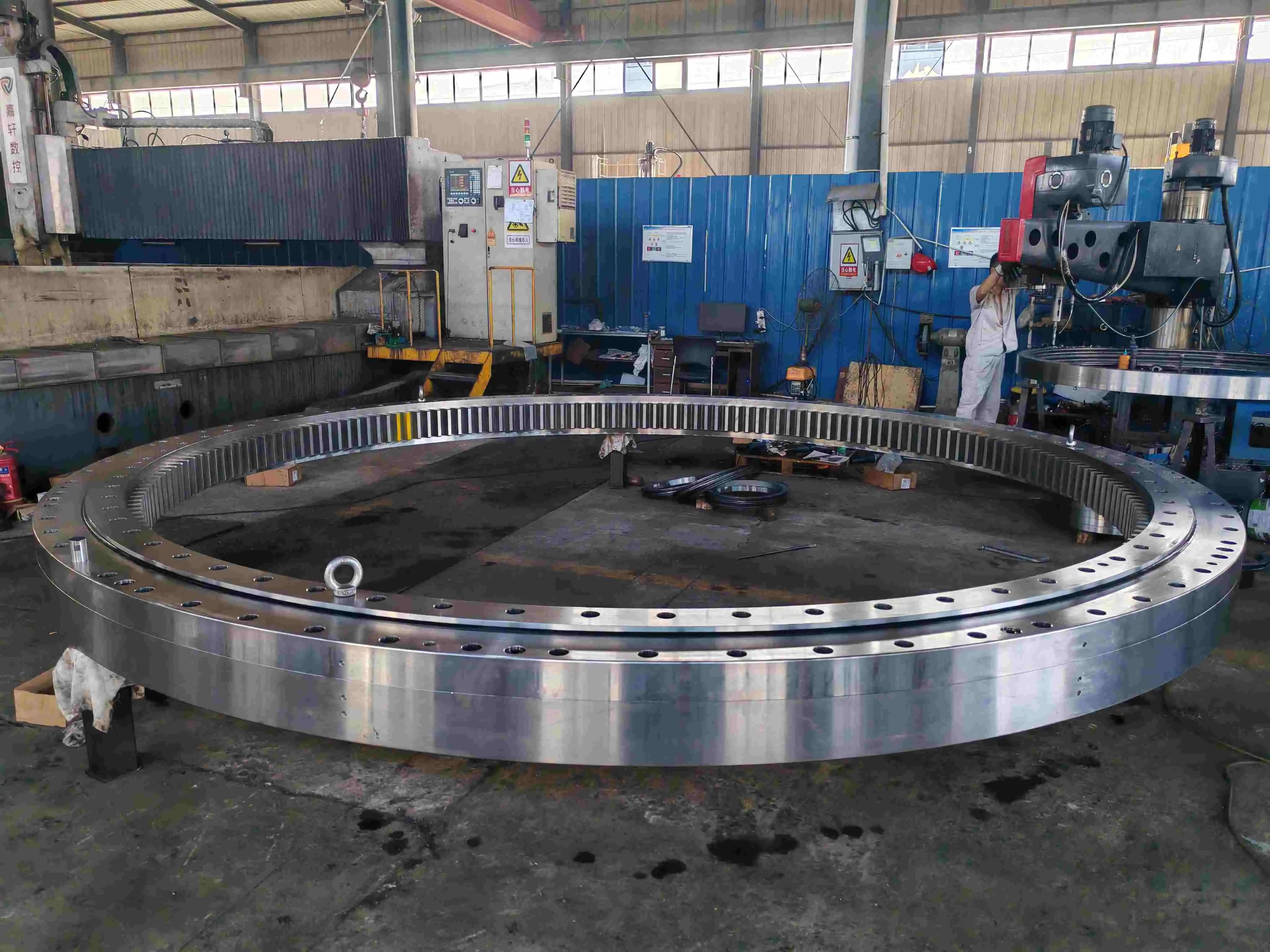
Size alone does not determine heavy load capability. It is the raceway shape, material treatment, and the distribution of contact stress among rolling elements that do. The 013.75.3550 Slewing Bearing is designed with a heavy-duty ring construction with reinforced raceways to withstand the combined axial, radial, and moment stresses common for large rotating platforms.
This item is often listed as a 013.75.3550 internal gear bearing, and torque transmission occurs via an internally cut gear ring, protecting the driving pinion within the housing rather than being exposed to debris and damage. This is very important on work sites where dust, wetness, and shock loading are ever-present facts of life.
If you are considering severe load applications, you also need to inquire about hardness depth and core toughness, since a bearing that appears the same on paper might perform quite differently under continuous cyclic stress.
| Load Factor | Design Response |
|---|---|
| Axial Load | Reinforced raceway contact angle |
| Radial Load | Thick-section ring geometry |
| Moment Load | Wide raceway spacing |
| Shock Loading | Surface-hardened, tough core |
013.75.3550 Slewing Bearing Dimensions, Load Capacity, and Design
Dimensional accuracy is where many replacement or new-build projects succeed or fail, so it pays to review the design details closely before ordering. A 013.75.3550 Slewing Bearing in this size class typically measures 3,776 mm outer diameter, 3,322 mm inner bore, and 174 mm section height, with a raceway center diameter of 3,550 mm and 75 mm diameter steel balls distributed through the four-point contact ball structure. If drawings are not available, our engineering team can be reached directly at mia@hgb-bearing.com to confirm dimensional data against your equipment model.
As a manufacturer producing diameters from 50 mm up to 10,000 mm across P0, P6, P5, and P4 accuracy grades, HGB can also supply this bearing as a custom internal gear slewing bearing, adjusting gear module, tooth count, and mounting hole pattern to match non-standard machinery. This flexibility is particularly valuable for buyers working with older equipment or imported machines where original specifications are hard to trace.
The internal gear cut on this bearing uses module 20 with 162 teeth, a +0.5 profile shift, 20° pressure angle, and a tip diameter of 3,220 mm, machined to DIN 8 / AGMA equivalent accuracy with surface hardness of 55–62 HRC and a hardened case depth of at least 3.5 mm. Rated capacities reach 26,900 kN static axial, 19,500 kN static radial, and 18,200 kN·m overturning moment, with a maximum rotational speed of 25 rpm.
How Does the 013.75.3550 Slewing Bearing Support Large Machinery?
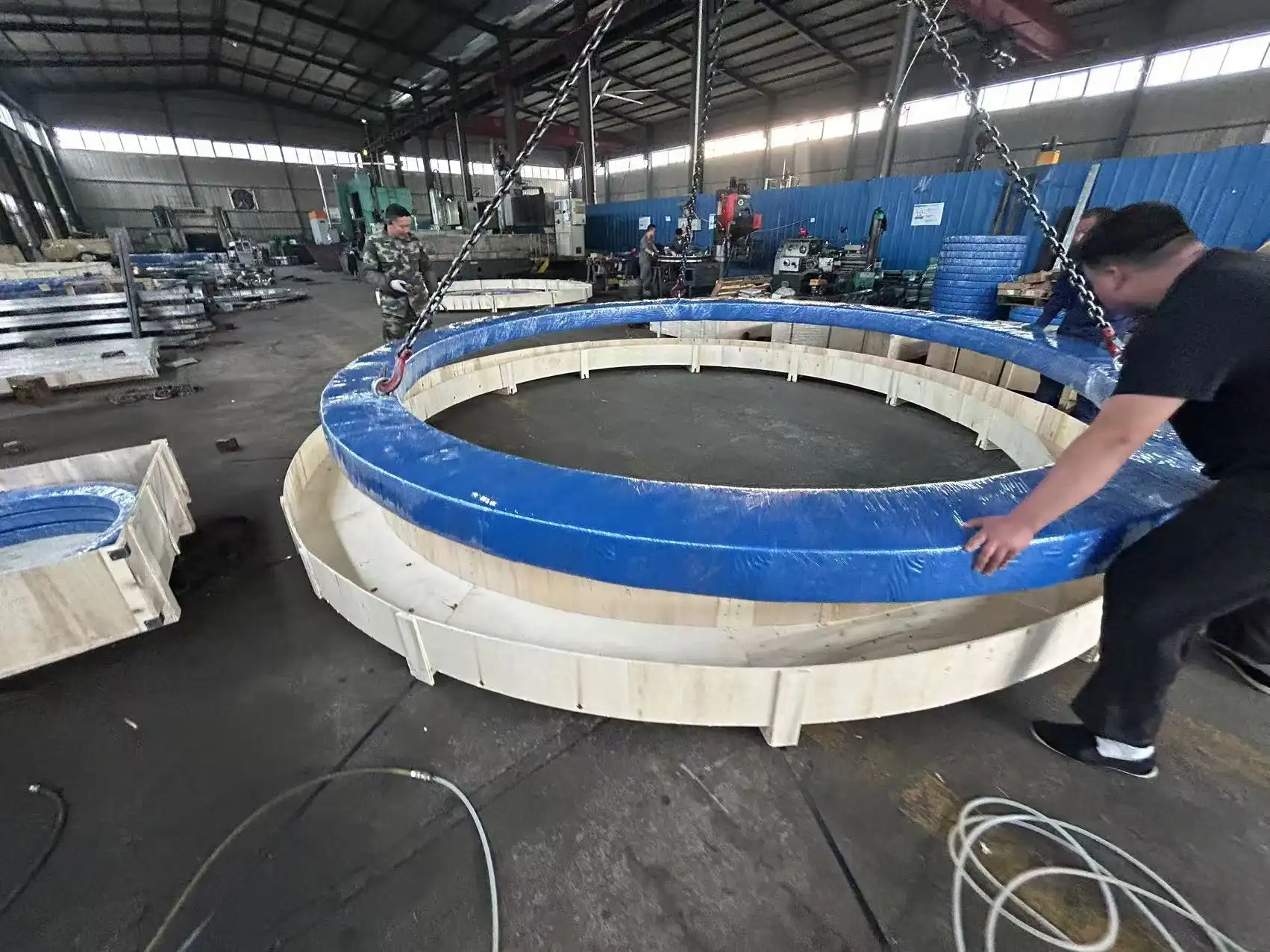
This puts extraordinary demands on large equipment. A rotating bearing has to carry the whole weight of an upper structure and enable flawless 360-degree rotation under unequal, changing loads. This is achieved by a combination of raceway design and gear engagement, providing a steady rotation when load direction varies during operation with the 013.75.3550 Slewing Bearing. Also, the bearing tends to operate quietly and is better shielded from contamination with an internal gear than with an external gear, a significant benefit in mining, port, and construction sites.
If you are considering bearing alternatives for a big machine, it pays to go beyond the part number and consider how the bearing will perform during thousands of rotation cycles under actual operating circumstances, not simply static load ratings on a spec sheet.
| Operating Condition | Benefit of Internal Gear Design |
|---|---|
| Dusty/Wet Environments | Gear stays enclosed and protected |
| Continuous Rotation | More consistent engagement, less wear |
| Noise Sensitivity | Quieter operation vs. exposed gear |
013.75.3550 Slewing Bearing Applications in Cranes and Excavators
This size of bearing is often found in use in cranes and excavators, two of the most popular applications. Both of these applications require rotation to rotate reliably under varying, often unexpected loads. The crane slewing bearing 013.75.3550 is normally located at the bottom of the rotating superstructure, carrying the weight of the boom and the hoisted loads and permitting regulated slewing movement. It links the top carriage to the undercarriage of excavators and manages digging forces, swing torque, and vibration at the same time across machines in the 40–80 ton class. Other applications include tunnel boring machines, small crawler cranes, and rotary drilling rigs.
Faced with such requirements, machine builders usually search for a provider that can be a bespoke internal gear slewing bearing partner, not simply a parts supplier – someone who knows the application-specific pressures and can change design features appropriately. That is why we are embracing this consultative approach as part of how we interact with equipment manufacturers, given HGB’s expertise with lifting, building, mining and port gear.
Conclusion
The 013.75.3550 Slewing Bearing combines internal gear protection, strong load capacity, and precise design for demanding machinery. Heng Guan Bearing is ready to support your next project with verified production capacity, ISO 9001-certified quality, and engineering support from drawing review through delivery — build with confidence today.
FAQ
Q1: Is the 013.75.3550 an internal or external gear bearing?
A: It is typically supplied as a 013.75.3550 internal gear bearing, with the gear ring cut on the inside of the race.
Q2: What machinery commonly uses this bearing?
A: Cranes and 40–80 ton excavators are the most common applications, along with TBMs, compact crawler cranes, and rotary drilling rigs.
Q3: Can this bearing be customized for non-standard machines?
A: Yes, HGB supplies it as a custom internal gear slewing bearing, adjusting dimensions and gear specs as needed.
Q4: What accuracy grades are available?
A: HGB manufactures across P0, P6, P5, and P4 precision grades.
Q5: What load ratings does the 013.75.3550 deliver?
A: Static axial capacity reaches 26,900 kN, static radial 19,500 kN, and overturning moment 18,200 kN·m at up to 25 rpm.
Q6: What is the typical lead time for this bearing?
A: Standard orders ship in 4–6 weeks; custom gear modifications add 2–3 weeks for tooling.
Need a 013.75.3550 Slewing Bearing for Your Machinery?
Do not let an unverified bearing slow down your build. Contact LYHGB at 013.75.3550 Slewing Bearing at mia@hgb-bearing.com for drawings, engineering support, or a custom quote — our team responds fast and helps you specify the right part the first time.
References
1. International Organization for Standardization. ISO 76:2006 — Rolling Bearings — Static Load Ratings. Geneva: ISO, 2006.
2. International Organization for Standardization. ISO 281:2007 — Rolling Bearings — Dynamic Load Ratings and Rating Life. Geneva: ISO, 2007.
3. International Organization for Standardization. ISO 1328-1:2013 — Cylindrical Gears — ISO System of Flank Tolerance Classification — Part 1: Definitions and Values of Deviations and Tolerances Relevant to Flanks of Gear Teeth. Geneva: ISO, 2013.
4. Harris, T. A., & Kotzalas, M. N. Rolling Bearing Analysis: Advanced Concepts of Bearing Technology, 5th Edition. Boca Raton: CRC Press, Taylor & Francis, 2007.
5. Brändlein, J., Eschmann, P., Hasbargen, L., & Weigand, K. Ball and Roller Bearings: Theory, Design and Application, 3rd Edition. Chichester: John Wiley & Sons, 1999.
6. International Organization for Standardization. ISO 15243:2017 — Rolling Bearings — Damage and Failures — Terms, Characteristics and Causes. Geneva: ISO, 2017.

WHAT OUR CUSTOMERS SAY
Here is the customer's evaluation of us