



Why Choose a China Wind Turbine Slewing Bearing Factory?
Selecting a Chinese wind turbine slewing bearing plant means that you have direct access to experts who understand large-diameter bearings and can reduce delivery times and costs. Located in Luoyang, the center of the bearing manufacturing industry, Luoyang Heng Guan Bearing Technology Co., Ltd. (LYHGB) produces the bearings that keep turbines facing the wind. We have units operating within onshore and offshore wind farms in over 50 nations, from Norwegian offshore installations to the Texas wind corridors, taking yaw and pitch loads from low-speed, high-altitude machines to typhoon-resistant platforms.
The key issue is not whether a China wind turbine slewing bearing manufacturer can quote a lower price, but whether that facility can retain raceway geometry on a 4-meter ring, record the heat that went into it, and still deliver within your outage window. This article outlines what to look for in a manufacturer – so read on and evaluate your alternatives with confidence.
What Makes a Wind Turbine Slewing Bearing Factory Reliable?
A dependable wind turbine slewing bearing manufacturer begins with the correct foundation: competent engineers, regulated materials, and proven field results. Heng Guan Bearing has over 20 years' experience and a 50-engineer team with CNC vertical lathes, induction quenching systems, and precision gear hobbing machines. Those assets are important because a yaw bearing is not a commodity item: the ring needs to be spun, hardened, gear cut, and measured on the same site, under the same quality system, if the final bearing is to maintain its geometry for a 20-year service life.
In our wind turbine slewing bearing series, the rings are made of 42CrMo or 50Mn alloy steel and the rolling elements are GCr15SiMn. The bearings are intended for a service life of 20 years or more, based on the IEC 61400 design standards. In addition, a yaw ring must be able to withstand the reverse bending loads that a turbine imparts to it every time it rotates into the wind. 42CrMo base rings have around 900 MPa tensile strength. Our products are already in use in more than 50 countries, from offshore wind farms to interior wind corridors. Each bearing has a batch traceability identifier with the raw material inspection certificate, so you always know where the material comes from. Next, we will observe how this quality is maintained;
| Capability Area | What to Verify | Heng Guan Bearing Position |
|---|---|---|
| Engineering depth | In-house design team and machine list | 50 engineers; CNC vertical lathes, induction quenching, gear hobbing |
| Material control | Steel grade and traceability | 42CrMo / 50Mn rings, GCr15SiMn elements, batch traceability codes |
| Process ownership | Hardening and gear cutting done in-house | Induction hardening and hobbing under one ISO 9001 system |
| Field evidence | Installed base and reference climates | 50+ countries, offshore and inland sites |
| Design basis | Life calculation standard | 20+ years per IEC 61400, confirmed by 1,000,000-cycle endurance testing |
How Do Chinese Manufacturers Ensure Bearing Quality and Precision?
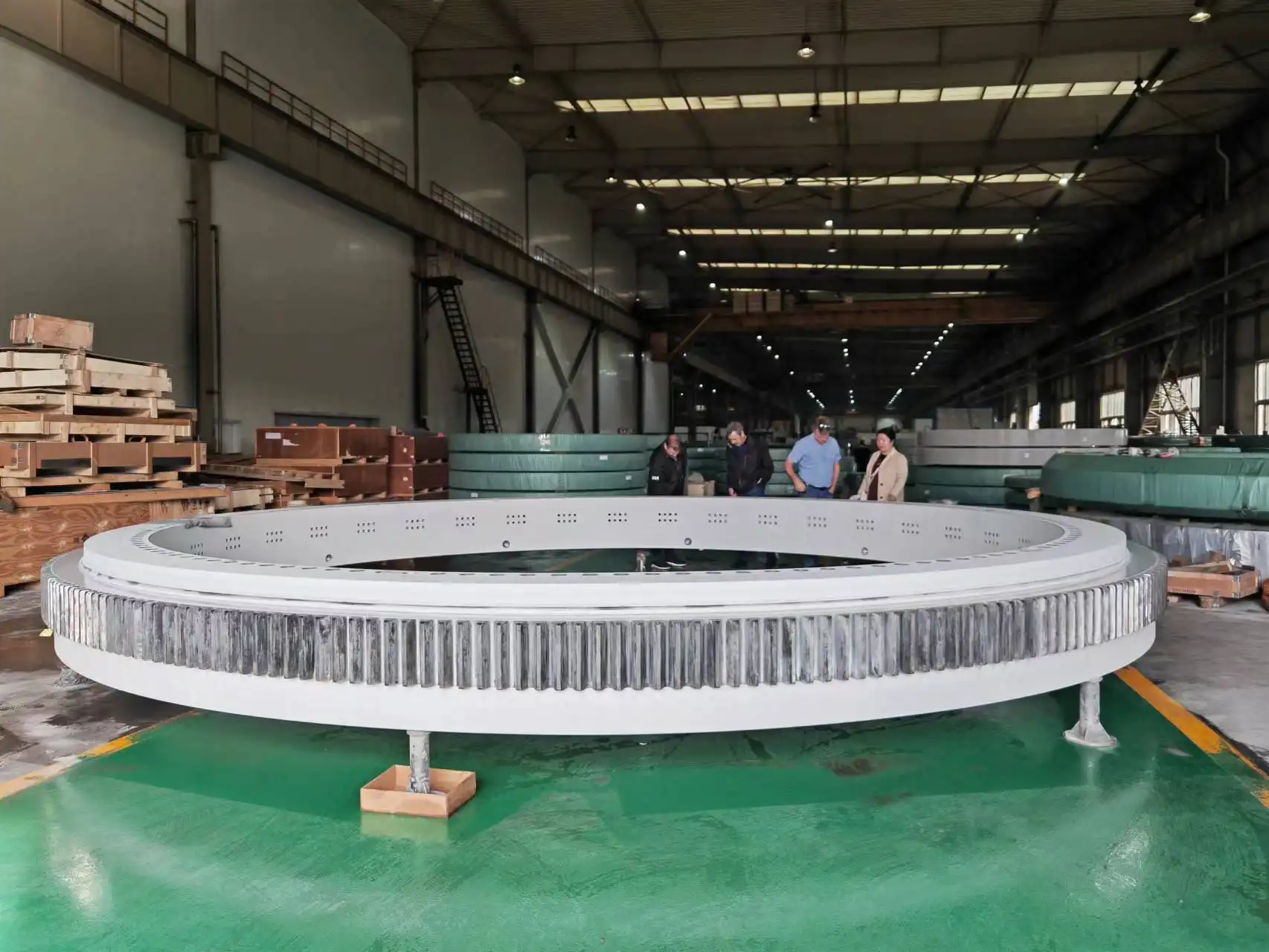
Chinese producers provide consistency and accuracy since it’s all done inside. Raceway geometry is ±0.01 mm at LYHGB, and the raceways are induction-hardened (55–62 HRC), and the rolling elements are (60–64 HRC). That coupling of hardnesses is deliberate: the raceway absorbs the contact stress while the rolling element is even harder, so wear is concentrated where it can be foreseen and controlled, rather than where it produces an abrupt failure.
Overall dimensions are verified using coordinate measuring equipment, and vibration test guaranties the rotation stability with a runout below 0.3 μm. Runout at that level is what stops a yaw drive from hunting—if the ring is wobbling, the drive motor is fighting geometry rather than the load, and the pitch actuators pick up a vibration signature that finally shows up as blade-root wear. You may choose the precision you need, with each wind turbine slewing bearing available in P0, P6, P5, or P4 precision grades, matching the accuracy to your turbine design: P0 and P6 are suitable for most onshore yaw jobs, while P5 and P4 are worth specifying for pitch systems where positioning repeatability drives power production. Long-term performance is also further validated by endurance testing of over a million cycles. Here are some of the primary process controls you can expect:
| Process | Control | Why It Matters |
|---|---|---|
| Raceway grinding | Geometry within ±0.01 mm | Uniform contact ellipse, even load sharing |
| Induction hardening | Raceway 55–62 HRC | Wear resistance under oscillating load |
| Rolling element treatment | 60–64 HRC | Predictable wear location, extended life |
| Precision grades | P0, P6, P5, P4 | Accuracy matched to yaw or pitch duty |
| Vibration testing | Runout below 0.3 μm | Stable rotation, no drive hunting |
| Endurance testing | Over 1,000,000 cycles | Confirms 20-year design life assumption |
| Temperature capability | -40°C to +120°C | Polar winters through desert summers |
Custom Wind Turbine Slewing Bearing Solutions for Yaw and Pitch Systems
Each turbine platform is distinct; hence, the design is bespoke. Heng Guan Bearing provides single-row four-point contact ball bearings for yaw systems, double-row ball bearings for improved load distribution, and triple-row roller bearings for high-duty offshore applications. Pitch and yaw units may also be provided as a package, which ensures uniform gear shape and bolt patterns across the machine, making installation planning easier.
Inner diameters range from 1,500 mm to 5,000 mm, exterior diameters from 1,800 mm to 5,500 mm, and heights from 100 mm to 400 mm, with gear modules from M16 to M40 in external, internal, or gearless versions. The axial load capacity is up to 3,000 kN, and the radial load capacity is up to 2,000 kN, sufficient to accommodate the overturning moments experienced by most multi-megawatt platforms at the tower top. Low-temperature and sensor-integrated versions are offered with corrosion-resistant properties, and offshore versions may be supplied with electroless nickel plating and superior sealing for salt-spray situations. If you are replacing an older device that doesn’t have 3D designs, our experts can reverse engineer it based on your mounting information. Email your requirements to mia@hgb-bearing.com, and we will recommend a suitable wind turbine slewing bearing for your yaw or pitch system. The table below gives the full specification set.
| Parameter | Specification |
|---|---|
| Bearing type | Single-row 4-point contact / double-row ball / triple-row roller |
| Inner diameter range | 1,500 mm – 5,000 mm |
| Outer diameter range | 1,800 mm – 5,500 mm |
| Height range | 100 mm – 400 mm |
| Gear module | M16 – M40 (external / internal / no gear) |
| Base material | 42CrMo, 50Mn alloy steel |
| Rolling element material | GCr15SiMn high-carbon chromium steel |
| Hardness | Raceway 55–62 HRC / rolling elements 60–64 HRC |
| Seal type | Nitrile rubber (NBR) or fluororubber (FKM) |
| Operating temperature | -40°C to +120°C |
| Design life | 20+ years per IEC 61400 standards |
| Load capacity | Axial up to 3,000 kN / radial up to 2,000 kN |
| Precision grade | P0, P6, P5, P4 available |
| Special versions | Corrosion-resistant, low-temperature, sensor-integrated |
Which Quality Certifications and Tests Should Buyers Check?
Ask to see the credentials and test documents behind your wind turbine slewing bearing when you order. Our goods are RoHS compliant and ISO 9001 certified. Every bearing is subjected to spectrum analysis, ultrasonic testing, coordinate measurement, hardness testing, and tooth profile inspection. Spectral analysis checks the steel grade before a single chip is cut; ultrasonic testing detects internal impurities in the forging; hardness testing indicates the heat treatment truly achieved the necessary case depth all around, not just at one handy point.
For offshore projects, we additionally conduct 1000-hour salt spray testing and issue material certifications with Charpy impact values to demonstrate the performance of the steel at the lower end of the temperature range, not simply at room temperature. Standard modifications typically take 8-10 weeks, and fully custom designs take 12-16 weeks after drawing approval. Schedule the outage window to the longer of the two figures, not the shorter, so the wind turbine slewing bearing is on the quay before your vessel slot opens, not two weeks after it closes. Heng Guan Bearing provides inspection records along with every shipment, so your quality team may verify the facts. The important checks are shown in the table below.
| Test | Purpose | Acceptance Focus |
|---|---|---|
| Spectral analysis | Confirms material grade | Chemistry within 42CrMo / 50Mn specification |
| Ultrasonic testing | Detects internal defects | No reportable inclusions in ring forging |
| CMM measurement | Verifies dimensions | Geometry within drawing tolerances |
| Surface hardness testing | Confirms heat treatment | 55–62 HRC raceway, correct case depth |
| Tooth profile inspection | Ensures clean gear meshing | Backlash 0.2–0.4 mm for M20+ modules |
| Salt spray (1,000 h) | Proves corrosion resistance | No base-metal corrosion on treated surfaces |
| Charpy impact values | Confirms low-temperature toughness | Values reported on material certificate |
Conclusion
A reliable China wind turbine slewing bearing manufacturer provides regulated material, accurate production, flexible customization and verifiable certification. Analyzing each of these factors protects turbine uptime and reduces lifetime costs — a yaw bearing that arrives on schedule, meshes smoothly, and retains its shape for two decades costs significantly less than the offshore vessel call you prevent. Ask for the process data, ask for the material certificate, and ask who measured the raceway and the distance between a quote and a real wind turbine slewing bearing partner rapidly becomes apparent. Heng Guan Bearing is prepared to be your long-term partner.
FAQ
Q: What size range do your wind turbine bearings cover?
A: Inner diameters of 1,500–5,000 mm and outer diameters of 1,800–5,500 mm, with heights from 100 mm to 400 mm.
Q: Which bearing structures are available?
A: Single-row four-point contact ball, double-row ball, and triple-row roller designs.
Q: What is the expected service life?
A: Designed for 20+ years under IEC 61400 standards, confirmed by endurance testing beyond 1,000,000 cycles.
Q: Can you supply bearings for offshore turbines?
A: Yes, with corrosion protection, quality seals, electroless nickel plating, and 1,000-hour salt spray testing.
Q: How long does custom production take?
A: Standard modifications take 8–10 weeks; fully custom designs take 12–16 weeks after drawing approval.
Start Your Wind Turbine Slewing Bearing Project Today
Contact Heng Guan wind turbine slewing bearing at mia@hgb-bearing.com with your drawings, dimensions, or application details. Our engineers will review your needs, provide load calculations, and send a tailored quote promptly. Let us power your next wind project together.
References
1. International Electrotechnical Commission. IEC 61400-1: Wind Energy Generation Systems – Design Requirements.
2. International Organization for Standardization. ISO 281: Rolling Bearings – Dynamic Load Ratings and Rating Life.
3. Harris, T. A., & Kotzalas, M. N. Rolling Bearing Analysis. CRC Press.
4. Burton, T., Jenkins, N., Sharpe, D., & Bossanyi, E. Wind Energy Handbook. Wiley, 2011.
5. Manwell, J. F., McGowan, J. G., & Rogers, A. L. Wind Energy Explained: Theory, Design and Application. Wiley.
6. Hau, E. Wind Turbines: Fundamentals, Technologies, Application, Economics. Springer.

WHAT OUR CUSTOMERS SAY
Here is the customer's evaluation of us