




Which Slewing Ring Type Best Fits Your Application?
Selecting the right slewing ring is one of the most important decisions in any rotating machine design, because the bearing carries load, guides rotation, and keeps the whole structure stable. Choose a ring that is too light, and you face early wear, unplanned downtime, and costly replacements. Choose a slewing ring that does not match your drive or mounting layout, and the delay shows up on the assembly line. At Heng Guan Bearing, we help engineers compare structures, accuracy grades, and mounting options so the final choice fits real working conditions. Whether you need a standard unit or a China stacker slewing bearing for material handling, this guide explains the main options step by step. Keep reading to find the design that suits your project.
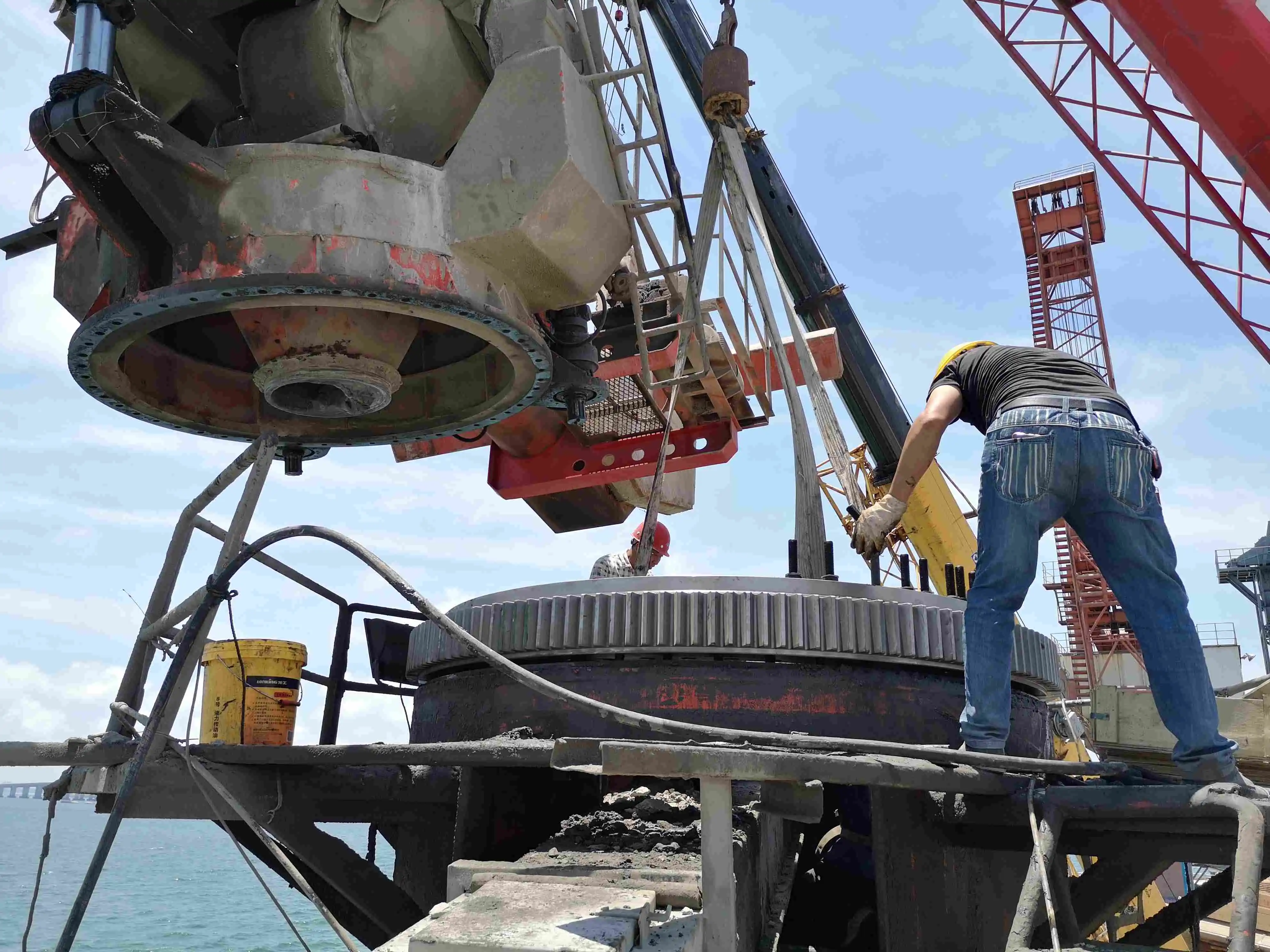
What Are the Main Types of Slewing Ring Bearings?
A slewing ring is a huge bearing that is used to allow one section of a machine to revolve smoothly against another, while carrying high combined loads. HGB Bearing manufactures sizes from 50 mm to 10,000 mm in four accuracy classes: P0, P6, P5, and P4. The rings are constructed from 42CrMo or 50Mn alloy steel, while the rolling elements are made from GCr15SiMn high-purity bearing steel, which can carry axial, radial, and moment stresses simultaneously.
Common configurations include single-row four-point contact ball, double-row ball, cross cylindrical roller, three-row cylindrical roller, ball and roller combination, thin-wall flange, and big thrust ball designs. Each one has a distinct duty level. China stacker slewing bearing is often used in port and warehouse equipment with requirements for small size and reliable rotation. So how do these designs perform in practice?
| Configuration | Primary Load Characteristic | Typical Application |
|---|---|---|
| Single row four-point contact ball | Balanced axial, radial, and moment loads in a compact envelope | Medical equipment, automation tables, light machinery |
| Single row cross cylindrical roller | High rigidity and precise rotation | Cranes, mining equipment, turntables |
| Double row ball | Higher radial and axial capacity with smooth turning | Excavators, tower cranes, aerial work platforms |
| Three-row cylindrical roller | Very high moment and axial capacity; maximum rigidity | Port machinery, wind power, heavy gantry systems |
| Ball and roller combination | Mixed capacity for medium-to-heavy duty | Stackers, reclaimers, industrial rotating platforms |
Technical Specifications
| Parameter | Specification |
|---|---|
| Diameter Range | 50 mm – 10,000 mm |
| Precision Grades | P0, P6, P5, P4 |
| Base Material | 42CrMo, 50Mn special alloy steels |
| Rolling Elements | GCr15SiMn high-purity bearing steel |
| Raceway Hardness | Induction hardened, HRC 55–60, depth 2.5–5 mm |
| Gear Teeth Hardness | Induction hardened, HRC 45–50 |
| Load Capacity | High radial and axial loads, plus tilting moments |
| Operating Temperature | -40°C to +120°C |
| Sealing Options | Multiple configurations available |
| Mounting | Internal gear, external gear, or no gear |
Ball vs. Roller Slewing Ring: Which Design Handles Your Load Best?
The most significant question when comparing a ball slewing ring to a roller type is how heavy and how shocky your load will be. The ball designs provide smooth spinning, compact construction, and cost-effective performance. They are good for medium-load machinery. The roller design allows the force to be distributed over a line contact, which gives increased stiffness and capacity for demanding activities.
We are asked a lot about a China stacker slewing bearing, and the answer is typically dependent on the lifting weight and the duty cycle. Heng Guan experts may also customize the raceway design to suit your working requirements, so you don't have to compromise between smooth turning and powerful support. Raceways are induction hardened to HRC 55–60. This ensures uniform wear across the whole 360° of rotation and a longer service life for ball and roller versions. The table below provides a fast glance, and the following part will break out how loads affect the ultimate choice.
| Design | Main Advantage | Typical Use | Best Fit When |
|---|---|---|---|
| Single row four-point ball | Compact, light turning | Medical, automation | Loads are moderate, and space is tight |
| Cross cylindrical roller | High rigidity | Cranes, mining | Shock loads and high precision are both needed |
| Three-row roller | Highest capacity | Port, wind power | Heavy lifting over long duty cycles |
How Do Axial Loads, Radial Loads, and Tilting Moments Affect Selection?
Each slewing bearing has to withstand three simultaneous loads: axial loads in the direction of rotation, radial loads in the horizontal direction, and tilting moments tending to topple the structure. For example, a china stacker slewing bearing must endure high tilting moments when the boom is extended. For high moments, the larger raceway span and multi-row roller configuration provide good stability, whilst single-row ball rings can easily accommodate balanced loads.
| Load Type | What It Does | Design Response |
|---|---|---|
| Axial load | Pushes along the rotation axis | Ball rings for light loads, roller rows for heavy loads |
| Radial load | Pushes sideways across the ring | Double-row ball or cross-roller structures |
| Tilting moment | Tries to overturn the ring | Wider raceway span and multi-row roller layout |
Teams should also evaluate the kind of gear, bolt pattern, and accuracy needed. Internal gears are good for tight spaces, exterior gears provide simple access to the drive, and no-gear rings are designed to be used with various driving methods. Integrated gear teeth are induction hardened to HRC 45-50 for seamless meshing with your drive system. Advanced sealing keeps dust, mud, and moisture away from the raceway. If you are unsure how to calculate these values, send your drawings to mia@hgb-bearing.com, and the HGB Bearing team will recommend a suitable slewing ring with a personalized design.
Matching Slewing Ring Types to Cranes, Excavators, and Precision Equipment
Different machines have different bearing structures. Three-row roller rings assist port equipment and cranes that carry huge lifting loads over long periods of time. High shock resistance is required for excavators, and hence they commonly utilize cross roller or double row ball designs. The best-performing bearings for precision equipment such as medical scanners and automation tables are Thin-wall flanges or four-point contact ball rings with better accuracy ratings.
Heng Guan Bearing China stacker slewing bearing assures smooth operation of stacker-reclaimers in repetitive cycles. Manufacture to order lets you choose the diameter, teeth and mounting holes to satisfy your slewing ring requirements. Our products are utilized in Europe, America, and Asia by customers in more than 50 countries. Each ring is tested by coordinate measurement, vibration, hardness and gear inspection. We manufacture to ISO 9001 standards, and our materials are RoHS compliant. A 50-person technical crew is available to assist with selection, installation, and life cycle questions. Here's the lowdown on common pairings:
| Equipment | Recommended Design | Key Consideration |
|---|---|---|
| Cranes | Three-row roller | Heavy lifting loads and long duty periods |
| Excavators | Cross roller or double row ball | Shock resistance and sealing in dusty, muddy sites |
| Stackers | Roller-type China stacker slewing bearing | Strong tilting moments and repeated cycles |
| Precision equipment | Thin-wall four-point ball | Higher accuracy grade (P5/P4) and smooth rotation |
Conclusion
The proper slewing ring depends on load type, duty level, and precision. Balls are good for close tolerance operations; rollers are for large cranes and stackers. Heng Guan Bearing allows you to confidently match every application, including durable China stacker slewing bearing with tailored solutions.
FAQ
Q: What diameters can a slewing ring cover?
A: Heng Guan Bearing supplies sizes from 50 mm to 10,000 mm, with custom dimensions available on request.
Q: Which accuracy grades are available?
A: P0, P6, P5, and P4.
Q: When should I choose a roller design over a ball design?
A: Choose rollers for heavy loads, high rigidity, and strong tilting moments.
Q: Where is a china stacker slewing bearing typically used?
A: It is common in stackers, reclaimers, and port material handling equipment.
Q: Can the bearing be customized?
A: Yes. Diameter, gear teeth, and mounting holes can be adjusted to your needs.
Q: What is the typical delivery time?
A: Standard products ship within 2–4 weeks. Custom rings usually take 6–8 weeks, depending on specifications.
Ready to Choose Your Slewing Ring? Contact Us Today
Contact Heng Guan Bearing for a tailored solution:
- Slewing rings from 50 mm to 10,000 mm, P0–P4 precision
- ISO 9001-certified production, custom sizing, and material options
- Engineering support for load analysis, bearing selection, and installation guidance
- Proven solutions for cranes, excavators, stackers, port machinery, and precision equipment
Send your load data and drawings to mia@hgb-bearing.com or Contact Us, and our engineers will quickly recommend the right slewing ring or china stacker slewing bearing. Let's build reliable rotation for your next project together.
References
1. Harris, T. A., & Kotzalas, M. N. (2006). Essential Concepts of Bearing Technology. CRC Press.
2. Harris, T. A., & Kotzalas, M. N. (2006). Advanced Concepts of Bearing Technology. CRC Press.
3. International Organization for Standardization. (2007). ISO 281: Rolling Bearings – Dynamic Load Ratings and Rating Life.
4. Budynas, R. G., & Nisbett, J. K. (2014). Shigley's Mechanical Engineering Design. McGraw-Hill.
5. Hamrock, B. J., Schmid, S. R., & Jacobson, B. O. (2004). Fundamentals of Machine Elements. McGraw-Hill.
6. Rothe Erde. Slewing Bearings Technical Catalogue. Thyssenkrupp Rothe Erde.

WHAT OUR CUSTOMERS SAY
Here is the customer's evaluation of us