



What is the function of the slewing device in a special gantry crane?
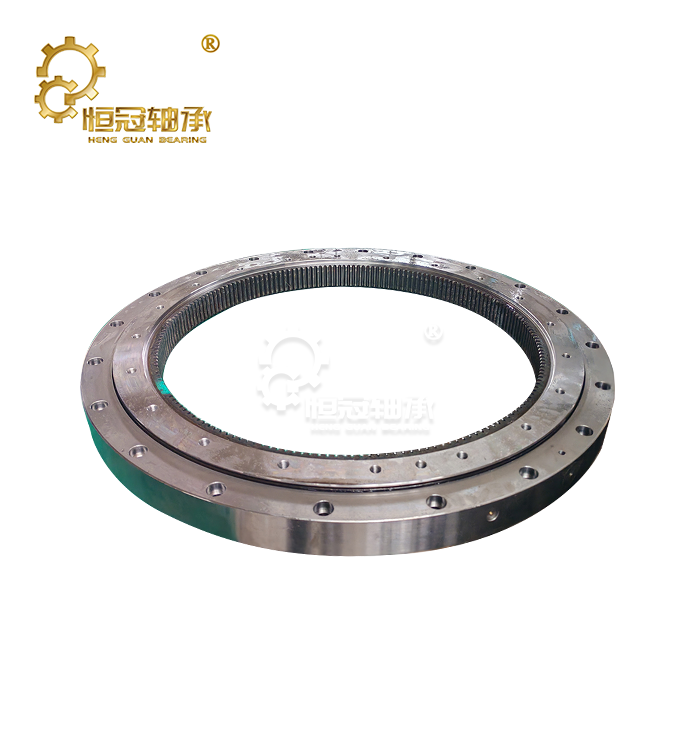
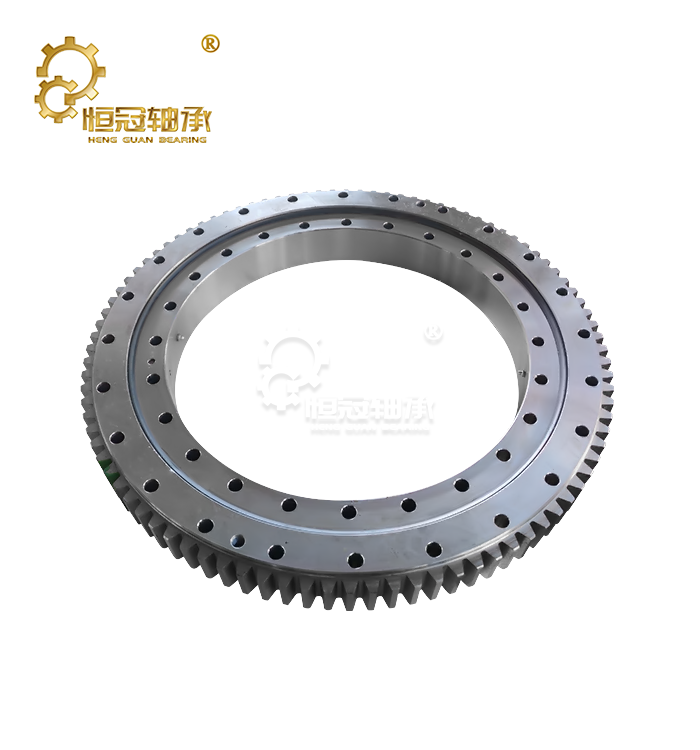
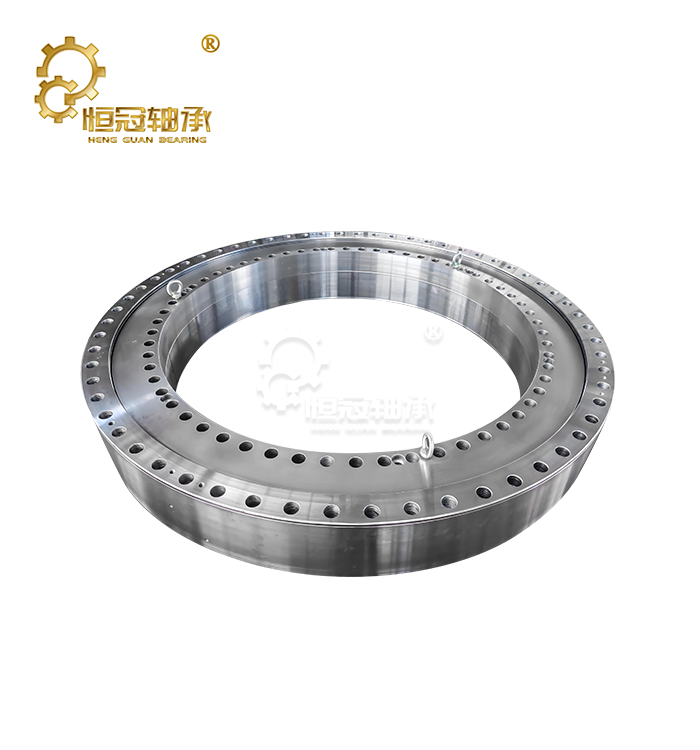
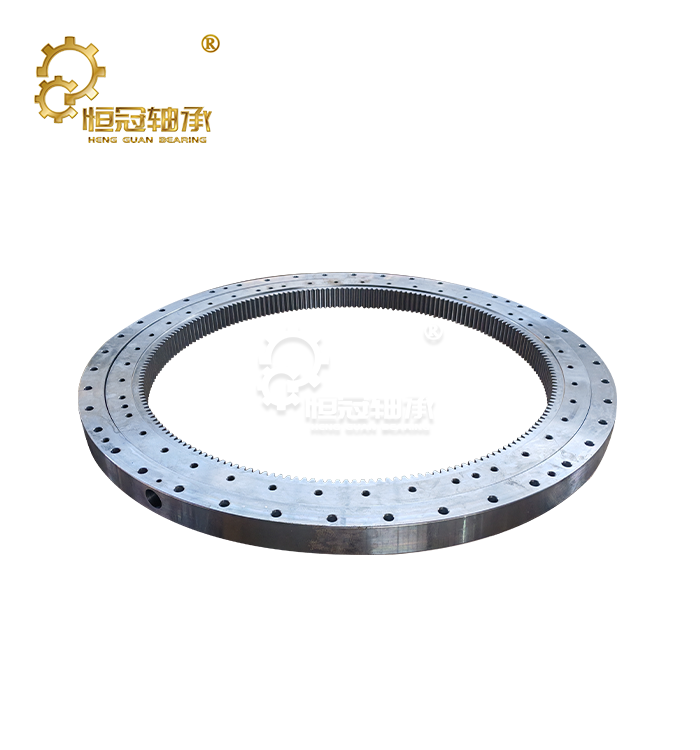
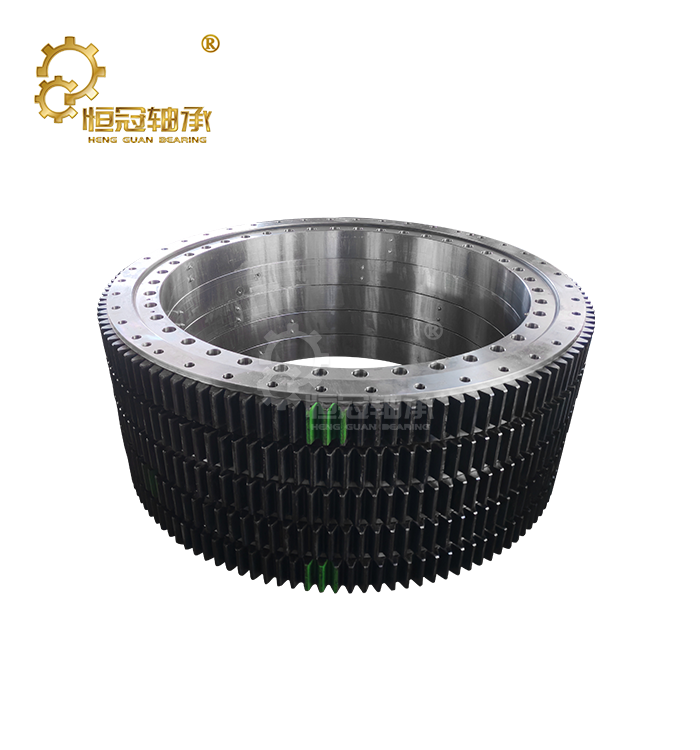
A special gantry crane needs more than vertical lifting capability to handle complex material handling tasks. In many applications, the crane must also rotate the upper structure accurately to position loads within a wider working area. This is where the slewing device becomes essential. The Gantry Crane Slewing Ring is the key bearing component inside the slewing system, allowing the crane’s upper structure to rotate smoothly while supporting heavy axial loads, radial loads, and overturning moments.
The slewing system on a crane provides more operating flexibility than a conventional gantry crane that runs mostly on fixed rails. They may change the load position without moving the whole crane structure, which makes operations more efficient in ports, shipyards, construction projects, and industrial plants. By attaching the rotating top frame to the stationary base, the slewing unit transforms a basic lifting machine into a more versatile handling solution.
Understanding the function of the slewing device is vital for engineers and purchasing teams. The performance of this system directly influences the stability, positioning accuracy, maintenance costs, and overall service life of the crane.
Why Is a Slewing Device Important in Special Gantry Cranes?
How Does the Slewing System Expand Crane Operating Capability?
The main role of a slewing device is to allow controlled rotation between the top part of the crane and a fixed supporting base. Without this mechanism, a gantry crane would often be restricted to linear movement along its track system and, therefore, its ability to position loads accurately.
The crane operator can rotate the lifting structure to different operating positions with a reliable slewing mechanism. This is especially useful in applications where materials have to be moved from one direction to another, such as
Port container handling
Shipyards and repair facilities
Plants for the production of heavy equipment
Large building sites
For example, in a port context, a slewing gantry crane can change the direction of lifting while moving containers from ships, storage places, and transportation vehicles. This avoids unnecessary crane movement and improves efficiency of operation.
The slewing mechanism also increases flexibility of the working environment since the crane does not have to be solely dependent upon movement of the rails. In this way, the operator is also able to carry out more complex handling tasks by combining the movements of horizontal travel, lifting, and rotating.
The Role of Gantry Crane Slewing Ring in Supporting Heavy Loads
Rotation is the apparent function of the slewing device, but the bearing system also has to take care of complex forces created during crane operation. Gantry Crane Slewing Ring: The Gantry Crane Slewing Ring is the structural connection between the rotating and stationary parts, providing stable movement.
In the course of lifting operations the bearing may be subjected to numerous kinds of loads simultaneously:
Axial loads: Vertical forces resulting from lifting and suspended loads.
Radial loads: Sideways applied forces caused by crane motion, wind pressure, or load movement.
Moment loads: Forces that create a tilting moment when the load is displaced from the center of rotation.
These forces are transferred through precise raceways and rolling elements within a high-quality slewing ring. This avoids excessive concentration of stresses in any one place and helps to avoid premature wear.
For heavy-duty gantry cranes, the choice of bearing structure is of particular importance, as unexpected deformation or excessive clearance may compromise positioning accuracy and operating safety.
How Does a Gantry Crane Slewing Ring Work?
Connection Between the Rotating Structure and Crane Base
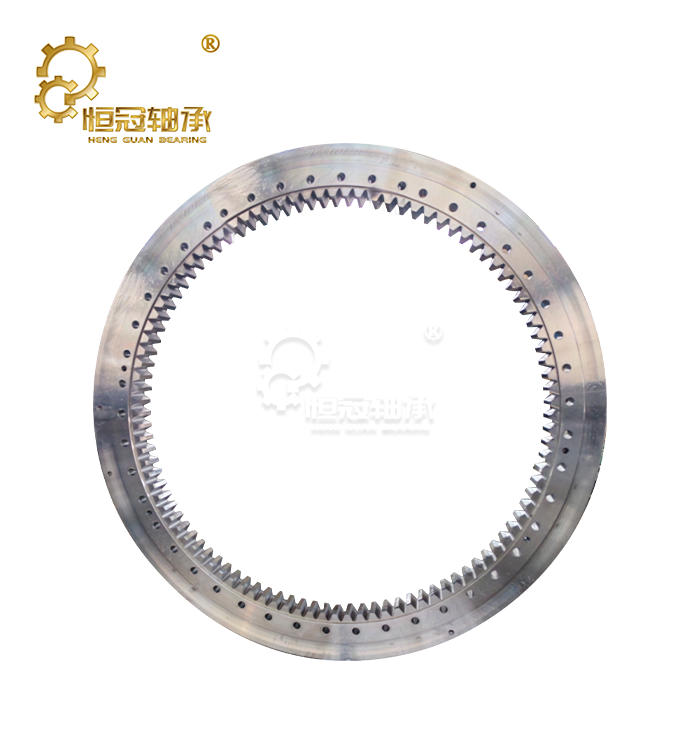
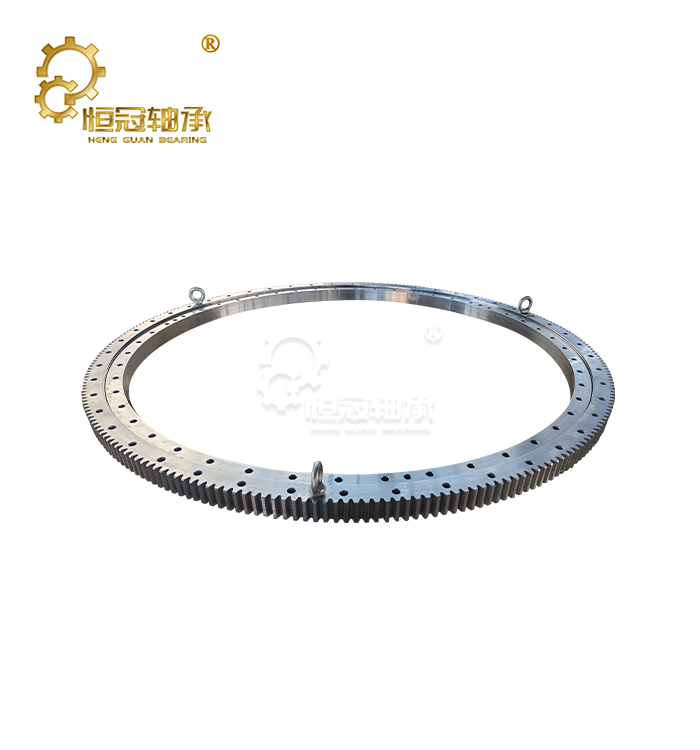
The slewing ring establishes a mechanical connection between the spinning superstructure of the crane and the stationary foundation. The inner and outer rings are attached to distinct parts of the crane so that one can spin and the other can stay still.
When the drive system is running, rotational force is applied through gears and pinions. The drive is transmitted through the slewing ring while retaining the alignment of the joined parts.
The basic operation is:
The driving power is supplied by the electric or hydraulic motor.
The gearbox slows speed and increases torque.
The teeth of the pinion gear engage the slewing ring gear.
The bearing is allowing the upper crane construction to be rotatable.
This design allows the crane to move in a regulated way, not in a quick or unstable rotation.
The accuracy of this technique depends on various aspects, including:
Quality of gear machining
Bearing clearance
Installation precision
Condition of lubrication
Load distribution
In particular, a good slewing system can reduce vibration and increase operator control while handling heavy or precious goods.
Gear Drive and Controlled Rotation Mechanism
Most industrial slewing systems are driven by gears. The gear can be made on the outer or inner surface of the bearing ring according to the specifications of the crane.
The drive mechanism has to consider numerous factors:
Speed of rotation
Torque required
Loading of cargo
Precision of location
Heavy-duty cranes are more interested in torque and stability than in a high rotation speed. The slower and controlled rotation procedure helps to prevent rapid movements of the load and reduce mechanical stress.
The gear teeth of the gantry crane slewing ring must be machined properly, since uneven loading may result from inadequate tooth engagement. This can lead to increased wear on the gear system and bearing raceway over time.
Professional producers, therefore, emphasize machining precision, surface treatment, and quality testing to ensure dependable performance throughout multiple crane cycles.
Key Engineering Factors Affecting Slewing Ring Performance
Selecting the Right Bearing Structure for Different Crane Applications
Most industrial slewing systems are driven by gears. The gear can be made on the outer or inner surface of the bearing ring according to the specifications of the crane.
The drive mechanism has to consider numerous factors:
Speed of rotation
Torque required
Loading of cargo
Precision of location
Heavy-duty cranes are more interested in torque and stability than in a high rotation speed. The slower and controlled rotation procedure helps to prevent rapid movements of the load and reduce mechanical stress.
The gear teeth of the slewing ring must be machined properly, since uneven loading may result from inadequate tooth engagement. This can lead to increased wear on the gear system and bearing raceway over time.
Professional producers, therefore, emphasize machining precision, surface treatment, and quality testing to ensure dependable performance throughout multiple crane cycles.
Material Selection and Heat Treatment Requirements
The material used for a slewing ring directly affects its load-bearing ability, fatigue resistance, and service life. Since gantry cranes often operate under repeated loading conditions, the bearing components must maintain stable mechanical properties over thousands of operating cycles.
High-strength alloy steels are commonly selected for heavy-duty slewing ring applications because they provide a good balance between hardness, toughness, and structural strength. Materials such as 42CrMo are widely used for large bearing rings because they can withstand high mechanical stress while maintaining good machinability during manufacturing.
Heat treatment is another critical factor in bearing performance. Through processes such as quenching and tempering, manufacturers can improve the strength of the steel while maintaining the toughness required for impact resistance.
The raceway surface requires sufficient hardness to resist wear caused by rolling contact. At the same time, the inner structure of the ring needs enough toughness to prevent cracking under fluctuating loads.
For rolling elements, bearing steels such as GCr15SiMn are commonly selected because they offer excellent wear resistance and fatigue strength after proper heat treatment. These properties help maintain smooth rotation when the crane operates under heavy loads.
In addition to the bearing material itself, sealing and protection systems also influence long-term reliability. Gantry cranes are often installed in demanding environments, including:
Coastal areas with salt spray exposure
Construction sites with dust and debris
Industrial plants with temperature changes
Outdoor locations exposed to rain and humidity
A suitable sealing design prevents contaminants from entering the raceway while keeping lubricant inside the bearing system. This reduces friction, minimizes wear, and helps maintain stable operation.

How to Choose the Right Gantry Crane Slewing Ring Supplier?
Confirm Load Requirements and Installation Conditions
Choosing the correct slewing ring is not only about selecting a bearing with sufficient size. Engineers must evaluate the complete operating condition of the crane and consider the specific requirements of a gantry crane slewing ring to ensure reliable performance and long service life.
Important selection factors include the following:
Load Capacity
The supplier should understand:
Maximum lifting weight
Working load frequency
Impact loads
Safety requirements
A crane that operates continuously in a port environment requires a different bearing solution compared with equipment used occasionally at a construction site.
Mounting Dimensions
The slewing ring must match the crane structure accurately.
Important dimensions include:
Outer diameter
Inner diameter
Mounting hole arrangement
Bolt specifications
Gear configuration
Incorrect installation dimensions may cause uneven loading and reduce bearing life even if the bearing itself is manufactured correctly.
Operating Environment
Environmental conditions strongly influence bearing design.
For example:
Marine applications may require improved corrosion protection.
Mining equipment may need stronger sealing against abrasive particles.
High-temperature facilities may require special material selection.
A professional supplier should evaluate these conditions before recommending a solution.
Evaluate Manufacturing Capability and Technical Support
For large crane components, supplier capability is as important as product specifications.
A reliable manufacturer should provide the following:
Engineering support during selection
Technical drawings for confirmation
Manufacturing quality inspection
Installation guidance
Maintenance recommendations
During production, important quality control procedures may include:
Dimensional inspection
Gear accuracy testing
Hardness testing
Raceway inspection
Final assembly verification
These processes help ensure that the finished slewing ring meets the requirements of heavy-duty crane applications.
Technical support after delivery is also valuable. Installation mistakes, incorrect lubrication, or unsuitable operating conditions can reduce service life even when the product quality is high.
A supplier that understands crane applications can help customers avoid these problems through proper guidance.
Conclusion
The slewing device, including the Gantry Crane Slewing Ring gantry crane slewing ring, changes the function of a special gantry crane from a simple lifting machine into a flexible material handling system capable of accurate positioning and multi-directional operation. By enabling controlled rotation between the upper structure and the crane base, the slewing system improves working efficiency in ports, shipyards, construction projects, and industrial facilities.
The performance of the slewing device depends on several engineering factors, including bearing structure, material selection, manufacturing accuracy, lubrication conditions, and installation quality. A properly designed slewing ring must handle combined axial, radial, and moment loads while maintaining smooth rotation under repeated operating cycles.
For crane operators and purchasing teams, selecting the right gantry crane slewing ring requires more than checking dimensions. Load conditions, working environment, maintenance requirements, and supplier technical capability should all be considered before making a decision.
Reliable performance comes from combining high-quality materials, precise manufacturing processes, and proper maintenance practices. When working with an experienced supplier that provides engineering support and customized solutions, companies can improve crane reliability, reduce downtime, and achieve better long-term operating value.
|
|
FAQ
1. How Often Should Slewing Rings Be Inspected?
How often you inspect Gantry Crane Slewing Rings relies on how busy your operations are and what the surroundings are like. Standard practice says that eye checks should be done during cleaning intervals every 100 hours of normal use. Every 1,000 hours, the engine should be thoroughly checked out, with readings of power and a look at the raceway surface. In harsh settings with a lot of dirt or extreme temperatures, checks should be done every 50 hours to find early signs of accelerated wear patterns.
2. What Indicates a Slewing Ring Needs Replacement?
Several signs show that the end-of-service life is getting close. Being properly oiled but still having too much rotating resistance is a sign of damage or wear inside the machine. Visible raceway spalling or large corrosion pitting creates stress concentration points that raise the risk of a quick failure. When the clearance gets big enough to let you feel the wobble during spinning, it means that the wear is beyond what is reasonable. Strange noise patterns, like grinding or clicking sounds, during operation should be looked into right away, because these signs often come before major failures. If these symptoms occur, it is a clear sign that a Gantry Crane Slewing Ring needs to be replaced.
3. Can Standard Slewing Rings Handle Special Heavy-Load Applications?
To check the load capacity, you have to do a full analysis that compares operating needs to bearing values. Standard catalog designs work well for many uses as long as the real amount is within the limits set by the manufacturer. Customized shapes that improve load distribution are often helpful in heavy-load situations with high moment loads or shock loads. Our engineering team looks at the needs of each application and either suggests the right standard choices or creates custom solutions that make sure there are enough safety gaps for real-world situations instead of idealized ones.
Partner with Heng Guan for Superior Gantry Crane Slewing Ring Solutions
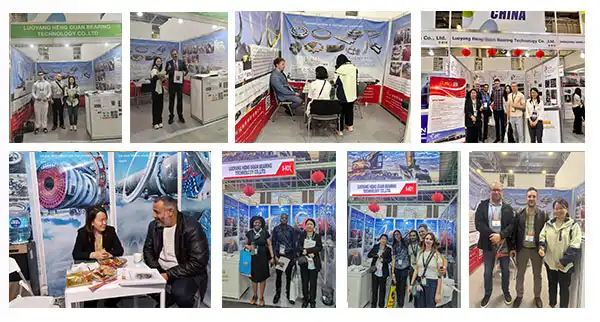
Choosing the right bearing provider affects how well your equipment works and how long it lasts. Heng Guan brings more than 20 years of experience in specialized manufacturing to every project. They combine advanced Gantry Crane Slewing Ring technical skills with full customer support. Our ISO9001-certified factories in Luoyang use China's best infrastructure for making bearings to make accurate parts that meet the standards of the European Machinery Directive. As a reliable company that makes Gantry Crane Slewing Ring, we can make them in a wide range of sizes, from 50 to 10,000mm, so that they are perfect for any purpose. Our expert consulting services, reasonable prices, and quick after-sales support are relied on by customers around the world in building, mining, and port operations. Email our engineering team at mia@hgb-bearing.com to talk about your unique needs, get full technical datasheets, or get quotes for your project. We offer skilled services and high-quality goods at low prices that help long-term partnerships succeed for both parties.
References
1. Zhao, H., & Liu, S. (2019). Design and Analysis of Large-Scale Slewing Bearings for Heavy Lifting Equipment. Journal of Mechanical Engineering Science, 233(8), 2847-2862.
2. Patel, R. K. (2020). Materials Selection for High-Performance Slewing Rings in Industrial Crane Applications. International Journal of Materials Science and Applications, 9(3), 45-58.
3. European Committee for Standardization. (2018). Cranes - Slewing Bearings: EN 12478-1 Safety Requirements. Brussels: CEN Publications.
4. Anderson, T. M., & Wong, J. (2021). Maintenance Strategies for Extending Service Life of Rotating Bearing Systems in Heavy Machinery. Tribology and Lubrication Technology, 77(4), 38-47.
5. Schmidt, F. (2017). Comparative Analysis of Rotational Bearing Technologies for Mobile Crane Applications. Journal of Construction Equipment and Technology, 42(2), 112-128.
6. International Organization for Standardization. (2019). Rolling Bearings - Slewing Bearings: ISO 12043 Information for Procurement. Geneva: ISO Standards Press.

WHAT OUR CUSTOMERS SAY
Here is the customer's evaluation of us