



Single Row Ball Slewing Ring Internal Gear: Custom Solutions
Choosing the correct slewing bearing may be the difference between a machine that runs well or not at all, and here is where a single-row ball slewing ring internal gear makes a name for itself. A misaligned rotating unit on a crane, solar tracker, or automation platform rapidly reveals itself – indexed positioning that drifts, drive pinions that wear unevenly, or a small housing that pushes a bulkier external-gear design into an already tight environment. We design and manufacture this type of bearing at Heng Guan Bearing for customers needing reliable rotation within a compact footprint, with applications ranging from construction equipment to specialised automation platforms. The internal gear teeth are protected inside the ring, and the whole assembly is sized to save 30 – 40% of installation space versus traditional Shaft-and-bearing stacks. In this post, we describe how the design works, what aspects form a solid custom solution, and what to look for whether you need a conventional part or a custom-built tiny internal gear slewing ring to meet unique requirements.


How Does a Single Row Ball Slewing Ring Internal Gear Work?
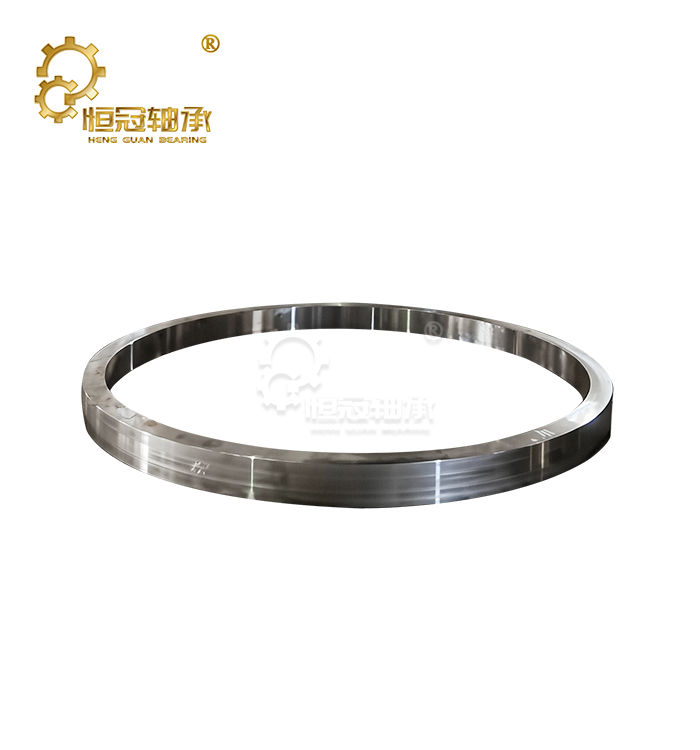
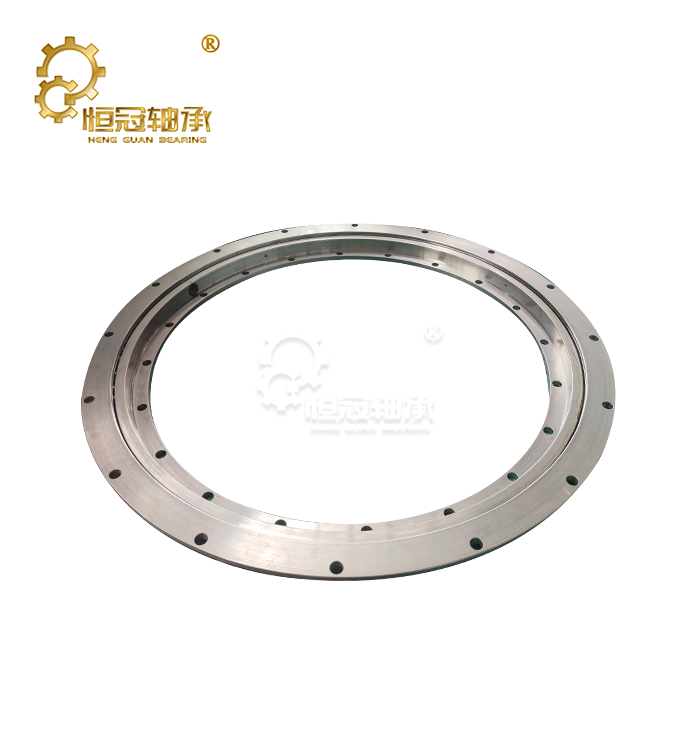
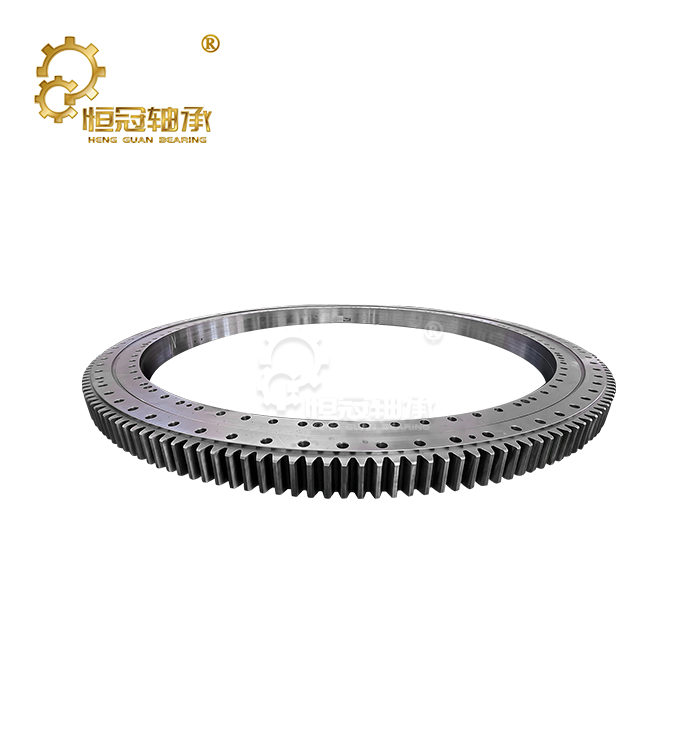
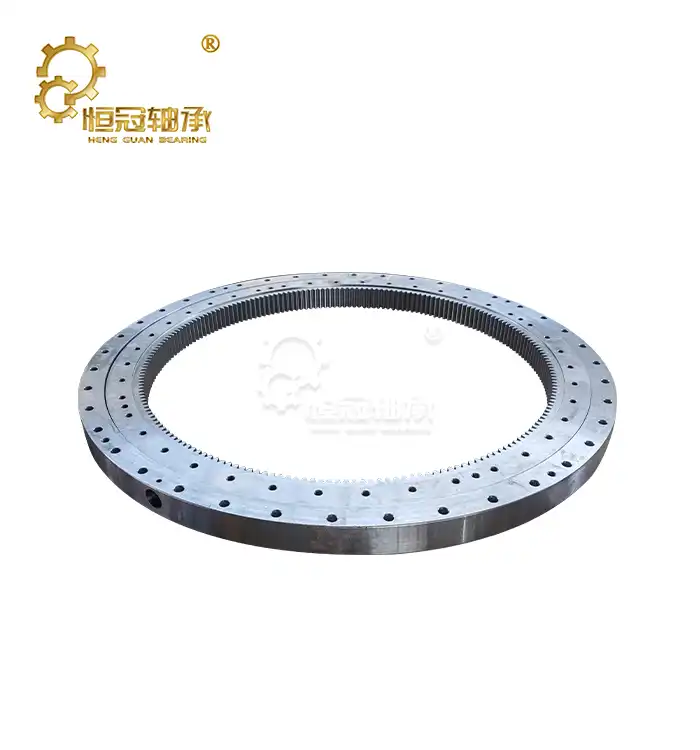
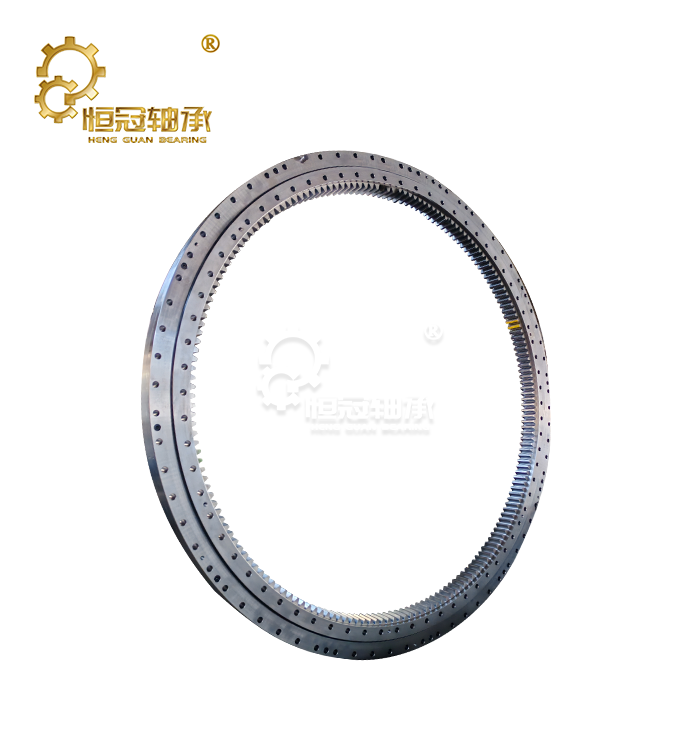
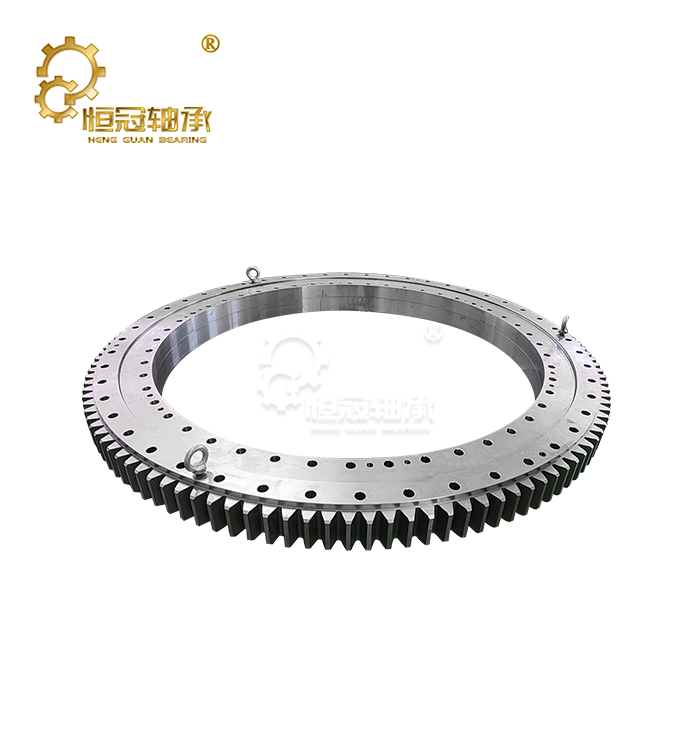
A single-row ball slewing ring internal gear is generally made up of a single row of steel balls in four-point contact sandwiched between an inner and outer raceway. With each ball making contact with the raceway at four locations on a 90° contact angle, the bearing can concurrently handle axial loads, radial loads and tilting moments – a capacity that often needs numerous independent rows of bearings in conventional machine designs. Instead of cutting the teeth of the gear into the outer edge, they are cut into the inner ring, protecting them from dirt, debris, and impact damage during operation. The outer ring remains fixed to the base construction.
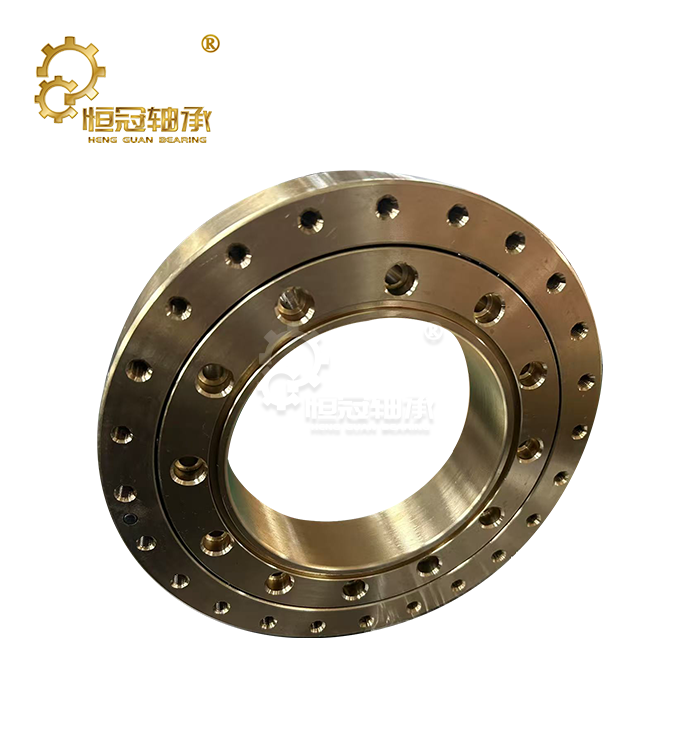
The inner ring rotates, causing the associated mechanism to revolve, using a pinion gear that meshes with the internal teeth. The usual size range is between raceway center diameters of about 175 mm and 500 mm (e.g., model 02-0245-00 with an inner diameter of 174.5 mm, an outer diameter of 300 mm, and a height of 40 mm), and the series may be extended to 4,500 mm for bigger machines. The design is used when engineers want a compact internal gear slewing ring for installation inside a confined enclosure, yet want smooth, controlled rotation for cranes, platforms and turntables, since the gearing is on the inside.
| Model | Inner Diameter | Outer Diameter | Height | Typical Positioning |
|---|---|---|---|---|
| 02-0245-00 | 174.5 mm (6.87 in) | 300 mm (11.81 in) | 40 mm (1.57 in) | Small general-purpose |
| 02-0422-00 | 316 mm (12.44 in) | 515 mm (20.28 in) | 54 mm (2.13 in) | Mid-size multifunction |
| 02-1050-00 | 882 mm (34.72 in) | 1,170 mm (46.06 in) | 98 mm (3.86 in) | Heavy crane duty (120 t class) |
Key Design Factors for a Single Row Ball Slewing Ring Internal Gear
Getting the design right starts with understanding the load case the bearing will face in service. Engineers typically look at combined axial force, radial force, and tilting moment together, rather than any single value in isolation, since real-world equipment rarely applies pure loads. Ball diameter and raceway hardness both influence fatigue life, while the number of gear teeth and module size determine how the bearing meshes with the drive pinion. Bolt circle diameter, hole spacing, and flange thickness must also match the mounting structure precisely.
On the manufacturing side, the raceway is CNC induction-hardened to HRC 55 – 62 whi–62, while gear flanks run at HRC 45 – 55, cut by CNC shaping or hobbing to DIN class 6 precision — equivalent to ISO 1328-1. A single-row ball slewing ring internal gear performs best when these variables are calculated together rather than adjusted individually after the fact, which is why early collaboration between the customer and the engineering team tends to produce a longer-lasting result.
| Design Factor | What It Affects | Typical Standard |
|---|---|---|
| Ball diameter & raceway hardness | Load capacity, fatigue life | GCr15 balls; raceway HRC 55 – 62 |
| Gear module & tooth count | Drive compatibility, torque | CNC shaped/hobbed, DIN 6 (ISO 1328-1) |
| Bolt circle & hole pattern | Mounting accuracy | Hole pattern matched to frame |
| Seal design | Contamination resistance | Triple-seal: dual lip + O-ring barrier |
| Raceway hardening depth | Wear resistance | Induction-hardened raceway, HRC 55 – 62 |
What Should You Consider When Customizing the Internal Gear?
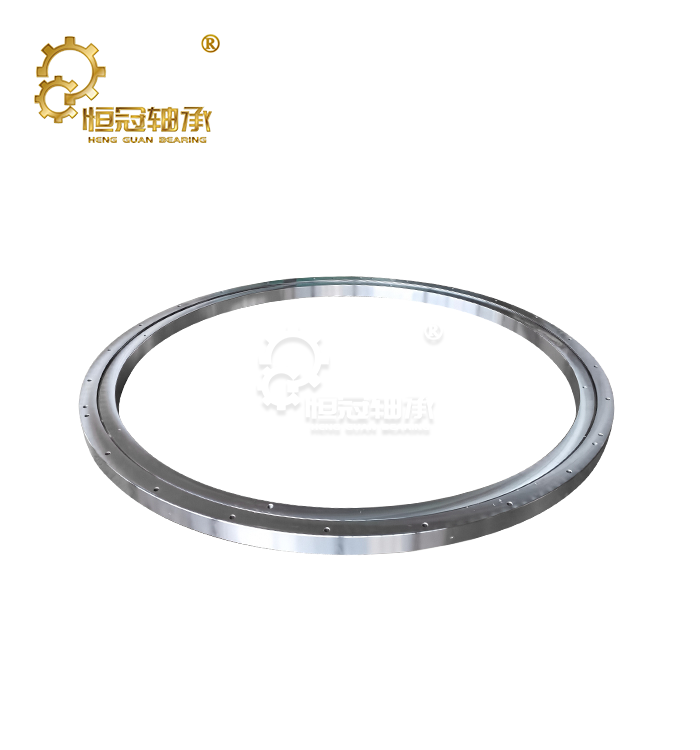
Customization usually begins with the available installation space, since a small internal gear slewing ring often needs to fit inside a housing that leaves little room for adjustment later. Beyond dimensions, customers should decide on tooth profile and module to match their existing pinion or motor, and specify hardening depth suited to the expected duty cycle — including the option of an unhardened gear for field machining, an external-gear variant, or a friction-driven ring without teeth when the drive arrangement calls for it. Sealing arrangement matters too, particularly for equipment exposed to dust, moisture, or washdown cycles; the standard triple-seal system (dual lips plus an O-ring barrier) handles most industrial environments, while stainless 316L rings suit food-grade or highly corrosive duty.
Material choice itself is part of the decision: 42CrMo delivers impact toughness for cold climates and shock loading, 50Mn gives cost-effective performance under steady mid-range loads, and 40Cr suits budget-sensitive projects. If your project has unusual mounting constraints or performance targets, our engineers at mia@hgb-bearing.com can review drawings and load data before production begins. Getting these details confirmed up front, rather than during assembly, is what allows a single rosingle-rowwing ring internal gear to be delivered right the first time.
| Material Option | Best-Fit Duty | Notes |
|---|---|---|
| 42CrMo alloy steel | Cold climate, high impact, shock loads | Superior toughness and hardenability |
| 50Mn alloy steel | Steady mid-range loads | Cost-effective standard choice |
| 40Cr alloy steel | Budget-sensitive projects | Economical where duty is light |
| 316L stainless steel | Food-grade, marine, corrosive | Full corrosion resistance, premium cost |
Single Row Ball Slewing Ring Internal Gear: Load, Gear & Material Selection
The kind of material and equipment used is closely related to the load that the bearing has to handle. Ring forgings are commonly manufactured from medium-carbon alloy steel, selected for its mix of toughness and machinability, then induction-hardened along the raceway and gear sides to withstand wear. The gear module is determined based on torque needs and pinion compatibility, while teeth count impacts rotation ratio and positioning precision. Accuracy grade is also a consideration. Applications that need strict indexing accuracy may demand a tighter tolerance class than a general rotation job. The manufacturer offers P0, P6, P5, and P4 grades throughout a manufacturing range of 50 mm to 10,000 mm raceway diameter.
Real-world reference points from this product line show how load focuses shift by application: radar and antenna platforms demand backlash below 0.1° for smooth rotation, solar trackers target a 25-year service life under wind and moment loads, and welding positioners run at elevated temperatures where special grease supports operation up to 200 °C. The project may need a standard single-row ring with internal gear, or a compact small internal gear slewing ring for space-limited equipment, but the performance is consistent over years of use, not months, by matching the material grade and gear geometry to the actual duty cycle.
| Application | Typical Load Focus | Common Size Range |
|---|---|---|
| Robotic/automation arms | Precision, moderate load | Small diameter |
| Solar trackers | Wind & moment load | Small to mid-diameter |
| Radar & antenna platforms | Backlash < 0mid-diameterrotation | Small to mid-diameter |
| Aerial work platforms | Combined axial/radial | Mid diameter |
| Construction turntables | Heavy combined load | Mid to large diameter |
How Can Custom Solutions Improve Slewing Ring Performance and Service Life?
Off-the-shelf bearings work well for standard applications, but many machines benefit from adjustments that only custom engineering can provide. Optimized raceway curvature reduces contact stress, extending fatigue life beyond what a generic part offers. Tailored sealing keeps contamination out in harsh environments, cutting maintenance frequency significantly — the triple-seal configuration, for example, is what lets a marine deck crane keep rotating reliably through salt-spray exposure with standard grease intervals of 100 operating hours (tightened to 50 hours in heavy dust). Custom bolt patterns eliminate the need for adapter plates, which simplifies assembly and removes an extra source of play.
For equipment makers working with limited space, a properly engineered small internal gear slewing ring can replace a bulkier standard part without sacrificing load capacity — the single-row ball design already undercuts crossed-roller equivalents by 30 – 40% in cost while offering higher speed tolerance, trading some overturning-moment stiffness for those gains. Heng Guan Bearing works through these adjustments with customers directly, aligning gear geometry, material choice, and sealing to the actual operating conditions so the finished single-row ring internal gear performs reliably well past its expected service interval.
| Characteristic | Single-Row Ball Internal Gear | Crossed Roller |
|---|---|---|
| Structural stiffness | Moderate — suits dynamic loads | High — suits precision machines |
| Tilting moment capacity | Good (4/5) | Excellent (5/5) |
| Speed capability | Higher rotation tolerance | Lower speed limit |
| Relative cost | 30 – 40% lower | Premium pricing |
| Maintenance | Standard grease, 100 h interval | More frequent checks |
| Best fit | Solar trackers, cranes, excavators | CNC tables, medical CT gantries |
Conclusion
A well-engineered single row ball slewing ring internal gear delivers smoother rotation and longer service life, with internal gear teeth protected from debris and an installation envelope 30 – 40% smaller than conventional drive stacks. Heng Guan Bearing partners with customers on every design detail, from load calculations to sealing — 42CrMo, 50Mn, 40Cr, or 316L rings, raceways hardened to HRC 55 – 62, and gears finished to DIN class 6 — ensuring each custom solution truly fits the application.
FAQ
Q1: What makes an internal gear design different from an external gear slewing ring?
A: The teeth sit on the inner ring instead of the outer edge, protecting them from external impact and debris. Internal gearing also lets the drive pinion sit inside the envelope, which saves 30 – 40% of installation space compared with traditional shaft-and-bearing arrangements.
Q2: Can a small internal gear slewing ring still handle heavy loads?
A: Within its size class, yes — load capacity depends more on ball diameter, raceway hardness (HRC 55 – 62), and material grade than on overall footprint. The 02-1050-00 model, for example, carries roughly 120 tons of crane duty at under 1.2 m outer diameter.
Q3: What lead time should I expect for a custom slewing ring?
A: Standard models typically ship in 7 – 15 days, while custom designs run 4 – 6 weeks after drawing approval. Sharing drawings and load data early helps confirm an accurate schedule and avoid rework at the assembly stage.
Q4: Do I need to specify the seal type when ordering?
A: Yes, sealing should match your operating environment, especially for dusty, wet, or washdown conditions. The standard triple-seal system (dual lips plus O-ring barrier) covers most industrial duty; marine or food-grade applications may warrant 316L stainless rings and enhanced sealing.
Q5: What accuracy grade is recommended for precision positioning applications?
A: A tighter tolerance class is generally recommended whenever repeatable, precise indexing is required. The factory supports P0, P6, P5, and P4 grades, and radar-class platforms typically specify backlash below 0.1° for smooth rotation.
Q6: What grease interval applies after installation?
A: Standard lubrication runs every 100 operating hours, tightened to every 50 hours in heavy dust to flush contaminants. High-temperature duty, such as welding positioners, can use special grease rated up to 200 °C.
Get a Custom Quote
Need a single-row ball slewing ring internal gear built around your exact specifications? Send your drawings and load data to mia@hgb-bearing.com, and the Heng Guan Bearing engineering team will get back to you with a tailored recommendation and quote.
References
1. Harris, T. A., & Kotzalas, M. N. (2006). Rolling Bearing Analysis (5th ed., 2 vols.). CRC Press.
2. International Organization for Standardization. (2007). ISO 281:2007: Rolling bearings — Dynamic load ratings and rating life. ISO.
3. International Organization for Standardization. (2006). ISO 76:2006: Rolling bearings — Static load ratings. ISO.
4. SAE International. (2026). SAE J1063_202603: Cantilevered Boom Crane Structures — Method of Test. SAE International.
5. American Bearing Manufacturers Association. (1994). ANSI/ABMA 26.2-1994: Thin Section Ball Bearings — Inch Design. ABMA.
6. Ministry of Industry and Information Technology of the People’s Republic of China. (2018). JB/T 2300-2018: Slewing Bearings. China Machinery Industry Standard.

WHAT OUR CUSTOMERS SAY
Here is the customer's evaluation of us