




Forged Ring vs Cast Ring: Which Is Better for Your Project?
A ring that fails in service costs a lot to replace. Buyers of a forged ring or a cast ring often face the same worries: hidden internal defects that show up only after machining, rings that crack or wear out early under heavy load, and suppliers who cannot provide material records or match a drawing. Choosing between a forged ring and a cast ring affects strength, lifespan, and total project cost, so it pays to compare them carefully. At Heng Guan Bearing, we work with ring blanks every day, because the quality of a slewing bearing starts with the quality of its ring. In this guide, we explain how the two processes differ, why China rolled ring forging is valued for demanding applications, how cost and service life compare, and how to choose a dependable manufacturer.
What Are the Key Manufacturing Differences Between Forged Rings and Cast Rings?
The ring can be cast. This is accomplished by pouring molten metal into a mold, which is allowed to cool and harden. This method is very suitable for flexible production and complicated shapes. Forging is the formation of a solid billet, heated, perforated, expanded, and rolled under pressure to create a ring. This working of the metal will refine and align the grain structure of the metal to the contour of the ring. This will help in the development of strength and toughness. Raceways are built thick and provide a reliable basis for hardening and precision machining when applied to a forged ring that is used in a slewing bearing.
| Aspect | Cast Ring | Forged Ring |
|---|---|---|
| Forming method | Molten metal poured into a mold | Heated billet pierced and rolled |
| Internal structure | Solidified from liquid | Refined, directional grain flow |
| Typical strength | Suitable for lighter duty | Strong for heavy-duty use |
Heng Guan Bearing customizes the choice of ring materials according to the operating conditions of each individual project, so as to offer customers a base component suitable for their load and accuracy requirements.
| Forging Step | What Happens |
|---|---|
| Billet heating | Solid steel billet is heated to forging temperature |
| Piercing | The billet is pierced to form a donut-shaped preform |
| Ring rolling | The preform is rolled and expanded to the required diameter |
| Heat treatment | Quenching and tempering set hardness and toughness |
| Machining | CNC machining brings the ring to drawing size |
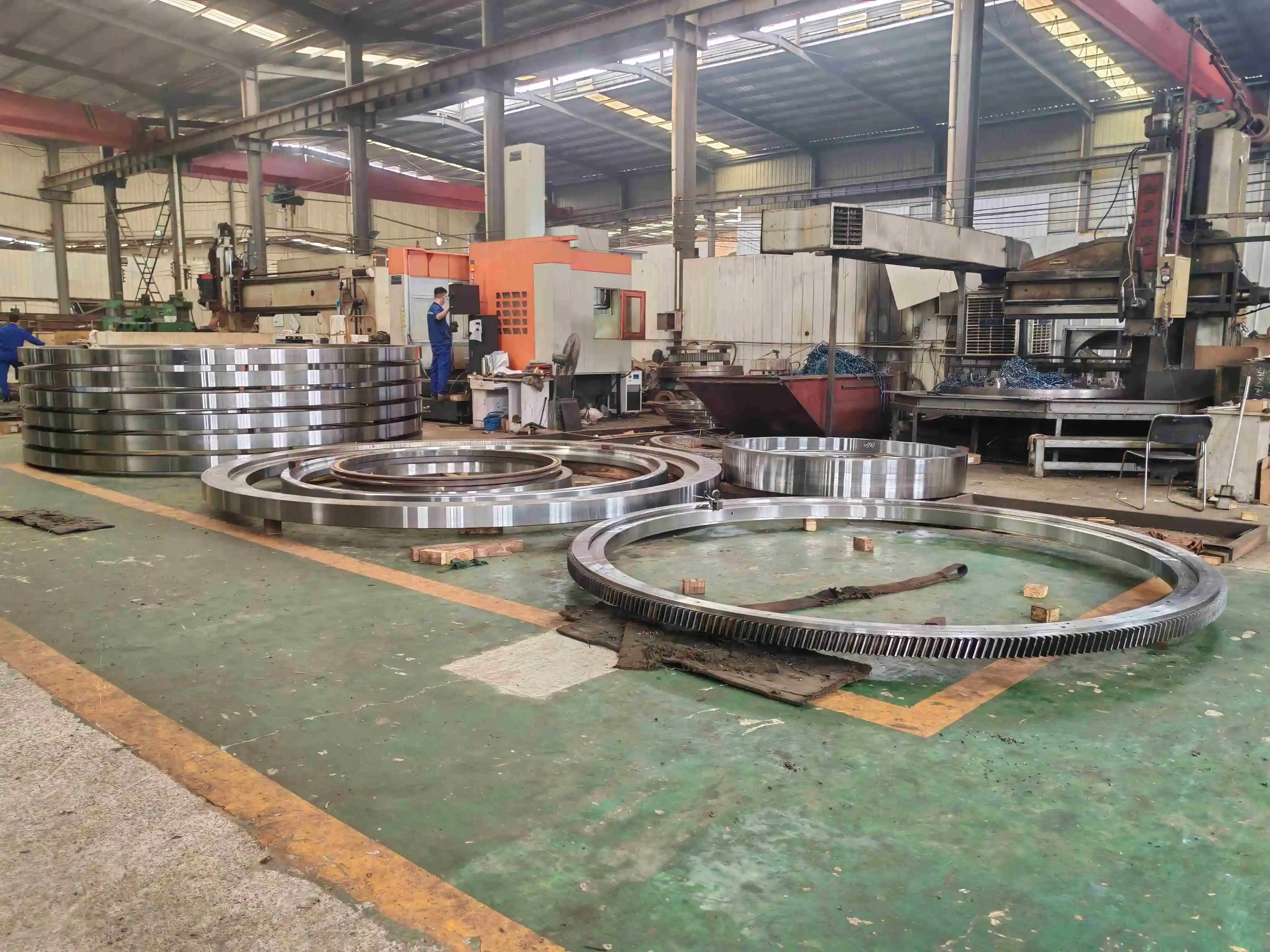
How Does China Rolled Ring Forging Improve Ring Quality and Performance?
China rolled ring forging has become a leading route for producing seamless rings because of its mature industrial base, modern equipment, and skilled operators. The rolling process reduces the ring wall and increases the diameter. This produces a compact body that is uniform and has the same properties all over the circumference. The ring is next subjected to heat treatment and machining in order to achieve the desired level of hardness and precision.
Raceways that are resistant to wear and fatigue under severe loads are what this refers to when it comes to slewing bearings. As a result of the fact that forged rings may be manufactured in a wide variety of diameters, designers have the ability to create products that are both standard and tailored to specific shapes. As a result of Luoyang's competent bearing processing base, Heng Guan Bearing is able to closely coordinate the material, forging, and machining processes, thereby maintaining quality control.
| Parameter | Value |
|---|---|
| Process | Hot ring rolling forging, seamless |
| Typical Materials | 42CrMo / 42CrMo4 alloy steel (50Mn available for slewing bearing rings) |
| Heat Treatment | Quenching and tempering |
| Surface Treatment | Shot blasting |
| Machining | CNC machining to drawing |
| Customization | Size and shape made to your drawings |
| Quality System | ISO 9001-certified production |
| Traceability | Raw material identification and finished product inspection |
Which Ring Manufacturing Process Offers Better Cost Efficiency and Service Life?
Cost effectiveness should be evaluated not just on the initial purchase price of the equipment, but over its entire lifespan. A cast ring may be suitable for light-duty or low-volume items, whereas a forged ring often provides greater fatigue resistance and more consistent performance under large loads that are repeated over and over again. This longevity helps reduce downtime, replacement frequency, and maintenance costs, which is one reason China rolled ring forging is frequently used for cranes, wind-generating facilities, mining equipment, and port machinery.
If you would like help weighing both options for your drawings, email mia@hgb-bearing.com, and Heng Guan Bearing will recommend a practical solution. The table below gives a quick overview for planning.
| Factor | Cast Ring | Forged Ring |
|---|---|---|
| Typical application | Light or moderate duty | Heavy-duty, high-reliability |
| Service life outlook | Good for simple conditions | Extended under demanding loads |
| Long-term value | Lower initial cost | Fewer replacements over time |
How to Choose a Reliable China Rolled Ring Forging Manufacturer for Your Project?
A reliable partner is one that possesses the ability to produce, maintain quality control, and communicate effectively. Your first order of business should be the equipment, material traceability, and inspection techniques of the manufacturer. In order to verify each batch, obtain certificates and test reports. Could you please verify the size range that you require? Bearings for slewing can be manufactured by us with diameters ranging from 20 millimeters to 10,000 millimeters. Please let us know if there are any unique designs that you require.
A trustworthy supplier of forged ring products will also explain in plain terms the lead time, packaging, and after-sales support. Heng Guan Bearing has customers in Europe, America, Asia, and other regions, so we understand the documentation and delivery details required for international projects. Tell us what you need, and we’ll respond quickly with workable solutions.
| Check Item | What to Request |
|---|---|
| Material | Steel grade and material certificate |
| Heat treatment | Quenching and tempering record |
| Dimensions | Drawing and dimensional inspection report |
| Quality system | ISO 9001 certificate |
Conclusion
Forging rings are often more durable and long-lasting than cast rings, which are better suited for projects that require less intricate work. It is possible to use cast rings for a wide range of tasks. Cast rings are a fantastic option for projects that have a lower level of intricacy than other types of structures. Because it is possible to acquire a combination of quality and flexibility with rolling ring forging in China, this method is an excellent option for projects that demand a high level of flexibility. Furthermore, it helps safeguard your equipment from costly defects at an earlier stage, which is a huge advantage due to the fact that it helps protect your equipment.
This provides you with an additional layer of protection that a forged ring can take advantage of. With the support that you require, a representative from Heng Guan Bearing is prepared to provide you with aid in picking the solution that is most suitable for your requirements and to provide it to you with the assistance that you desire.
FAQ
What is a forged ring?
It is a seamless ring made by piercing and rolling a heated billet. This process refines the grain structure and aligns it with the ring contour, producing a dense, uniform, and tough ring suitable for demanding applications.
Why choose China rolled ring forging?
It makes dense and uniform rings for heavy-duty use. China has a mature industrial base, modern equipment, and a skilled workforce, so the quality, size, and performance of cranes, wind power, mining, and port machinery are consistent, customizable, and reliable.
Is a forged ring better than a cast ring?
For demanding loads, it usually gives better performance. Forged rings are more fatigue-resistant, last longer, and need fewer replacements under repeated heavy loads, which means less downtime and lower long-term maintenance costs.
Can sizes be customized?
Yes. Heng Guan Bearing adapts designs to your drawings. We manufacture slewing bearings and forged rings with diameters from 20 mm to 10,000 mm, matching your required size, shape, material, and accuracy specifications.
What documents should I request?
Material certificates, heat treatment records, and inspection reports. Also request dimensional inspection reports, ISO 9001 certification, and raw material identification to verify each batch meets your drawing and quality requirements.
Ready to Start Your Project? Contact Us Today!
When you want quality, individualized solutions, and expert service, Heng Guan Bearing is the company to choose:
- Bearings that are slewing and rings that are fabricated according to your drawings
- Production that is accredited to ISO 9001 standards, with sizes and materials that can be customized
- The engineering staff is ready for the selection of materials and the inspection of drawings.
Send your drawings and requirements to mia@hgb-bearing.com, and our team will reply with a clear proposal. Let us help you build with confidence.
References
1. Altan, T., Ngaile, G., & Shen, G. (2005). Cold and Hot Forging: Fundamentals and Applications. ASM International.
2. Campbell, J. (2015). Complete Casting Handbook: Metal Casting Processes, Metallurgy, Techniques and Design. Butterworth-Heinemann.
3. Harris, T. A., & Kotzalas, M. N. (2006). Essential Concepts of Bearing Technology. CRC Press.
4. Kalpakjian, S., & Schmid, S. R. (2014). Manufacturing Engineering and Technology. Pearson.
5. Groover, M. P. (2019). Fundamentals of Modern Manufacturing. Wiley.
6. ASM International. (1988). ASM Handbook, Volume 14: Forming and Forging. ASM International.

WHAT OUR CUSTOMERS SAY
Here is the customer's evaluation of us