




Crane Slew Ring Replacement: When Should You Upgrade?
You need to know when it’s time to change out a crane slew ring to preserve your equipment, your crew, and your project timeline. Luoyang Heng Guan Bearing Technology Co., Ltd. is located in "Bearing Town" in China, specializing in slewing rings and bearings for lift machines all over the globe. Our rings are capable of axial, radial, and tilting moment loads at the same time, and each unit is sent with material certifications and dimensional reports from an ISO 9001:2015-certified facility. In this book, you will understand the warning signs of wear, how engineers assess it, how to evaluate repair vs. replacement, and what to inspect before installation.
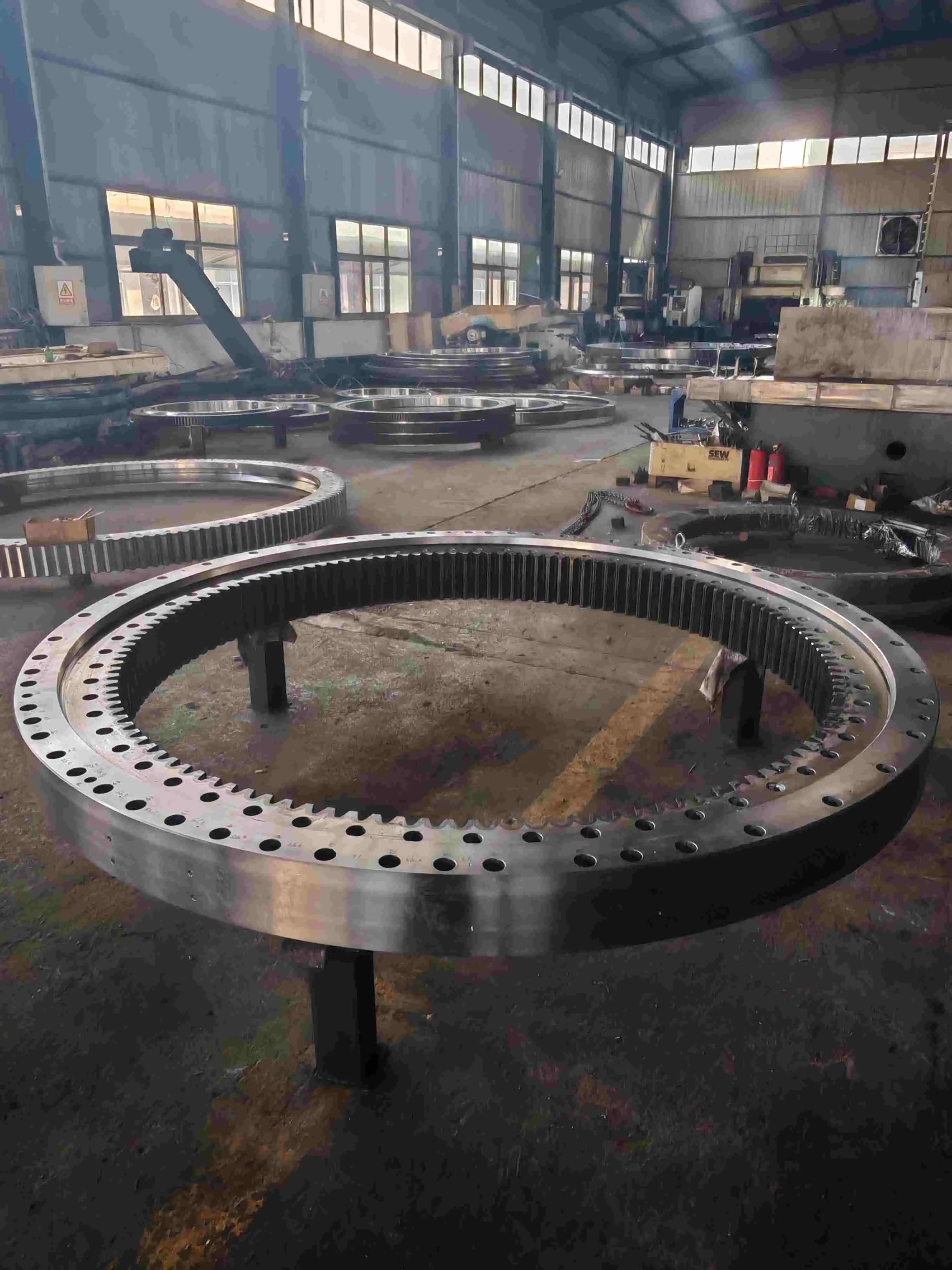
What Are the Warning Signs That a Crane Slew Ring Needs Replacement?
A worn crane slew ring usually provides some warning before it fails, so knowing the early signs allows you to schedule an update before output is affected. Look for uneven or loud rotation, jerky starts, increased rotating torque, and black grease or grease with metal particles in it.
Also, loose bolts that recur, noticeable gaps at the mounting flange, or a minor tilt in the boom are signs of the bearing losing support. The crane slewing gear also demands equal care. Flattened teeth, surface pitting, or rising backlash indicate that the gear mesh is deteriorating.
If two or more of these symptoms are present at the same time, upgrading to a new crane slew ring may often restore smooth slewing and offer operators fresh confidence. Heng Guan Bearing can evaluate your photos and service history to assist you in determining the ideal time. Below is a table that maps each indication to its probable source and next step.
| Warning Sign | Likely Cause | Recommended Action |
|---|---|---|
| Noisy or uneven rotation | Raceway wear or rolling element damage | Measure clearance and plan an upgrade |
| Rising rotation torque | Lubrication breakdown, internal friction | Compare with baseline, inspect lubricant |
| Metal particles in grease | Surface spalling | Schedule an inspection immediately |
| Bolts that keep loosening | Mounting surface deflection | Check flatness, re-torque in a star pattern |
| Growing backlash | Tooth wear on the crane slewing gear | Assess pinion and ring together |
How Do Engineers Measure Crane Slew Ring Wear and Clearance?
Engineers start with a basic, repeatable check. They fasten a dial indicator to the stationary structure and measure the amount of lift and tilt of the rotating section as the load moves, giving a measurement of axial and radial clearance in the crane slewing gear. The readings are then compared to the original specification. The crane slewing gear is inspected for backlash using a backlash gage and visual inspection of tooth contact patterns.
If you record outcomes at regular intervals, you will notice the trend, rather than a number, which makes planning simpler and minimizes surprises. A good guideline in the field is that the rotational resistance should not vary by more than roughly 15% from the baseline value measured at commissioning. The common checks are summarized in the table below.
| Measurement | Tool | What It Shows |
|---|---|---|
| Axial tilt clearance | Dial indicator | Raceway wear |
| Radial clearance | Dial indicator | Rolling element condition |
| Gear backlash | Feeler or backlash gauge | Tooth wear |
| Rotation torque | Torque wrench | Internal friction |
Repair or Replace? Evaluating Bearing Damage, Gear Wear, and Operating Costs
Once the measurements are done, it's only a matter of condition and pricing. For little surface wear on a crane slewing gear, greater lubrication and adjustment may occasionally be a solution, but for raceway fatigue, deep pitting, or damaged components, replacement is typically the more economical choice. Frequent repairs, more downtime, and more inspection work all add up, and a new crane slew ring gives predictable performance and a new service life.
Heng Guan Bearing offers inner diameters of 500 mm to 8,000 mm and outer diameters of 700 mm to 10,000 mm in accuracy ratings P0, P6, P5, and P4, as well as non-standard designs, so your replacement may equal or be better than the original. If there is no drawing, we can also reverse engineer using the outside diameter, bolt hole count, and gear spec. Email mia@hgb-bearing.com with your drawings and wear data, and our engineers will help you compare options and costs before you commit. The table below lists the core technical parameters of a replacement unit.
| Parameter | Specification |
|---|---|
| Inner diameter | 500 mm – 8,000 mm (oversized on request) |
| Outer diameter | 700 mm – 10,000 mm |
| Height | 100 mm – 500 mm |
| Precision grades | P0, P6, P5, P4 (ISO) |
| Base material | 42CrMo, 50Mn alloy steel |
| Rolling elements | GCr15SiMn high-purity bearing steel |
| Raceway hardness | HRC 55–62 |
| Gear options | Internal, external, or non-geared |
| Seals | Nitrile rubber (NBR) or fluoroelastomer (FKM) |
| Cages | Brass, steel, or engineering plastic |
| Operating temperature | -40°C to +80°C (standard seals) |
Key Inspection Checks Before Installing a Replacement Crane Slew Ring
Your new crane slewing gear will function from the first shift with a pre-installation evaluation. Ensure bolt holes, grade, and torque values are as per specification and mounting surfaces are smooth, clean, and free from burrs. Flatness of the mounting surface should be maintained within 0.5 mm over the bolt circle and the bolt hole location within ± 0.5 mm. The deflection of the supporting structure under load shall not exceed 0.001 times the diameter.
Before full operation, examine the contact pattern and backlash by comparing the teeth of the crane slewing gear pinion with the new ring. Lubricate the raceway with NLGI Grade 2 lithium complex grease until new lubricant develops at the seal gaps. Rotate the unit gently to distribute the lubricant evenly. Run at 25% of rated load for 10 rotation cycles. Recheck bolt torque. Keep the following checklist handy throughout installation.
| Check Item | Purpose |
|---|---|
| Mounting surface flatness | Even load distribution |
| Bolt grade and torque | Secure connection |
| Gear mesh and backlash | Smooth, quiet slewing |
| Lubrication | Lower friction, longer life |
Conclusion
The time to replace a crane slew ring protects safety, uptime, and budget. Detecting warning indicators, assessing wear, and having a close look before installation will provide you with trustworthy slewing performance. Heng Guan Bearing has expertise in design and manufacturing and can provide tailor-made solutions.
FAQ
Q1: How do I know my crane slew ring is worn?
A: Noise, jerky rotation, rising torque, and metal particles in the grease are common signs.
Q2: How is clearance measured?
A: A dial indicator records axial and radial movement against the original specification.
Q3: Can the crane slewing gear be replaced separately?
A: Light wear may be managed, but heavily worn teeth usually call for a new ring.
Q4: What sizes does Heng Guan Bearing supply?
A: Inner diameters from 500 mm to 8,000 mm and outer diameters from 700 mm to 10,000 mm, including non-standard designs.
Q5: Which accuracy grades are available?
A: P0, P6, P5 and P4.
Plan Your Crane Slew Ring Upgrade Today
Ready to restore smooth, safe slewing? Send your drawings and wear measurements to Heng Guan Bearing at mia@hgb-bearing.com. Our engineers will recommend a cost-effective replacement crane slew ring and support you from design to delivery. Contact Us now and keep your crane working at its best.
References
1. Harris, T. A., & Kotzalas, M. N. Essential Concepts of Bearing Technology. CRC Press, 2006.
2. Brändlein, J., Eschmann, P., Hasbargen, L., & Weigand, K. Ball and Roller Bearings: Theory, Design and Application. Wiley, 1999.
3. Harnoy, A. Bearing Design in Machinery: Engineering Tribology and Lubrication. CRC Press, 2002.
4. Shigley, J. E., Mischke, C. R., & Budynas, R. G. Mechanical Engineering Design. McGraw-Hill.
5. Hamrock, B. J., Schmid, S. R., & Jacobson, B. O. Fundamentals of Machine Elements. McGraw-Hill, 2005.
6. ISO 281:2007. Rolling Bearings: Dynamic Load Ratings and Rating Life. International Organization for Standardization.

WHAT OUR CUSTOMERS SAY
Here is the customer's evaluation of us