




Can a Custom Slewing Ring Turntable Improve Machine Performance?
A perfectly balanced slewing ring turntable handles large loads smoothly and keeps equipment in line under difficult conditions. Luoyang Heng Guan Bearing Technology Co., Ltd. is based in “Bearing Town”, China, and specializes in developing and producing slewing rings and bearings for your equipment. With 50 engineers and decades of experience designing slewing bearings, we support equipment manufacturers in over 50 countries. Read on to find out how customization affects load capacity, design alternatives, precision, long-term maintenance, and how a customizable slewing ring turntable enables you to specify with confidence.
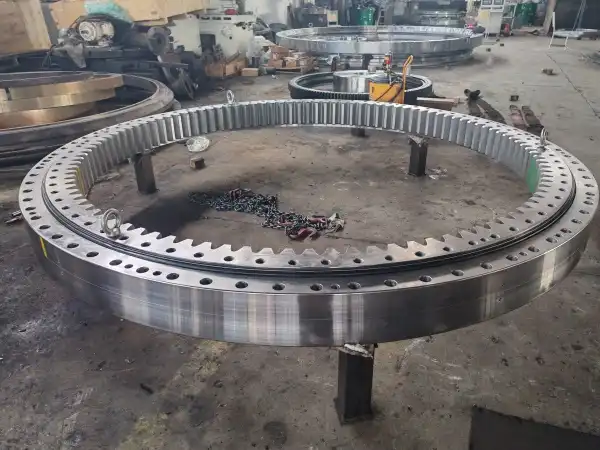
How Does a Custom Slewing Ring Turntable Improve Load Capacity and Stability?
A one-of-a-kind slew ring turntable combines a bearing, mounting holes, and sometimes a built-in gear into one compact spinning product. It can bear axial and radial loads, and tilt moments at the same time. It is a good base for cranes, excavators, wind turbines, and medical equipment. The turntable is matched to your real working loads, evenly distributes stress, and stabilizes the machine during slewing. Raceway form, ball or roller arrangement, and hardened steel.
You may also adjust the diameter, flange arrangement, and gear specification so the unit fits your structure without any extra adapters. Induction hardened to HRC 55-62, with a case depth of 3- 6 mm. This also provides a steady load route under shock loading.
Here you will see how each design choice contributes to reliable, balanced rotation and extended service life of your equipment. The table below illustrates the effect of the primary levers of customization on capacity and stability.
| Customization Lever | Effect on Load Capacity and Stability |
|---|---|
| Raceway geometry matched to real loads | Even stress distribution, steadier slewing |
| Ball or roller arrangement | Higher axial, radial, or tilting moment capacity |
| Diameter and flange layout | Fits your structure without extra adapters |
| Gear specification (internal, external, or none) | Direct drive integration, cleaner load path |
| Thick-wall or thin-section design | Machine height reduced by 30–50% |
Which Slewing Ring Turntable Design Best Fits Your Machine Requirements?
Choosing the right structure starts with understanding your load direction, speed, and space limits. Heng Guan Bearing produces single-row four-point contact ball, cross cylindrical roller, three-row roller, double-row ball, and combination designs, in outer diameters from 200 mm to 10,000 mm and accuracy grades P0, P6, P5, and P4. Each slewing ring turntable type suits different duties, so a quick comparison helps you narrow the options before talking to an engineer.
| Design | Best For | Key Advantage |
|---|---|---|
| Single row four-point ball | Light to medium loads | Compact, cost-effective |
| Cross cylindrical roller | Precision rotation | High rigidity |
| Three row roller | Heavy-duty lifting | Maximum load capacity |
| Double row ball | Balanced loads | Strong overturning resistance |
If your application falls between these categories, our designers can build a non-standard slewing ring turntable from your 2D drawing, or reverse engineer a worn sample when no 3D model exists. Email us at mia@hgb-bearing.com to share your drawings and receive a tailored recommendation.
Can Precision Engineering Reduce Friction, Vibration, and Machine Downtime?
The worth of a custom-made slewing ring turntable is precision engineering. Accurate grinding of the raceways, controlled clearance, and carefully heat-treated surfaces provide smooth movement of rolling elements, low friction, and quiet operation. Smoother rotation also means less vibration, helping to protect nearby gears, motors, and structural parts from excessive wear. Heng Guan Bearing employs sophisticated processing equipment and testing instruments, skilled designers, and an expert production team to ensure quality from raw material to finished product.
Each item is verified using coordinate measuring instruments, portable hardness testing, and vibration spectrum analysis, with material traceability to the steel mill test report. maintains your machine in position properly, cuts down on maintenance interruptions, and maintains production on schedule with constant functioning.
Whether you are in automation, mining, ports, or renewable energy, a well-produced slewing ring turntable gives you a more consistent output, less maintenance work, and greater confidence in daily operation. The critical technical specifications are shown in the table below.
| Parameter | Specification |
|---|---|
| Outer diameter | 200 mm – 10,000 mm |
| Precision grades | P0, P6, P5, P4 (ISO) |
| Ring material | 42CrMo, 50Mn alloy steel (Q+T, core 229–269 HB) |
| Rolling elements | GCr15SiMn high-purity bearing steel |
| Raceway hardness | HRC 55–62, case depth 3–6 mm |
| Gear accuracy | ISO/DIN 8–10, optional tooth surface hardening |
| Seals | Nitrile or fluororubber double-lip |
| Cages | Brass, steel, or engineering plastic |
| Operating temperature | -40°C to +80°C |
| Compliance | ISO 9001:2015, RoHS, EN 10204 3.1 |
Installation and Maintenance Practices for Long-Lasting Slewing Ring Turntable Performance
Good practices are important in installation and in service to get the maximum capabilities of any slewing ring turntable. Mount on a flat, clean surface and then evenly tighten nuts in a crisscross manner to the proper torque. Fill the race with sufficient oil. Gently turn the device to spread the lubrication and check the meshing of the gears before putting the machine into full use. Practical goals include flatness of the mounting surface within 0.5 mm, bolts tightening in three steps, 30%, 70%, and 100% torque with a calibrated wrench, and gear backlash within 0.1 mm and 0.3 mm.
Then a simple routine will provide consistent performance and provide early notice of any need for adjustment. By planning these operations in the specification stage, a customized slewing ring turntable is easier to install and cheaper to own throughout its full service life.
| Task | Suggested Frequency |
|---|---|
| Inspect bolt tightness | Every 100 operating hours |
| Re-lubricate raceway and gear | Every 3 to 6 months |
| Check seals and rotation smoothness | Every 6 months |
Following this schedule helps your equipment run reliably for years.
Conclusion
A unique slewing ring turntable increases load capacity, stability, and accuracy while reducing vibration and downtime. Properly selected, installed, and cared for, it becomes a long-term asset. Heng Guan Bearing has the design skills and flexible manufacturing to meet your demands. Contact Us immediately to step up your machine performance.
FAQ
Q1: What loads can a slewing ring turntable handle?
A: It handles axial, radial, and tilting moment loads at once.
Q2: What size range does Heng Guan Bearing offer?
A: Outer diameters from 200 mm to 10,000 mm, including non-standard designs.
Q3: Which accuracy grades are available?
A: P0, P6, P5 and P4.
Q4: Which industries use these products?
A: Wind power, construction, mining, medical, ports, and automation, among others.
Q5: How often should I lubricate it?
A: Every three to six months, depending on working conditions.
Start Your Custom Slewing Ring Turntable Project Today
Ready to improve your machine performance? Send your requirements and drawings to Heng Guan Bearing at mia@hgb-bearing.com. Our engineers will recommend a cost-effective, precisely matched slewing ring turntable solution and support you from design to delivery. Contact us now and build a stronger future together.
References
1. Harris, T. A., & Kotzalas, M. N. Essential Concepts of Bearing Technology. CRC Press, 2006.
2. Brändlein, J., Eschmann, P., Hasbargen, L., & Weigand, K. Ball and Roller Bearings: Theory, Design and Application. Wiley, 1999.
3. Harnoy, A. Bearing Design in Machinery: Engineering Tribology and Lubrication. CRC Press, 2002.
4. Budynas, R. G., & Nisbett, J. K. Shigley's Mechanical Engineering Design. McGraw-Hill Education.
5. Hamrock, B. J., Schmid, S. R., & Jacobson, B. O. Fundamentals of Machine Elements. McGraw-Hill, 2005.
6. ISO 281:2007. Rolling Bearings: Dynamic Load Ratings and Rating Life. International Organization for Standardization.

WHAT OUR CUSTOMERS SAY
Here is the customer's evaluation of us