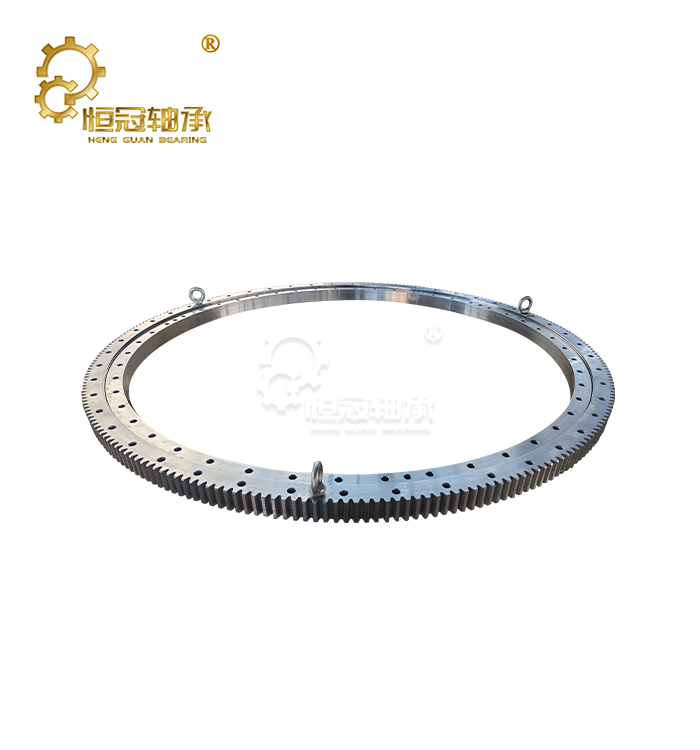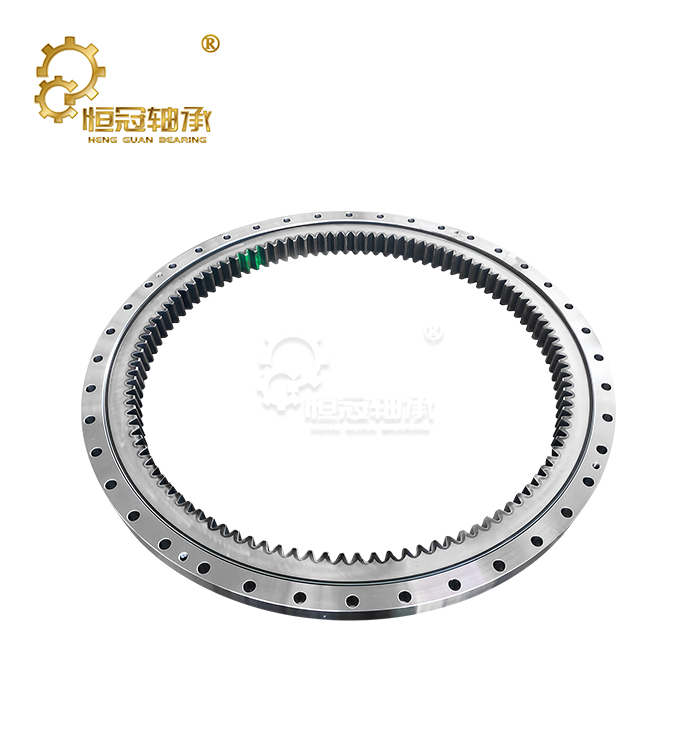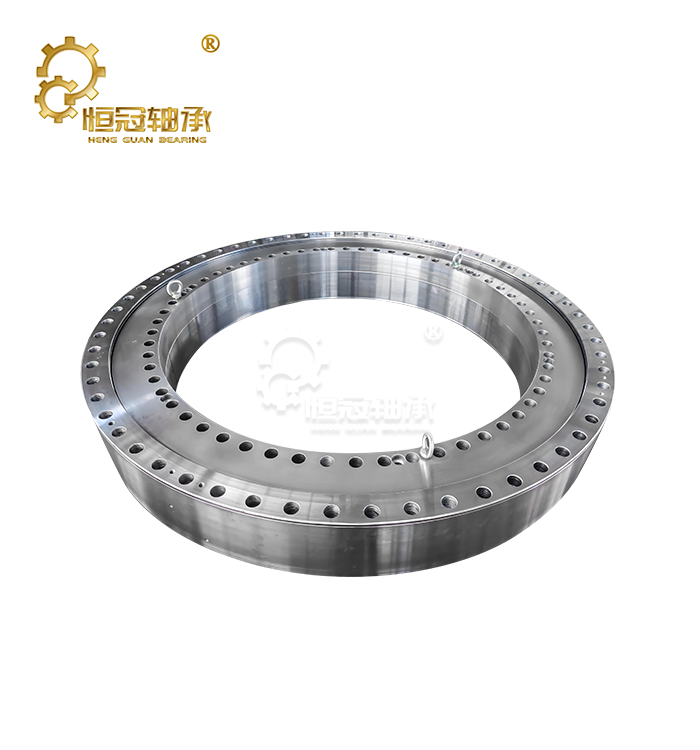




Common applications for large slewing bearings
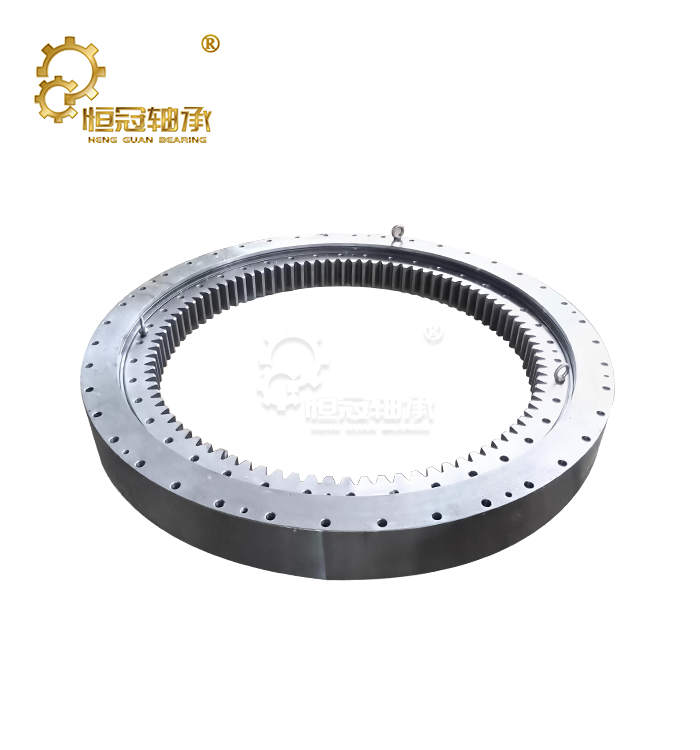
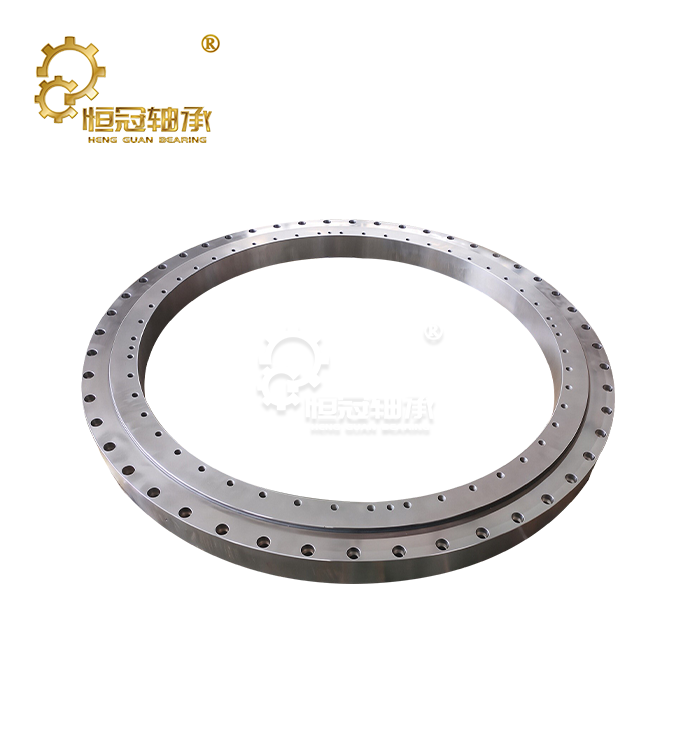
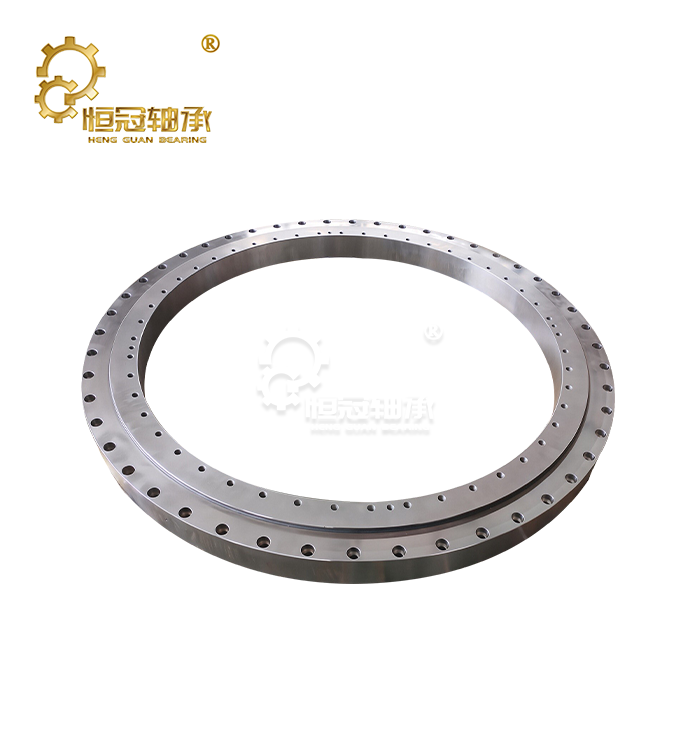
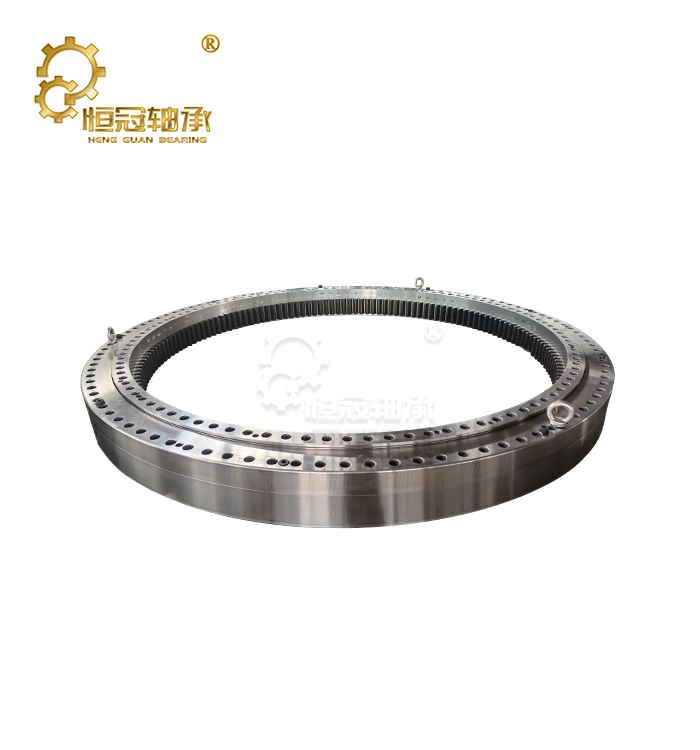
Large slewing bearings are designed to support controlled rotation while carrying combinations of axial loads, radial loads, and overturning moments. Unlike conventional bearings that are often installed around a rotating Shaft, a slewing bearing normally forms a large-diameter interface between two machine structures, allowing one assembly to rotate relative to the other. This makes them suitable for equipment where high load capacity, compact installation, and controlled rotation are required. A large diameter crane slewing bearing ,For example, it connects the rotating and non-rotating parts of a crane, transferring the lifting loads and resisting the overturning moments generated by the boom and suspended load. Similar configurations of bearings are found in port machinery, mining equipment, wind turbines, excavators, material handling systems and other heavy-duty machines. The bearing may be internal gear, external gear or gearless depending on the application. Ball or roller raceways may be selected according on the required load capacity and operating circumstances. Knowing where massive slewing bearings are employed is merely the beginning. For equipment makers and purchasing departments the more essential concern is whether the bearing chosen is suitable for the actual load spectrum, mounting arrangement, gear required, operating environment and maintenance circumstances of the machine.
How Do Large Slewing Bearings Support Heavy Machinery?
A large rotating interface for complex loads
The fundamental advantage of a slewing bearing is that it can combine a wide rotating diameter and the ability to sustain numerous load directions in one structural component. For example, in a crane the bearing may be subjected concurrently to an axial load from the load being hoisted, radial forces due to the machine construction, and an overturning moment due to the location of the boom.
This load combination is distinct from the operating conditions of many conventional bearings. Thus, the engineer must consider the total load case and not choose a bearing based on bore or outside diameter simply.
The geometry of the bearing raceway, rolling elements, cross section, bolt arrangement, and mounting structure influence the performance of the bearing. The rigidity of the surrounding machine frame is also significant, since an otherwise perfectly designed bearing may suffer from uneven loading if the supporting structures are not sufficiently rigid or properly aligned.
Internal and external gear arrangements
If the application demands an integrated drive gearbox of rotation, large slewing bearings can be supplied with internal or external gear teeth.
The teeth may be arranged in an internal gear arrangement in the bearing ring. This may be desirable if the pinion and drive must be within the bearing envelope or if the surrounding machine design benefits from a more compact layout.
The teeth are on the exterior of the bearing ring in an external gear arrangement. This design provides easy access to the driving components. It may be suitable where the available machine layout permits the pinion to mesh with the outside circumference.
The two configurations are not better “across the board." The selection is based on the installation space available, the arrangement of drives, the required torque, the access for maintenance, and the geometry of the surrounding equipment.
Ball and roller bearing configurations
Varied raceway configurations are available to meet varied load and accuracy requirements. Single-row four-point contact ball slewing bearings are generally employed where modest axial, radial, and moment stresses have to be accepted within a compact design.
Double-row ball variants are available for applications requiring more load-carrying capacity within a given dimensional envelope.
Three-row roller slewing bearings are engineered for demanding applications where strong radial and axial loads and significant overturning moments need to be supported. This design is often used for heavy industrial equipment, because different sets of rollers can carry different parts of the load.
Cross-roller arrangements can offer high rigidity and rotational accuracy where deflection control is very critical. Always select the proper structure according to the actual working loads and the performance required, not just the largest bearing you have.
Where Large Slewing Bearings Are Commonly Used?
Port cranes and container handling systems
Large slewing bearings are among the most demanding settings for port machinery. Ship-to-shore cranes, gantry cranes, reach stackers, and other material handling systems rotate frequently while managing significant loads.
In such equipment a slewing bearing has to endure many loading cycles and yet rotate accurately. There may also be significant overturning moments on the bearing as the lifting mechanism or boom passes through the various stages of operation.
The oceanic environment complicates matters further. If sealing and lubrication are not correctly controlled, corrosion can be accelerated by salt-laden air, moisture, dust, and temperature variations, or the raceway and gear system can be contaminated.
Hence, port equipment buyers should go beyond static load capacity. Seal design, corrosion protection, gear quality, lubrication access, mounting accuracy, and inspection needs can all impact long-term operating durability.
Tower cranes and mobile cranes
Cranes have slewing systems that turn the upper structure with loads in different boom positions. Therefore, the slewing bearing is not only a rotating mechanism but also an indispensable part of the load transfer.
The comparatively large slewing bearings may be used in tower cranes. This is because the bearing has to transfer the combined loads from the tower, counterweight, boom, and hanging load. The bearing and its mounting bolts must function properly with the structural frame of the crane to resist overturning moments.
Mobile cranes have unique criteria since their operating circumstances may vary widely from one job site to the next. The bearing will have to withstand frequent starts and stops, different load positions, and various working circumstances.
When specifying a crane bearing, engineers should describe the maximum axial load, radial load, overturning moment, rotation speed, gear requirements, mounting dimensions, and the estimated duty cycle. These factors offer a far more dependable basis for selection than diameter alone.
Excavators and mining equipment
Another big application for slewing bearings is in excavators. The upper structure of an excavator has to turn in relation to the undercarriage with the boom, arm, bucket, hydraulic components, and working load attached.
During the digging process, the bearing experiences shock impacts and variable loads. Furthermore, the operating environment of the bearing may be exposed to muck, dust, vibration, moisture, and abrasive particles.
Mining equipment can make circumstances considerably worse. Large excavators, bucket-wheel systems, stackers, reclaimers, and other material-handling equipment may run constantly under large loads.
If a high load capacity and rigidity are required, then the roller-based slewing bearing designs can be desirable for these machines. However, the bearing selection still needs to take into account the real load spectrum, the rotation frequency, the structure stiffness, the lubrication method, and the projected maintenance interval when selecting a large diameter crane slewing bearing.
Wind turbine yaw and pitch systems
Yaw and blade pitch are two essential rotational systems in wind turbines where slew bearings are used.
The yaw mechanism allows the nacelle to spin around the tower so that the rotor can be aligned with the wind direction. The yaw bearing has to be able to carry the loads transferred by the nacelle and rotor and allow for repetitive low-speed rotation and placement.
Pitch bearings do something distinctive. Each blade is free to spin about its own longitudinal axis so that the angle of the blade can be changed in flight. Control of the pitch is important to regulate aerodynamic forces, optimize the capture of energy, and safeguard the turbine under high wind situations.
Wind turbine bearing design needs to take into account lubrication, sealing, fatigue performance, corrosion resistance, and long-term inspection carefully. Maintenance can be particularly expensive, as access to the turbine often involves specialist lifting equipment or working at considerable height.
Material handling and industrial turntables
Large slewing bearings also find application in industrial turntables, lifting platforms, positioning equipment, stackers, reclaimers, and automated material handling systems.
In certain applications the bearing may be required to offer regulated rotation as opposed to continuous high-speed movement. Therefore, the distribution of the load and the accuracy of the rotation may be more significant than the maximum rotation speed.
For OEM equipment the bearing can be built to match the current mounting interface of the equipment. It can feature customized bolt-hole patterns, gear diameters, seals, raceway arrangements, and mounting surfaces.
This customization is particularly handy when a normal catalogue bearing is not suitable for the installation area available or when a specific drive interface is needed for the machine.
What Buyers Should Check Before Selecting a Slewing Bearing?
Start with the complete load case.
The most important selection step is defining the actual operating loads. Buyers should provide the maximum and typical axial load, radial load, and overturning moment whenever these values are available.
It is also useful to distinguish between normal operating loads, peak loads, shock loads, and emergency conditions. A bearing that performs adequately under a steady load may require a different design if the machine frequently experiences impact loading or sudden changes in direction.
Rotation speed and duty cycle should also be included. A bearing used for occasional positioning does not necessarily require the same design considerations as one that rotates continuously throughout a production cycle.
Check mounting dimensions and structural stiffness.
The bearing must match the machine's mounting interface. Important dimensions include the outside diameter, inside diameter, overall height, mounting-hole pattern, bolt size, and mounting-surface requirements.
However, dimensional compatibility alone is not sufficient. The supporting structures must provide adequate stiffness and maintain alignment under operating loads.
If the mounting surface is distorted or uneven, the bearing may experience localized raceway loading. This can increase wear and may reduce service life even when the nominal bearing capacity appears adequate.
Evaluate gear requirements.
For geared slewing bearings, the gear system must be compatible with the drive pinion. Buyers should check the module, number of teeth, pressure angle, gear accuracy, gear orientation, and required backlash according to the application.
The drive torque should also be considered. A bearing with an integrated gear is part of the complete rotary drive system, so the bearing, pinion, gearbox, motor, and supporting structure need to work together.
For OEM projects, providing the complete gear and drive requirements to the manufacturer can reduce the risk of interface problems during installation.
Consider the operating environment.
The working environment has a direct influence on bearing selection and maintenance.
Outdoor cranes may encounter rain, salt spray, dust, and temperature fluctuations. Mining machinery can operate in abrasive environments with heavy contamination. Wind turbines require long-term protection against moisture and corrosion.
These conditions affect the selection of seals, grease, surface treatments, and corrosion protection. For applications with unusual temperatures or aggressive contaminants, the manufacturer should be informed before the large diameter crane slewing bearing design is finalized.
Manufacturing Quality and Inspection Considerations
Material and heat treatment
The material selected for a slewing bearing ring must provide the required combination of strength, toughness, fatigue resistance, and machinability. Materials such as 42CrMo and 50Mn are used in different bearing components and applications, but the final performance depends on the complete manufacturing route rather than material grade alone.
Heat treatment is particularly important because the raceway and gear surfaces must withstand repeated mechanical loading and contact stress. The required hardness profile and depth depend on the bearing design and manufacturing process.
For procurement teams, asking for material certificates and relevant heat-treatment records can provide stronger quality evidence than relying only on a general statement such as “high-strength steel.”
Machining and gear accuracy
Large slewing bearing rings require controlled machining of raceways, mounting surfaces, gear teeth, and locating features. CNC machining, gear cutting, grinding, and dimensional inspection can be used at different stages of production.
Critical dimensions should be checked against the approved drawing and applicable manufacturing requirements. For OEM orders, inspection should cover not only the bearing itself but also the interface dimensions that determine whether it will fit the final machine.
Quality documentation
A professional supplier should be able to provide appropriate technical and quality documents for the application. Depending on the project, buyers may request material certificates, inspection reports, dimensional records, heat-treatment documentation, product drawings, lubrication information, and relevant quality-system certificates.
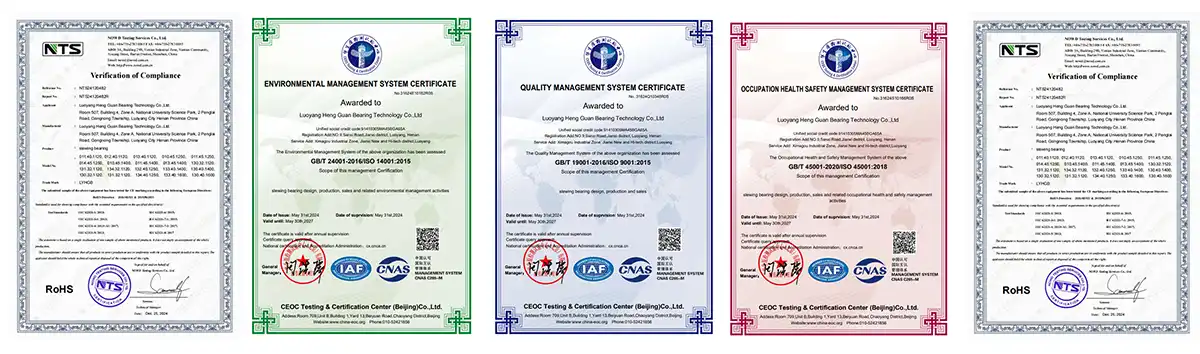
ISO 9001 certification can indicate that a supplier operates a documented quality-management system, but certification alone does not prove that a particular bearing is suitable for a specific machine. Product-level inspection and engineering validation remain important.
Maintenance Practices That Protect Bearing Performance
Lubrication and seal inspection
Correct lubrication is essential for protecting the raceway and rolling elements from excessive friction and wear. The lubrication method and interval should follow the bearing manufacturer's recommendations and be adjusted for operating conditions where appropriate.
Seals should also be inspected regularly. Damaged or degraded seals can allow water, dust, and other contaminants to enter the bearing.
For geared bearings, gear teeth should be inspected separately from the raceway. Abnormal tooth wear, pitting, or poor lubrication may indicate problems with the drive alignment or lubrication system.
Monitor bolts, backlash, and operating condition.
Mounting bolts are critical because they transfer forces between the bearing and machine structure. Inspection procedures should therefore include checking bolt condition and, where specified by the manufacturer, tightening torque.
For geared applications, monitoring gear backlash and tooth condition can help identify developing problems. Unusual vibration, temperature increases, noise, or changes in rotational resistance should also be investigated rather than ignored.
A maintenance record can be particularly useful for high-value machinery because it allows changes in operating condition to be compared over time.
Conclusion
Large slewing bearings are critical components in cranes, ports, mining equipment, wind turbines, excavators, material handling systems, and industrial positioning equipment. Their value comes from their ability to support large rotating structures while carrying combinations of axial loads, radial loads, and overturning moments.
Choosing the correct bearing requires more than matching an outside diameter. Engineers and procurement teams should evaluate the complete load case, raceway configuration, gear arrangement, mounting interface, operating environment, lubrication requirements, and expected duty cycle. Material quality, heat treatment, machining accuracy, inspection procedures, and supplier engineering support also influence long-term performance.
For applications such as cranes and heavy lifting equipment, a large diameter crane slewing bearing should be selected according to the actual mechanical and environmental conditions of the machine. A well-defined specification can reduce installation problems, improve maintenance planning, and lower the risk of unplanned downtime.
For OEM or replacement projects, buyers can improve the quotation process by providing drawings, load data, mounting dimensions, gear requirements, operating conditions, and target service requirements at the beginning of the project. Working with a manufacturer capable of engineering customization, dimensional inspection, and technical support makes it easier to develop a slewing bearing that fits the equipment rather than forcing the equipment to adapt to a generic bearing.
FAQ
1. What factors influence load capacity in large-diameter slewing bearings?
The load capacity is affected by many factors that are connected to each other, such as the diameter of the bearing, the shape of the race, the rolling element configuration, and the material properties. Single-row ball configurations are less capable than three-row roller configurations. Installing and aligning things correctly has a big effect on how much weight they can actually hold. This is because misalignment concentrates stress and lowers the effective capacity.
2. How often should the slewing bearings on a large diameter crane be serviced?
When to do maintenance depends on how often it needs to be done and the environment. Continuously used equipment in harsh environments needs more frequent attention than machinery that is only used sometimes in controlled settings. Manufacturers usually suggest an initial inspection after 100 hours of use, followed by lubrication every three months and a full inspection once a year. Condition monitoring systems let you make schedules that are based on the actual condition of parts instead of just picking random times.
3. Can slewing bearings be customized for unique applications?
Manufacturers with flexible production options can meet non-standard needs like custom sizes, odd mounting arrangements, and changes that are needed for a specific application. Customization helps with problems like limited space, strange load profiles, and integrating new and old equipment. Consulting an engineer makes sure that the custom solutions meet operational needs while keeping the structure's integrity and performance standards.
Partner with Heng Guan for Premium Slewing Bearing Solutions
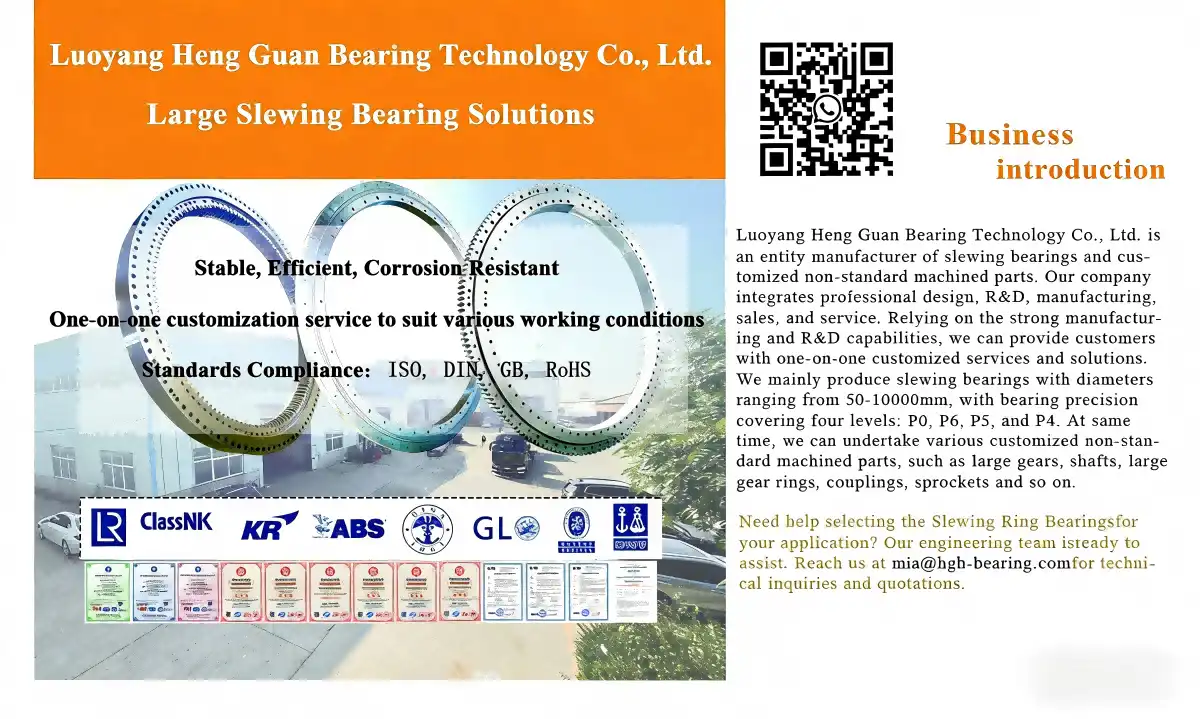
Luoyang Heng Guan Bearing Technology stands ready to support your heavy machinery needs with expertly engineered large diameter crane slewing bearing solutions. Our ISO 9001-certified manufacturing facility in Luoyang produces slewing bearings from 50mm to 10,000mm in diameter, covering accuracy grades P0, P6, P5, and P4. With over 20 years of specialized experience, we deliver personalized optimization design and customized flexible production meeting precise requirements across construction, mining, wind energy, and port machinery applications. Our products reach over 50 countries, earning recognition for quality and reliability. As a trusted Large Diameter Crane Slewing Bearing manufacturer, we combine advanced CNC manufacturing capabilities with comprehensive technical support, ensuring you receive high-cost-performance products backed by expert consultation. Contact our engineering team at mia@hgb-bearing.com to discuss your specific application requirements and receive detailed quotations tailored to your operational and budgetary objectives.
References
1. American Bearing Manufacturers Association. (2021). Slewing Bearing Design and Application Guide for Heavy Machinery. ABMA Standards Publications.
2. Chen, W., & Liu, H. (2020). Advanced Materials and Manufacturing Processes for Large Diameter Rotational Bearings. Journal of Mechanical Engineering Science, Vol. 234, Issue 12.
3. International Organization for Standardization. (2019). ISO 286-1:2019 Geometrical Product Specifications - Bearing Tolerance Standards. ISO Technical Committee.
4. Kruger, T., & Meier, F. (2022). Load Distribution Analysis in Multi-Row Roller Slewing Bearings for Wind Turbine Applications. Renewable Energy Engineering Quarterly, Vol. 18.
5. National Renewable Energy Laboratory. (2023). Wind Turbine Bearing Performance and Maintenance Best Practices. U.S. Department of Energy Technical Report.
6. Society of Automotive Engineers. (2021). SAE J1105: Testing and Performance Standards for Heavy Equipment Slewing Bearings. SAE International Standards.

WHAT OUR CUSTOMERS SAY
Here is the customer's evaluation of us