




Which single row ball slewing ring internal gear Fits Your Machine?
Choosing the incorrect slewing ring discreetly costs you money throughout the life of your crane, turntable, or medical scanner—in the form of unnecessary downtime, unscheduled inspections, and premature replacement. To avoid that danger, many machines use a single row ball slewing ring internal gear that combines a compact four-point contact ball raceway with gear teeth cut directly into the inner ring. The pinion is within the bore, keeping the assembly safe, and you have a clean exterior profile for cables, hydraulic lines, or a central Shaft. Luoyang Heng Guan Bearing Technology Co., Ltd. has been designing and manufacturing these rings for equipment producers throughout the globe for more than three decades. The four checkpoints below — load, gear data, measurements, and verification — teach you how to confidently match a ring to your machine.
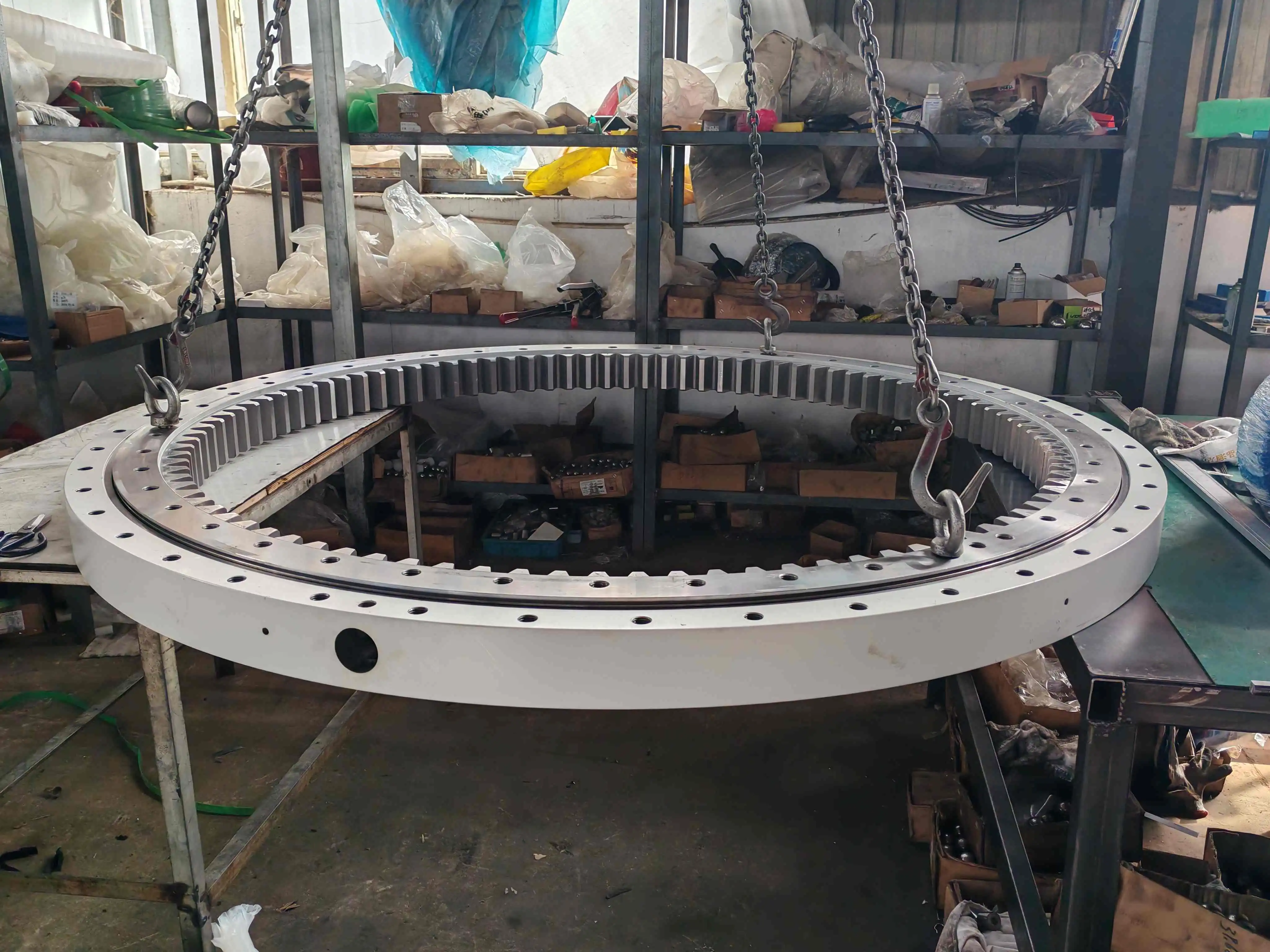
How Do You Match a Single Row Ball Slewing Ring Internal Gear to Load?
Begin with the loads your machine really creates, as each slewing ring is simultaneously subjected to an axial force, a radial force, and a tilting moment. A single-row ball slewing ring has a four-point contact raceway on the internal gear. This is designed to carry all three loads in one compact track, so there is no need to stack a thrust and a radial bearing. Calculate the maximum static loads your machine can apply and then calculate an appropriate safety factor for your job class. A packing line, a light turntable and a port crane all sit in distinct load levels, and the ring you choose has to sit well above your actual peak demand – not just above the marketing brochure.
For medium-load applications such as rotating tables, medical scanners, solar trackers and small mobile cranes, a tiny internal gear slewing ring is a good solution where low weight and a clean outside profile are more important than outright capacity. Heng Guan Bearing experts frequently examine client load charts and will prescribe a ring with a static capacity much in excess of the peak, which is the key to a long, steady service life.
| Application | Typical Load Profile | Suggested Focus |
|---|---|---|
| Rotary table | Light axial, low moment | Compact size and low friction |
| Medical scanner | Light radial, very low moment | Smooth rotation, low noise |
| Small mobile crane | Medium axial and moment | Raceway capacity and moment stiffness |
| Solar tracker | Wind-driven, oscillating moment | Corrosion protection and seal integrity |
| Welding positioner | Combined axial and moment | Heat-resilient grease and seal |
| Small wind yaw drive | Moderate moment, cyclic direction | Surface treatment and grease interval |
What Gear Parameters Matter When Choosing the Right Slewing Ring?
Once you have chosen the load capacity, look at the gear, since the improper module or pressure angle will make it loud and unevenly meshing and will consume the pinion quicker than the catalog indicates. The internal gear of a small internal gear slewing ring is often hardened on the tooth flank to prevent wear, and there are four numbers you need to validate with your supplier: module, number of teeth, pressure angle, and profile shift. If all four values do not perfectly match your pinion, the gearbox will feel harsh before the warranty is up.
The compact internal gear slewing ring generally has a finer module, enabling precise placement and silent rotation inside enclosed areas. Heng Guan Bearing can provide bespoke gear data and accuracy grades from P0 to P4, so you may specify precisely what your transmission requires, rather than fitting your design to a catalog product. Always compare the tooth width with the torque your drive can give and inquire whether the teeth are hardened all the way through the flank or only on the surface.
| Specification | Value or Range | Why It Matters |
|---|---|---|
| Raceway centre diameter | 50 – 10,000 mm | Covers most industrial machine sizes |
| Rolling element material | GCr15 high-carbon chrome steel | Stable contact under combined loads |
| Ring material (standard) | 42CrMo alloy steel | High toughness for impact loading |
| Ring material (options) | 50Mn, 40Cr, 316L stainless | Cost or corrosion tuning |
| Raceway hardness | 58 – 62 HRC | Resists pitting under cyclic load |
| Tooth flank hardness | 45 – 55 HRC | Wear resistance for the gear mesh |
| Gear precision | DIN 6 / ISO 1328-1 | Quiet, accurate meshing |
| Accuracy grades | P0 / P6 / P5 / P4 available | Match precision to duty |
| Contact angle (ball to raceway) | 90° | Even load sharing on all four paths |
How Do Bore Size and Mounting Dimensions Affect Machine Fit?
A ring that bears the strain but doesn’t bolt up to your frame is of limited value, so evaluate your installation area carefully before purchase. The internal gear arrangement permits a large center bore to transport cables, hydraulic lines, a slip-ring assembly, or a central shaft directly through the machine. Before you commit, check the outside diameter, bore diameter, overall height, bolt circle, and the number and size of mounting holes against your design.
A compact internal gear slewing ring might be the smart option if space is at a premium on your frame — the thin profile saves both weight and expense over a bigger four-point contact alternative. Heng Guan Bearing can manufacture any row ball slewing ring internal gear with non-standard hole patterns, unique flange thicknesses, and OEM plug-in replacement geometry, allowing you to typically retrofit the ring to an existing structure instead of reworking the chassis. Heng Guan’s small flange integration generally saves 30 to 40 percent of the installation area that a standard shaft-and-bearing solution requires. Send your drawings to mia@hgb-bearing.com and the team will check fit, walk you through the bolt-pattern options, and confirm tolerances before production begins.
| Dimension | What to Check | Why It Helps |
|---|---|---|
| Bore diameter | Cable, slip-ring or shaft clearance | Easy routing through the centre |
| Outer diameter | Frame envelope clearance | Avoids housing rework |
| Total height | Available frame space | Compact, low-profile design |
| Bolt circle | Hole count and pitch | Secure, even mounting |
| Mounting holes | Thread size and depth | Correct fastener strength |
| Flange thickness | Seating surface flatness | Stable support under moment load |
How Can You Verify Gear, Load, and Pinion Compatibility Before Buying?
Before you place an order, go through a quick checklist to make sure nothing is left to assumption. Compare your predicted moment, axial and radial loads against the ring’s rated capacity. Then verify that your pinion’s module, tooth count, and center distance mesh appropriately with the internal teeth of the single-row ball slewing ring internal gear you have identified. Ask about the centre-distance tolerance and the backlash range, since these two values affect gearbox feel and noise.
If it is a small internal gear slewing ring, additionally check the hardness zone of the raceway and the location of the soft zone; make sure it is located away from your primary load region and not beneath it. If you are choosing a tiny internal gear slewing ring for a precise application, ask for a review of the design and, if feasible, a sample trial before serial production. Heng Guan Bearing helps clients with design reviews, accuracy choices, and proven production runs, lowering the risk of surprises on the assembly line. Tell us about your working circumstances, your duty cycle, and your lubrication strategy, and the staff will be happy to check compatibility step by step.
| Configuration / Option | Typical Use Case | Practical Benefit |
|---|---|---|
| Hardened internal teeth (standard) | Most enclosed gear drives | Long gear life under cyclic load |
| Non-hardened internal teeth | Field machining or fine adjustment | Easier on-site modification |
| External-gear variant | Open drives with accessible pinions | Direct drive without idler gear |
| Gearless friction drive | Slow, smooth positioning | No tooth wear, very quiet |
| Standard surface finish | Indoor and sheltered equipment | Cost-effective baseline |
| Hot-dip galvanised finish | Marine, salt-spray or outdoor service | Long-term corrosion resistance |
| Standard grease interval | Clean indoor environments | Service every 100 working hours |
| Shortened grease interval | Construction, solar fields, dust | Service every 50 working hours |
How Luoyang Heng Guan Solves Your Single Row Ball Slewing Ring Internal Gear Challenges
Broad coverage. With more than 25 standard versions available, with raceway widths from 50 mm to 10,000 mm, the same provider may provide a tiny desktop turntable, a 1.5 MW yaw drive, and a heavy-duty port crane.
Flexibility of the material. Standard 42CrMo rings are tuned for impact. 50Mn, 40Cr, and 316L stainless are available for cost-sensitive or corrosive settings, as well as hot-dip galvanizing for marine operation.
Quality assured. Production is ISO 9001 certified, using RoHS-compatible materials and gear geometry cut to DIN 6 / ISO 1328-1 with size interchangeability against standard Rollix RKS references.
Designed details. CNC induction quenching provides a solid 58–62 HRc raceway and a 45–55 HRc tooth flank; the 90° contact angle is a good compromise between all four load routes, and triple-sealing (dual-lip seal + O-ring barrier) acts as a contamination barrier.
Practical assistance. Our team of 50+ engineers will examine load charts, verify drawings against machine envelopes, recommend bolt designs, and even execute a trial build prior to serial release.
Logistics: International Heng Guan Bearing ships to crane builders, excavator OEMs, medical device integrators, and renewable-energy platforms in over 60 countries, with documentation adapted to each market.
Long-term value. Typical designs have a 25-year service life in solar tracker duty, and the same quality system includes compact ring replacements for aging equipment.
Conclusion
In the single row ball slewing ring internal gear , the correct ring is loaded, then it moves on to gear data, and finally, it concludes with measurements and a compatibility check that is completely clean. Heng Guan Bearing is responsible for the production of an internal gear that is designed for a single-row ball slewing ring. This gear is characterized by its compact strength, silent meshing, and individual customization. Each of these characteristics helps to ensure that your computer continues to operate without any hiccups and with reliability for a substantial period of time.
FAQ
Q: What loads can a single row ball slewing ring internal gear carry?
It carries combined axial, radial, and tilting moment loads through a single four-point contact ball raceway, so there is no need to combine separate thrust and radial bearings.
Q: Is a small internal gear slewing ring suitable for medical equipment?
Yes. Its compact size, smooth rotation, and low moment of inertia suit scanners, imaging platforms, and other precision rotary equipment.
Q: Can the gear module be customised?
Yes. Heng Guan Bearing can customise the module, tooth count, pressure angle, and profile shift to match your pinion and your gearbox layout.
Q: Which accuracy grades are available?
Grades P0, P6, P5 and P4 are available, so you can match precision to duty cycle and budget.
Q: Can mounting holes be non-standard?
Yes. Hole patterns, bolt-circle diameters, and flange thicknesses can all be adapted to your existing structure, often saving a chassis redesign.
Ready to Find the Single Row Ball Slewing Ring Internal Gear That Fits Your Machine?
Send your drawings, load data, and pinion details to mia@hgb-bearing.com today. A single row ball slewing ring internal gear will provide a fast, professional recommendation and a tailored quotation, so your next project starts on solid ground.
References
1. Harris, T. A., & Kotzalas, M. N. (2007). Essential Concepts of Bearing Technology (5th ed.). CRC Press.
2. International Organization for Standardization. (2006). ISO 76:2006 — Rolling bearings — Static load ratings. ISO.
3. International Organization for Standardization. (2007). ISO 281:2007 — Rolling bearings — Dynamic load ratings and rating life. ISO.
4. American Gear Manufacturers Association. (2004). ANSI/AGMA 2001-D04 — Fundamental Rating Factors and Calculation Methods for Involute Spur and Helical Gear Teeth. AGMA.
5. Budynas, R. G., & Nisbett, J. K. (2015). Shigley’s Mechanical Engineering Design (10th ed.). McGraw-Hill Education.
6. Hamrock, B. J., Schmid, S. R., & Jacobson, B. O. (2005). Fundamentals of Machine Elements (2nd ed.). McGraw-Hill.

WHAT OUR CUSTOMERS SAY
Here is the customer's evaluation of us