




What Should Buyers Check Before Ordering Large Slewing Bearings?
When you order large slewing bearings, you're affecting the safety, uptime, and long-term cost of your machine. When people buy tools for wind power, ports, mines, and metallurgy, Heng Guan Bearing sees the same key checks over and over again. To help you feel good about placing your order, this guide talks about the item's load capacity, size, materials, and inspection records. Read on to make a list of things you need to buy.
What Load Capacity Should Large Slewing Bearings Meet for Heavy-Duty Applications?
What your equipment will really see is the following loads: axial thrust, radial force, and overturning moment. These factors typically function in concert. A single massive slewing bearing may carry all three load pathways in a short area. But the ideal internal structure will depend on how heavy and moving the load is. The single-row four-point contact ball type is best suited to light loads when smooth rotation is more critical than peak rigidity.
By comparison, the double-row ball design offers more moment stiffness to wind pitch and yaw systems that need an angle to be maintained while the wind is blowing. Due to the cross-roller construction, precision tables are more robust and may be assembled with closer clearance. Three-row roller designs are capable of supporting the highest weight for mining shovels, ladle turrets, and stacker-reclaimer slews. Tell the seller early what your peak working load, job cycle, and operational conditions are. This way, the experts can make sure the construction suits your demands and doesn’t build it too huge or too small.
| Structure | Typical Load Profile | Typical Application |
|---|---|---|
| Single-row four-point ball | Moderate combined loads | General cranes, turntables |
| Double-row ball | Steady wind-driven moment | Wind pitch and yaw systems |
| Cross-roller | High rigidity, low vibration | Precision rotary tables, robotics |
| Three-row roller | Highest axial, radial, moment capacity | Mining excavators, ladle turrets |
Which Dimensions, Gear Specifications, and Mounting Details Must Buyers Confirm?
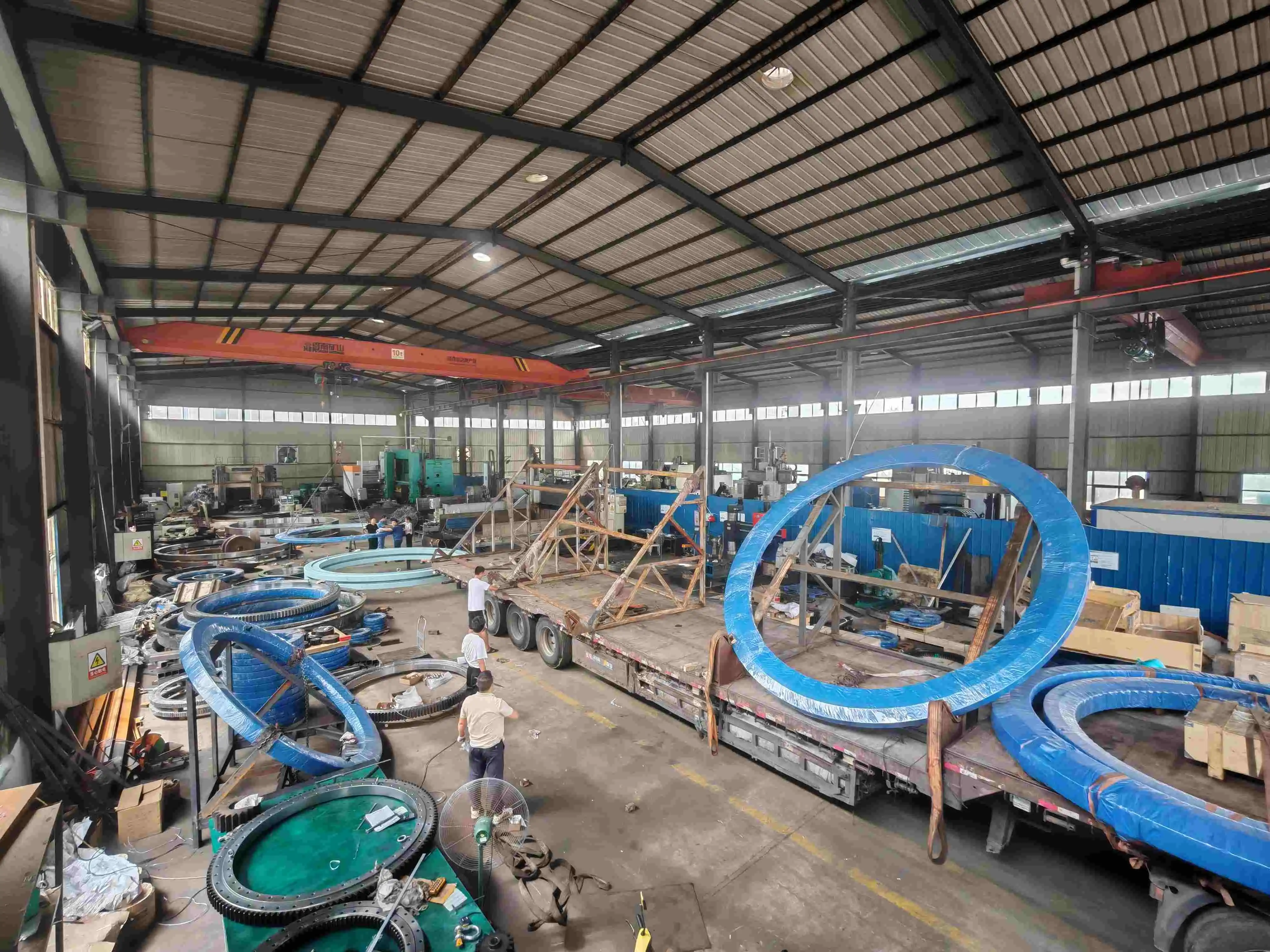
When you have a decent notion of the structure, compare the real characteristics to your image. Large slewing bearings from Heng Guan Bearing: inner diameter 50 mm to 8,000 mm; outer diameter 80 mm to 10,000 mm; height 20 mm to 500 mm. We can create custom sizes for equipment such as ship unloaders and tunnel boring machines that need handling of large parts. Decide whether you want an internal gear, external gear, or a non-geared ring.
Then check that the gear module, tooth count, pressure angle, and tooth hardening are all the correct ones for your driving pinion. Verify the drawing for the positions of the bolt holes, the diameter of the bolt circle, the flatness of the mounting surface (often maintained to within 0.2 mm per meter for an even distribution of torque), and any grease fittings that are to be utilized. Standardized bolt patterns make fitting quicker and simpler for future repairs, so be sure the bearing fits with a standard interface when you place your order.
If you have a schematic or 3D model of a test setup, send it to mia@hgb-bearing.com and the engineering team will check the fit and propose a tightening sequence before production begins.
| Item to Confirm | Why It Matters |
|---|---|
| Inner and outer diameter, height | Fit within the equipment envelope |
| Gear type, module and tooth count | Match the drive pinion without rework |
| Bolt circle, hole pattern and surface flatness | Ensure smooth installation and even preload |
How Do Material Grades and Heat Treatment Affect Bearing Service Life?
How long a bearing keeps turning smoothly depends on the material it is made of and how it is heated. Large slewing bearings excellent quality, with rings made of forged alloy steel 42CrMo or 50Mn and rolling elements made of high-purity bearing steel GCr15SiMn. The raceway surface is heated to HRC 55-62. This guarantees higher wear resistance and longer life. “The raceway shape is just as important as the chemistry. The contact angle is kept within ±2° by precise grinding, so that the stress is not concentrated in one area of the ring, but distributed uniformly throughout the rolling parts. You may choose a cage made of brass, steel, or engineering plastic.
Double seals, constructed of nitrile or fluorine rubber, seal in the lubrication and keep out dirt across the whole working range of -40°C to +80°C. Heng Guan Bearing chooses the combination depending on the temperature, dust, and moisture conditions in your location. This contributes to the longevity of big slewing bearings before they need servicing and minimizes the possibility of premature raceway brinelling.
| Material / Process Element | Effect on Service Life |
|---|---|
| Forged 42CrMo / 50Mn rings | High core toughness under shock loads |
| GCr15SiMn rolling elements | Stable fatigue life under combined loading |
| HRC 55–62 induction-hardened raceway | Wear resistance and long contact life |
| Precision-ground contact angle (±2°) | Even load distribution across rollers |
| Nitrile or FKM double seal | Lubricant retention and contamination exclusion |
What Quality Certifications and Inspection Reports Should a Manufacturer Provide?
The confirmation of the quality guaranteed in the catalog is on the shop floor. This is particularly true in large slewing bearings, which may not exhibit the impact of a soft batch for months of service. If your project or location requires it, seek a quality system that fulfills ISO 9001 criteria as well as ISO, DIN, GB, and RoHS standards. Provide dimensional inspection reports, material certifications, and installation data with each shipment. If required, other test reports such as hardness mapping, ultrasonic case depth check, and rotational torque records must be provided.
Heng Guan Bearing backs up its large slewing bearings with CNC machining, gear hobbing, and complete inspection records. It also provides remote technical help during installation, advising on the correct technique to tighten the bolts (30% → 70% → 100% torque in a star pattern) and suggesting to break them in for 50 hours at 25% of their rated load. Ask for these documents and check they fit your criteria before you pay. A confident seller will be pleased to hand them over, and if they seem to be reluctant, that's a signal you should be paying attention to.
| Document / Process | What It Confirms |
|---|---|
| ISO 9001 quality system | Controlled production process |
| Material certificate with heat number | Traceable steel grade and chemistry |
| Dimensional inspection report | Drawing-conformant geometry |
| Hardness and torque test records | Raceway hardness and smooth rotation |
| Installation data sheet | Correct on-site handling and bolt-up |
Conclusion
Before ordering large slewing bearings, confirm load capacity, dimensions, materials, and inspection records. With Heng Guan Bearing's customisation, ISO 9001 quality control, and engineering support, you can choose a bearing that fits your machine and runs reliably for years.
FAQ
1. What sizes of large slewing bearings are available?
Inner diameters of 50–8,000 mm and outer diameters up to 10,000 mm, with custom oversized options on request.
2. Which structure carries the heaviest loads?
Three-row roller types deliver the highest combined axial, radial, and moment capacity.
3. What precision grades are offered?
P0, P6, P5, and P4 grades are available across the large slewing bearings range.
4. Which documents come with shipment?
Dimensional inspection reports, material certificates, and installation data are standard.
5. How long is delivery for standard sizes?
About 4–6 weeks for standard large slewing bearings, with 8–12 weeks for large custom units.
Order Large Slewing Bearings from Heng Guan Bearing
Ready to place your order? Email your drawings, load data, or application details to mia@hgb-bearing.com. The Heng Guan large slewing bearings team will confirm your specification and send a tailored quotation promptly.
References
1. Harris, T. A., & Kotzalas, M. N. (2006). Rolling Bearing Analysis: Essential Concepts of Bearing Technology (5th ed.). CRC Press.
2. International Organization for Standardization. (2006). ISO 76: Rolling bearings — Static load ratings.
3. International Organization for Standardization. (2007). ISO 281: Rolling bearings — Dynamic load ratings and rating life.
4. International Organization for Standardization. (2015). ISO 9001: Quality management systems — Requirements.
5. Potočnik, R., Göncz, P., Flašker, J., & Glodež, S. (2010). Static capacity of a large double row slewing ball bearing with hardened raceway. Meccanica, 45, 927–935.
6. Smolnicki, T., Derlukiewicz, D., & Stańco, M. (2008). Evaluation of load distribution in the superstructure rotation joint of single-bucket caterpillar excavators. Automation in Construction, 17(3), 218–223.

WHAT OUR CUSTOMERS SAY
Here is the customer's evaluation of us