




How to Source a small slewing bearing for Precision Turntables?
It is more than just a diameter match to get a compact, small slewing bearing for a precise turntable. Heng Guan Bearing assists turntable designers who demand smooth rotation, high precision, and a small footprint, and the decisions you make early determine how your machine performs later. This handbook includes the parameters, performance considerations, bearing types, and supplier inspections that are most important. Read on to create a clear sourcing strategy.
What Specifications Matter When Selecting a Small Slewing Bearing for Precision Turntables?
Start with the envelope and the form. Heng Guan Bearing’s compact slewing bearing can fit in narrow spaces, with outside diameters from 80 to 500 mm, inner diameters from 60 to 400 mm, and heights from 8 to 40 mm. They can handle axial, radial, and overturning moment loads in one unit. Then choose the grade of precision: P0 suitable for ordinary equipment; P6 suitable for intermediate accuracy; P5 or P4 suitable for high-precision positioning and measuring.
Standard duty ring materials are GCr15 (SUJ2). Higher-strength alloy constructions use 50Mn and 42CrMo. SUS440C stainless steel is used for corrosive conditions such as food processing or maritime platforms. Please confirm gear selection (internal, external, or no gear), seal type (contact or non-contact), and mounting method through-bolt or threaded hole prior to ordering. Main parameters are summed together in the following table.
| Parameter | Range / Options |
|---|---|
| Outer diameter | 80–500 mm |
| Inner diameter | 60–400 mm |
| Height | 8–40 mm |
| Bearing type | Four-point contact ball or crossed roller |
| Precision grade | P0, P6, P5, P4 |
| Ring material | GCr15 (SUJ2), 50Mn, 42CrMo, SUS440C |
| Gear option | Internal, external, or no gear |
| Mounting style | Through-bolt or threaded hole |
| Operating temperature | -30°C to +80°C |
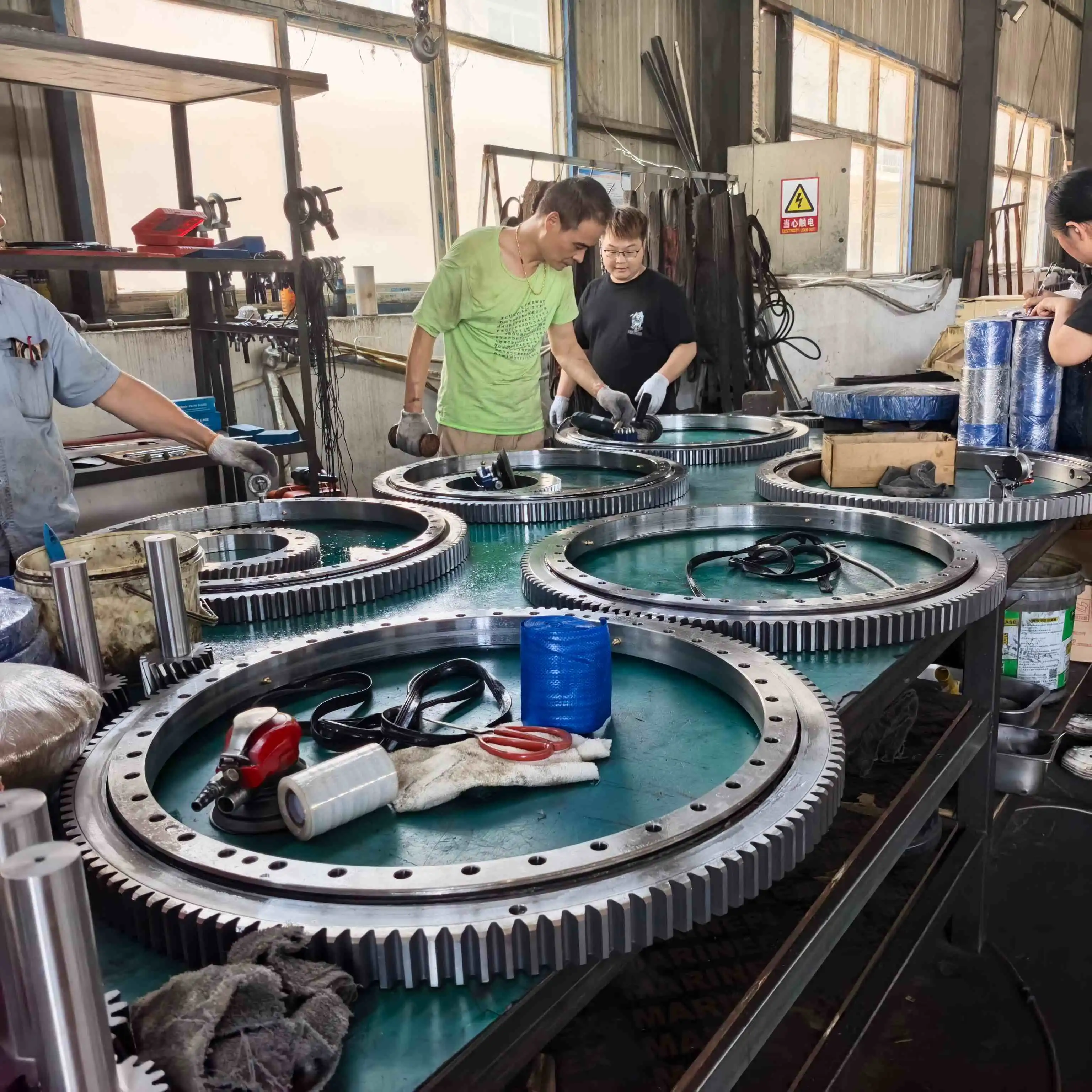
How Do Load Capacity, Runout, and Rotational Accuracy Affect Turntable Performance?
If your turntable is smooth or just okay, these three things will tell you. The tiny slewing bearing handles the working load with a comfortable margin; therefore, you will need to determine the load capacity from your maximum axial force, radial force, and overturning moment. The runout is the distance that the spinning surface wanders in a turn. This is kept low by precision-ground raceways with precisely chosen rolling elements. This is important to optical inspection, measuring, and positioning stages.
Smooth rotation also maintains picture quality and reproducibility. Helpful, too, is correct installation: faces flat to within approximately 0.05 mm, bolts torqued in a star pattern, and a last hand spin to be sure it runs free and doesn't bind. Share your load statistics with our engineers at mia@hgb-bearing.com. Heng Guan Bearing can help match capacity and accuracy to your turntable and propose a precision grade that fits both your duty cycle and your budget.
| Performance Factor | What It Means | What to Check |
|---|---|---|
| Load capacity | Axial + radial + moment margin | Compare against peak working loads |
| Runout | Rotating surface wander | Precision-ground raceway, low µ friction |
| Rotational accuracy | Repeatability under load | P5 or P4 for measurement stages |
Crossed Roller vs. Four-Point Contact Ball Bearings: Which Is Better for Precision Rotation?
Both types are suitable for a tiny small slewing bearing, and what is preferable depends on your task. Four-point contact ball types are adaptable and well suited for typical applications, providing high performance in a small package at a lower cost. Crossed roller types alternate cylindrical rollers at angles, delivering greater stiffness, larger moment load capacity, and tighter rotational accuracy; hence, they are widely used for precision turntables, robot joints, and imaging equipment.
Generally, crossed roller architecture is the stronger choice for a rotary stage that must keep position under variable loads. For a lighter, less demanding turntable – such as a tiny index table or a sluggish camera mount – a four-point contact ball design is ideally suited and cost-effective. Heng Guan Bearing provides both designs in the same envelope so engineers may choose the proper architecture without modifying the mounting interface.
| Feature | Four-Point Ball | Crossed Roller |
|---|---|---|
| Best for | General applications | Precision, high rigidity |
| Moment capacity | Good | Higher |
| Rotational accuracy | Standard | Tighter, micron-level |
| Typical use | Light turntables, PT units | Robots, imaging, measurement stages |
| Cost | Lower | Higher |
How Can Buyers Evaluate a Small Slewing Bearing Manufacturer for Quality and Reliability?
Demand evidence, not promises. You may expect a reputable manufacturer to be ISO 9001 certified, to construct to DIN, ISO and GB standards, and to do their CNC machining, gear cutting and precision grinding in-house rather than outsourcing those tasks. Request inspection reports and material certifications with heat-number traceability, and inquire about the supplier’s approach to customisation, including non-standard machining and reverse engineering from a physical sample when there are no drawings available.
Support is important too, from selection and installation to maintenance planning, such as re-lubricating every 6-12 months and rechecking bolt torque after the first 100 hours of operation and yearly afterward. Heng Guan Bearing is located in "China Bearing Town" in Luoyang, with a staff of over 50 engineers and over 20 years’ focus on slewing bearings. Heng Guan Bearing exports to 50+ countries. Before you buy, ask for samples and paperwork – a confident provider will give them to you freely. The chart below converts your expectations into a checklist you may bring to procurement.
| Evaluation Item | What to Ask For | Why It Matters |
|---|---|---|
| Quality system | ISO 9001 certificate | Auditable process control |
| Standards compliance | DIN, ISO, GB references | Interchangeable design fits |
| In-house machining | CNC, gear cutting, precision grinding | No subcontracting surprises |
| Documentation | Material cert, inspection report, dimensional record | Traceable quality per shipment |
| Customization | Reverse engineering, non-standard sizes, SUS440C | Fit when drawings are missing |
| After-sales | Installation guidance, maintenance schedule | Long bearing life on site |
Conclusion
The right small slewing bearing balances size, load capacity, accuracy, and bearing type for your turntable. With Heng Guan Bearing's customization, certified quality, and engineering support, you can source a dependable bearing that delivers smooth, precise rotation.
FAQ
1. What size range does a small slewing bearing cover?
Outer diameters of 80–500 mm, inner diameters of 60–400 mm, and heights of 8–40 mm.
2. Which type is better for precision turntables?
Crossed roller types offer higher rigidity, higher moment capacity, and tighter rotational accuracy.
3. Which precision grade should I choose?
P5 or P4 for high-precision positioning and measurement; P0 or P6 for general use.
4. Is a stainless steel version available?
Yes, SUS440C is offered for corrosive environments such as food, marine, and chemical plants.
5. Can you customize without drawings?
Yes, reverse engineering from a physical sample is available, including non-standard sizes and gear data.
Source Your Small Slewing Bearing with Heng Guan Bearing
Ready to move forward? Email your drawings, load data, or sample details to mia@hgb-bearing.com. The Heng Guan Bearing team will recommend the right small slewing bearing and send a tailored quotation quickly.
References
1. Harris, T. A., & Kotzalas, M. N. (2006). Essential Concepts of Bearing Technology (5th ed.). CRC Press.
2. International Organization for Standardization. (2006). ISO 76:2006: Rolling bearings—Static load ratings. ISO.
3. International Organization for Standardization. (2007). ISO 281:2007: Rolling bearings—Dynamic load ratings and rating life. ISO.
4. International Organization for Standardization. (2015). ISO 9001:2015: Quality management systems—Requirements. ISO.
5. Potočnik, R., Göncz, P., & Glodež, S. (2013). Static capacity of a large double row slewing ball bearing with predefined irregular geometry. Mechanism and Machine Theory, 64, 67–79.
6. Hamrock, B. J., Schmid, S. R., & Jacobson, B. O. (2004). Fundamentals of Machine Elements (2nd ed.). McGraw-Hill Higher Education.

WHAT OUR CUSTOMERS SAY
Here is the customer's evaluation of us