




RKS.160.14.0414 Slewing Bearings vs. Standard Slewing Rings
Making a decision between a crossed roller design and a standard ball-type ring can have an impact on the accuracy of your machine as well as the amount of time it operates. A number of concerns have been expressed by purchasers, including rotation that is not rigid enough to allow for precise positioning, rings that are heavier or bulkier than the design permits, and uncertainty regarding whether or not a replacement will be compatible with the bolt pattern that is currently in place. Located in Luoyang, China's "Bearing Town," Luoyang Heng Guan Bearing Technology Co., Ltd. (Heng Guan Bearing) is a company that designs and manufactures slewing bearings. Additionally, they frequently assist customers in comparing the various options available to them. The purpose of this article is to provide an explanation of how RKS.160.14.0414 Slewing Bearings function, how they differ from standard slewing rings, the areas in which each performs the best, and how to make an informed decision.
What Is an RKS.160.14.0414 Slewing Bearing and How Does It Work?
In the family of bearings known as crossed rollers, RKS.160.14.0414 Slewing Bearings are a member. These bearings have cylindrical rollers that are positioned at alternating 90-degree angles between the inner and outer rings. With this configuration, a single slewing bearing is able to carry axial load, radial load, and overturning moment all at the same time. Additionally, the ring section is able to remain lightweight, and the rotation is able to be smooth. Instead of making point contact with the raceways, the rollers make line contact with them.
This allows the load to be distributed over a larger area, which in turn supports high rigidity and gives the vehicle good running accuracy. The RKS.160.14.0414 is a single-row crossed cylindrical roller design that does not have a gear, and it operates with zero clearance as standard. RKS.160.14.0414 Slewing Bearings provide a neat and space-saving solution for machines that require precise rotation in a compact space.
Technical Specifications
| Parameter | Value |
|---|---|
| Designation | RKS.160.14.0414 (single-row crossed roller, no gear) |
| Mean raceway diameter (dm) | 414 mm |
| Outside diameter (D) | 486 mm |
| Inside diameter (d) | 344 mm |
| Total height (H) | 56 mm (±1 mm) |
| Weight | 28 kg |
| Bolt circles | 460 mm (outer ring) / 368 mm (inner ring), 24 holes each |
| Dynamic axial load rating (C) | 167 kN |
| Static axial load rating (C0) | 595 kN |
| Roller diameter | 14 mm, 100Cr6 through-hardened |
| Ring material | C45E / 42CrMo4 / 50Mn |
| Raceway hardness | 55–62 HRC, induction hardened |
| Running accuracy | ≤ 0.2 mm radial / ≤ 0.3 mm axial |
| Seals and lubrication | Integral NBR seals, NLGI 2 lithium EP grease, 4 × M10×1 grease fittings |
Next, let's compare this structure with standard ball-type rings.
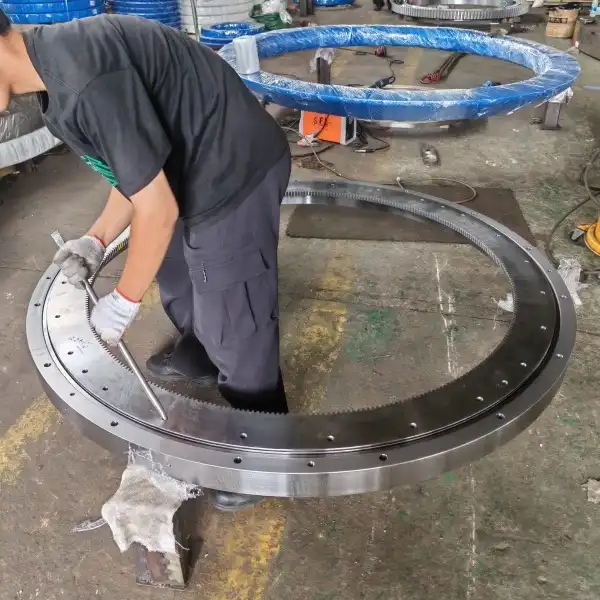
Crossed Roller Design vs. Standard Ball-Type Slewing Rings: Key Structural Differences
Four-point contact between balls and raceways is utilized in a standard single-row ball slewing ring. This contact method is not only straightforward and cost-effective, but it is also found in cranes and other construction machinery. As a result of the replacement of the balls with cylindrical rollers in a crossed roller slewing bearing, the load is carried along a line, which results in an increase in stiffness. The following table provides an overview of the primary distinctions, which helps to explain why the decision comes down to the specifics of your application rather than a single "best" design.
There are a variety of structures that are manufactured by Heng Guan Bearing, including cross cylindrical roller, three-row roller, double-row ball, and thin-wall flange types. This allows you to compare these structures within the same supplier. If you are already using a ball-type ring of this size, the mounting dimensions of the four-point contact version RKS.060.20.0414 are identical to those of the ball-type ring, which makes switching between the two versions convenient.
| Feature | Crossed Roller Design | Standard Ball-Type Ring |
|---|---|---|
| Contact type | Line contact | Four-point contact |
| Rigidity | High | Good |
| Ring section | Slim, compact | Compact |
| Clearance | Zero clearance or preload as standard | Depends on design |
| Typical focus | Precision and stiffness | General heavy duty |
Which Slewing Bearing Is Better for Industrial Machinery and Precision Applications?
Which option is superior is determined by the requirements of your apparatus. Slewing bearings with the model number RKS.160.14.0414 are an excellent match for applications such as automation, medical devices, robots, turntables, and testing equipment, all of which require precise positioning and rotational stiffness capabilities. In the case of cranes, excavators, port machinery, and other heavy equipment that has high overturning loads and large diameters, standard ball-type or multi-row roller slewing rings frequently provide the optimal balance of capacity and cost. P0, P6, P5, and P4 are the precision grades that Heng Guan Bearing offers, which means that either type can be constructed to the level of accuracy that you require.
If you would like a recommendation for your machine, you can send an email to mia@hgb-bearing.com with your requirements, and our engineers will be happy to assist you. Typical uses are summarized in the table below.
| Application | Suggested Type |
|---|---|
| Robots and automation (waist joints, CNC rotary tables) | Crossed roller |
| Medical CT scanners and testing equipment | Crossed roller |
| Radar pedestals and solar trackers | Crossed roller |
| Cranes and excavators | Ball-type or roller ring |
| Wind power and port machinery | Ball-type or multi-row roller |
How to Choose Between RKS.160.14.0414 Slewing Bearings and Standard Slewing Rings?
Begin by determining your working conditions, which include the size and direction of the load, the tilting moment, the speed, the required accuracy, the installation space, and the budget. You should then inquire with your supplier about the drawings, load curves, material records, and inspection reports that pertain to the slewing bearing that you are contemplating purchasing. Each bearing that is shipped by Heng Guan Bearing comes with a test report, and the company adheres to EN 10204 3.1 for the traceability of raw materials. If precision and compact size are at the top of your list of priorities, then you should give RKS.160.14.0414 Slewing Bearings their due consideration.
When it comes to heavy-duty capacity that is both cost-effective and efficient, a standard slewing ring might be the best option. As a result of Heng Guan Bearing's "people-oriented, customer-oriented, technological innovation, quality improvement" philosophy, the company provides individualized design and flexible production, which enables your slewing bearing to precisely correspond to the requirements of your project. Early communication of your duty cycle allows for a decision that is both quicker and safer.
| Item | Detail |
|---|---|
| Interchange reference | SKF RKS.160.14.0414 (100% dimensional match); INA XSU14 0414 (2 mm outside diameter difference) |
| Geared versions | RKS.161.14.0414 (external gear), RKS.162.14.0414 (internal gear) |
| Re-lubrication | About every 100 hours in continuous rotation, longer in oscillating service |
| Lead time | 15–25 days for in-stock sizes, 30–45 days for custom configurations |
Conclusion
A numeric value of RKS.160.14.0414 is in question. For applications that require precise positioning while simultaneously minimizing the amount of space that is required for it, slewing bearings are the best choice. Standard slewing rings, on the other hand, are the more suitable option when it comes to machinery that is designed to handle heavy loads. In light of the fact that they are so versatile, standard slewing rings are an excellent choice for use with heavy-duty machinery. If you are looking for a dependable and cost-effective solution for slewing bearings, you should work with an experienced partner like Heng Guan Bearing and tailor the structure to your loads, accuracy, and financial constraints. This will allow you to find the solution that best suits your needs. As a consequence of this, you will be in a position to accomplish the most favorable outcomes that are feasible.
FAQ
What is an RKS.160.14.0414 slewing bearing?
It is a single-row crossed roller slewing bearing without gear, designed for precise, compact rotation.
How is it different from a ball-type slewing ring?
It uses rollers with line contact, giving higher rigidity.
Which industries use crossed roller bearings?
Automation, medical, robotics, radar, and solar tracking equipment are common examples.
Are standard slewing rings still a good choice?
Yes, especially for cranes, excavators, and other heavy equipment.
Can Heng Guan Bearing customize slewing bearings?
Yes, personalized design and flexible production are available, including external or internal gear versions.
Get Expert Slewing Bearing Advice and a Customized Quote Today
Do you have any questions or concerns about the type of slewing bearing that would be appropriate for your appliance? In the event that you send your drawings, load data, and quantity to the email address mia@hgb-bearing.com, Heng Guan Bearing will provide you with expert advice and a customized quotation depending on the specifics of your situation. That the foundation of your next project is made up of products of exceptional quality and services that are provided by professionals is something that should be taken very seriously.
- A production process that is ISO 9001-certified and includes inspection by a coordinate measuring machine
- The material traceability requirements of EN 10204 3.1, along with a test report for each bearing
- It is available in a standard version without gear, with either an external or an internal gear, and with custom seals.
- Assistance with reverse engineering in the event that drawings are absent
References
1. ISO 76:2006. Rolling Bearings – Static Load Ratings. International Organization for Standardization.
2. ISO 281:2007. Rolling Bearings – Dynamic Load Ratings and Rating Life. International Organization for Standardization.
3. JB/T 10471. Slewing Bearings. Chinese Machinery Industry Standard.
4. ISO 15:2017. Rolling Bearings – Radial Bearings – Boundary Dimensions, General Plan. International Organization for Standardization.
5. Harris, T. A., & Kotzalas, M. N. (2006). Essential Concepts of Bearing Technology (5th ed.). CRC Press.
6. thyssenkrupp rothe erde. Slewing Bearings (product catalogue and selection guide).

WHAT OUR CUSTOMERS SAY
Here is the customer's evaluation of us