




How to Inspect and Maintain a Crane Slewing Ring?
The crane slewing ring takes the weight of the boom, the load, and all turning movements. Therefore, frequent inspection and maintenance determine how long the crane can function safely. Here at Heng Guan Bearing, we make slewing bearings for lifting, construction, and port equipment, and we know that most early failures are due to missing regular checkups. A missed oil shot or a loose bolt usually doesn’t produce problems the same day. It shows up weeks later as noise, blowback, and unwanted downtime. This tutorial will cover lubrication, bolts, clearance, and long-term maintenance, so you can maintain your crane functioning smoothly from the first to the final shift.
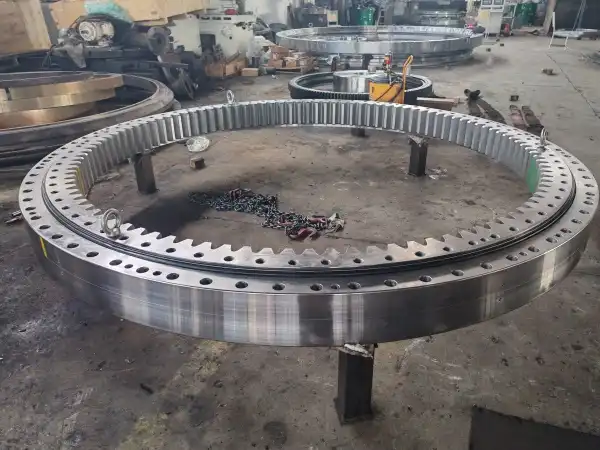
How Often Should You Lubricate a Slewing Bearing and Which Grease Should You Use?
Lubrication is the simplest way to protect a slewing bearing, and it should follow a fixed schedule rather than guesswork.
Choosing the Grease
For a crane slewing ring, a lithium-based extreme-pressure grease suits most raceways, while an open-gear grease works well on the teeth.
How to Apply It
Slowly work grease while the crane turntable bearing is rotated so that the lubricant is uniformly disseminated across the whole raceway until a thin bead is seen at the seal. Fresh grease also drives away moisture and fine particles. Increase frequency in dusty, humid, or high-duty circumstances. Always grease before extended idle periods. The chart below is a good guide, but look up the actual intervals in your supplier’s handbook.
| Component | Recommended Grease | Typical Interval |
|---|---|---|
| Raceway | Lithium-based EP2 | Every 100–250 hours |
| Gear teeth | Open-gear EP grease | Every 50–100 hours |
| Before storage | Same as raceway | Before idle periods |
Crane Slewing Ring Bolt Inspection: Checking Tightening Torque and Fastener Condition
Secure bolts keep a crane slewing ring seated evenly, so bolt checks deserve a place in every maintenance plan.
Torque Checks
How Often to Check: After the first 100 hours of service, thereafter at regular intervals (every 500 hours, for example).
How: Use a calibrated torque wrench and the value indicated for your bolt grade. Tighten in a cross pattern so the crane turntable bearing is flat on its mounting surface. Never miss a bolt because it looks good.
Fastener Condition
Inspect each fastener for stretching, thread damage, and corrosion, and replace any doubtful bolt with one of the same high-strength grade.
Heng Guan Bearing supplies technical guidance on bolt grades and torque values for every slewing bearing we ship. If you need help with a specific model, email us at mia@hgb-bearing.com, and our team will gladly assist.
How to Check Gear Backlash, Rotation Resistance, and Raceway Clearance?
Once the bolts are secure, move on to the moving parts of the slewing bearing.
Gear Backlash
Measure backlash at several points around the crane slewing ring, because the teeth wear unevenly and the tightest spot sets the limit.
Rotation Resistance
A crane turntable bearing should turn smoothly, without grinding, clicking, or sudden torque changes. Any change in turning effort is an early warning sign.
Raceway Clearance
Mount a dial indicator on the fixed structure and measure the axial and tilting movement during loading and unloading of the crane. Record each reading and see how it stacks up against the one before, since the trend is more informative than a single figure.
The checklist below summarizes the key points.
| Inspection Item | Method | What to Look For |
|---|---|---|
| Gear backlash | Feeler gauge or dial indicator | Even readings around the ring |
| Rotation resistance | Observe or torque measurement | Smooth, steady turning |
| Raceway clearance | Dial indicator | Stable readings over time |
Preventive Maintenance Strategies to Extend Slewing Bearing Service Life
Long service life comes from steady habits rather than occasional repairs.
Build a Written Plan
Link lubrication, bolt checks, and clearance measurements to the crane’s working hours, and keep a simple log for each crane slewing ring.
Protect the Bearing
Keep the seals clean and unbroken, wipe off dirt before greasing, and protect the crane slewing bearing from water and abrasive dust. Do not exceed the load rating. The greatest protection for any slewing bearing is a steady load. Plan for extra seals, nuts, and oil in advance so a short check never becomes a major standstill.
Know What You Are Maintaining
Heng Guan Bearing builds each product with robust raceways and precision machining, and these features help you obtain the most value out of that quality. The reference data below demonstrates what a typical crane slewing ring from our range is made of. Check your model for the precise values on the sketch.
| Parameter | Reference Data |
|---|---|
| Product | Crane slewing ring |
| Ring material | 50Mn or 42CrMo alloy steel |
| Rolling elements | GCr15SiMn |
| Seals | NBR |
| Raceway hardness | 55–62 HRC (induction hardened) |
| Accuracy grade | P0, P6, P5, P4 |
Conclusion
A crane slewing bearing is safe and productive with regular lubrication, inspection of bolts, clearance checks, and a documented maintenance plan. Each step is easy, yet combined, they improve service life and save downtime. Heng Guan Bearing is here to help your crane with quality goods and skilled guidance.
FAQ
1. How often should I grease a crane slewing ring?
Typically every 100–250 hours, or more often in harsh conditions.
2. Which grease is best?
Lithium-based EP2 grease suits most raceways.
3. When should bolt torque be checked?
After the first 100 hours, then at regular intervals.
4. How do I measure raceway clearance?
Use a dial indicator to record axial and tilting movement.
5. What signs show a bearing needs attention?
Rough rotation, unusual noise, or uneven backlash.
Keep Your Crane Turning Smoothly: Contact Heng Guan Bearing Today
Need a dependable crane slewing ring or expert maintenance advice? Send your equipment details to Heng Guan Bearing at mia@hgb-bearing.com, and our engineers will recommend the right slewing bearing and a practical maintenance plan. Reach out today and keep your crane working at its best.
References
1. ISO 281:2007. Rolling Bearings: Dynamic Load Ratings and Rating Life. International Organization for Standardization.
2. ISO 15243:2017. Rolling Bearings: Damage and Failures, Terms, Characteristics and Causes. International Organization for Standardization.
3. Harris, T. A., & Kotzalas, M. N. (2006). Rolling Bearing Analysis: Essential Concepts of Bearing Technology (5th ed.). CRC Press.
4. Bickford, J. H. (2008). Introduction to the Design and Behavior of Bolted Joints (4th ed.). CRC Press.
5. Neale, M. J. (Ed.). (1995). The Tribology Handbook (2nd ed.). Butterworth-Heinemann.
6. Budynas, R. G., & Nisbett, J. K. Shigley’s Mechanical Engineering Design. McGraw-Hill.

WHAT OUR CUSTOMERS SAY
Here is the customer's evaluation of us