




How to Inspect and Maintain a 013.75.3550 Slewing Bearing for Longer Service Life?
A large slewing bearing works quietly at the center of your machine, so small problems can grow unnoticed. A missed seal crack, a loose bolt, or a dry raceway rarely announces itself until the downtime and repair bill arrive. The 013.75.3550 slewing bearing is built for heavy rotation, and with regular care it can serve for many yearsLuoyang Heng Guan Bearing Technology Co., Ltd.'s brand: Heng Guan Bearing has been assisting clients to maintain their equipment up by easy and regular maintenance. What to check, how to lubricate, which mechanical inspections are important, and how to preserve seals will be covered in this guide. Read on to establish a practice that increases service life.
What Are the Key Inspection Points for a 013.75.3550 Slewing Bearing?
A successful inspection begins with listening and seeing. The slewing bearing 013.75.3550 should revolve smoothly, without strange noise, jolting, or heat. Inspect mounting surfaces for fractures or deformation. The bearing should move freely through a complete turn. Check for fresh oil at the seals, showing the raceway is adequately supplied. Keep a written record of each examination so that you may compare readings over time, beginning with the bearing's fundamental data below. Heng Guan Bearing suggests a daily eye inspection and a more thorough evaluation at intervals.
| Parameter | Specification |
|---|---|
| Model | 013.75.3550 |
| Structure | Single-row four-point contact ball |
| Gear type | Internal gear |
| Inner diameter | 3,322 mm |
| Outer diameter | 3,776 mm |
| Height | 174 mm |
| Ring material | 50Mn or 42CrMo steel |
| Precision grades | P0 to P4 |
| Load capacity | Radial, axial, and tilting moment at the same time |
How Often Should You Lubricate a Slewing Bearing to Prevent Premature Wear?
The best approach to protect a slewing bearing is by lubricating it. Fresh grease produces a protective barrier between the balls and raceways, decreases friction, and displaces moisture and dust. A good rule of thumb is to re-lubricate the raceway of the 013.75.3550 slewing bearing every 100 to 500 hours of operation, and more frequently in dusty, damp, or heavy-duty environments. Rotate the bearing carefully to work the grease in and distribute it. Continue until you see a tiny bead of new grease at the seal. The gear teeth need their own proper lubrication because of the internal-gear arrangement. Always use the kind of grease and change intervals specified in your equipment handbook.
| Condition | Suggested Approach |
|---|---|
| Normal duty | Relubricate toward the longer end of the 100–500 hour range |
| Dusty, wet, or heavy duty | Shorten the interval |
| During greasing | Rotate slowly until fresh grease shows at the seal |
| Gear teeth | Use a suitable gear lubricant separately |
If you need advice on grease type or intervals for your working conditions, contact our engineers at mia@hgb-bearing.com, and we will help you build a schedule that fits your machine.
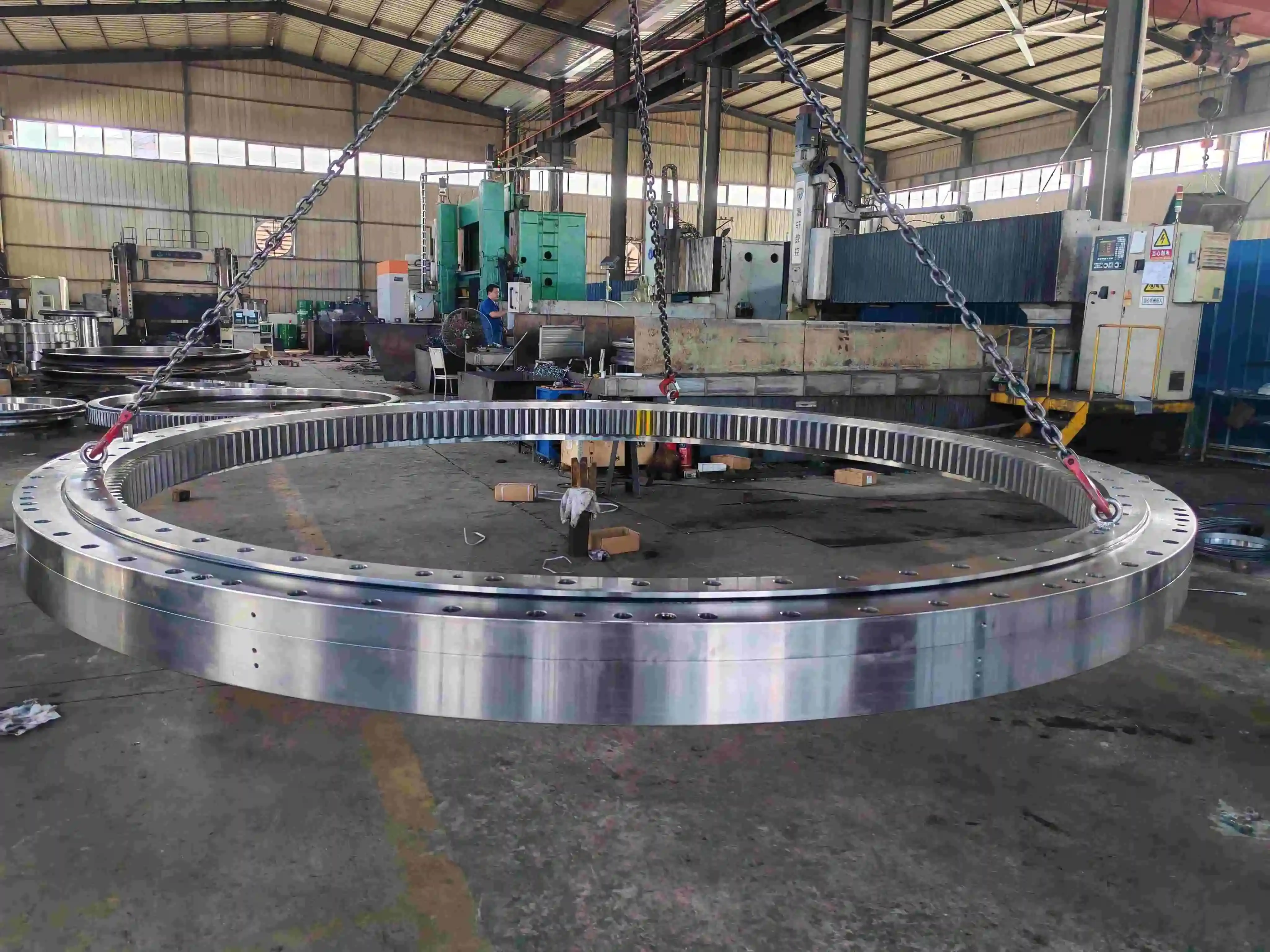
Checking Bolt Preload, Raceway Wear, and Gear Backlash
The 013.75.3550 slewing bearing is kept in top operating condition by three mechanical tests. 1) Bolt Preload. Loose bolts may enable movement, which might harm the rings. Be sure to torque bolts to the prescribed torque, check again after the first 100 hours of operation, then at regular intervals. 2) 2. Wear of the raceway: Check the axial and radial clearances against the values at the commencement of installation. 3. Gear Backlash: The internal teeth must mesh smoothly with the pinion and have the proper clearance. Heng Guan Bearing offers technical help to its clients on these three criteria. Each check is summarized in the table below.
| Check | Purpose | Action |
|---|---|---|
| Bolt preload | Keep the connection firm | Retighten to specified torque, recheck after the first 100 hours |
| Raceway wear | Track clearance changes | Measure axial and radial clearance and record regularly |
| Gear backlash | Ensure smooth tooth contact | Adjust pinion position as needed |
How Can Seal Damage and Contamination Affect Slewing Bearing Service Life?
Seals are your slewing bearing’s first line of defense. They retain the grease and keep out dust, water, and abrasive particles. Lubrication is just part of the equation. If the seal is worn or not seated properly, contaminants may enter the raceway and accelerate wear. Clean the area at each service. Check for cracks, hardness, or gaps. Replace any broken seals immediately. Do not direct high-pressure water directly at the seal while cleaning equipment.
| Seal Condition | Risk | Action |
|---|---|---|
| Cracks or hardening | Contaminants reach the raceway | Replace promptly |
| Gaps or displacement | Grease loss and dust ingress | Reseat or replace |
| Grease leakage | Dry raceway and faster wear | Inspect and re-lubricate |
For the 013.75.3550 slewing bearing, clean seals and fresh grease work together to protect the raceway for years of reliable use. Our team at Heng Guan Bearing can also advise on sealing choices for harsh environments.
Conclusion
The 013.75.3550 slewing bearing will endure a long time if it is inspected regularly, lubricated in time, the bolts and clearance are checked carefully, and the seals are healthy. Keep your equipment running dependably with a simple routine and a trusted partner like Heng Guan Bearing.
FAQ
Q: How often should I inspect the 013.75.3550 slewing bearing?
A: Do a quick visual check daily and a detailed review on a set schedule.
Q: How often should I lubricate it?
A: Commonly every 100 to 500 operating hours, depending on conditions.
Q: When should I check bolt tightness?
A: After the first 100 hours, then at regular intervals.
Q: Why do seals matter?
A: They keep grease in and contaminants out of the raceway.
Q: Can Heng Guan Bearing give maintenance advice?
A: Yes, our engineers offer technical guidance for your application.
Contact Heng Guan Bearing Today
Want a longer service life from your equipment? At Luoyang Heng Guan Bearing Technology Co., Ltd., we combine engineering expertise, manufacturing capability, and technical support to keep your slewing bearing running:
- Maintenance advice for inspection, lubrication, and sealing
- Replacement parts and custom slewing bearing solutions
- Engineering support from selection to installation guidance
Contact Heng Guan Bearing for maintenance advice, replacement parts, or a custom solution. Email us at mia@hgb-bearing.com, and our team will respond quickly with professional support.
References
1. Harris, T. A., & Kotzalas, M. N. Essential Concepts of Bearing Technology (Rolling Bearing Analysis, 5th ed.). CRC Press, 2006.
2. ISO 281: Rolling Bearings – Dynamic Load Ratings and Rating Life. International Organization for Standardization.
3. SKF Group. Slewing Bearings Catalogue. SKF.
4. thyssenkrupp rothe Erde. Slewing Bearings Catalogue. thyssenkrupp rothe Erde GmbH.
5. Bickford, J. H. Introduction to the Design and Behavior of Bolted Joints. CRC Press, 4th ed., 2007.
6. Brändlein, J., Eschmann, P., Hasbargen, L., & Weigand, K. Ball and Roller Bearings: Theory, Design and Application. Wiley, 1999.

WHAT OUR CUSTOMERS SAY
Here is the customer's evaluation of us