




How to Choose the Right Small Slewing Bearing for Your Machine?
A tiny machine never has much space, and the improper bearing choice shows up late and costs a lot. Typical frustrations include: multi-bearing arrangements that make a robot joint or turntable heavy and hard to assemble; bearings that look right on paper but lack the rigidity or accuracy for repeatable positioning; and suppliers that cannot help when you only have a physical sample and no drawings. Choosing a small slewing bearing starts with understanding exactly what your machine needs: accurate rotation, a sturdy support, and a small footprint. A compact slewing ring of enough size may take the place of a multi-bearing system, and result in lighter and simpler to construct equipment. In this article, Heng Guan Bearing leads you through the main selection considerations, bearing types, and service life issues, so you can decide with confidence.
What Factors Should You Consider When Selecting a Small Slewing Bearing?
Start with the machine itself. Specify the application, available area, operating weights, speed of rotation, and positioning precision necessary. A tiny slewing bearing can manage axial, radial, and overturning moment loads in one unit. This makes it suitable for robot joints, precision turntables, medical equipment, security monitoring, new energy systems, and aerospace devices. Next, consider mounting.
Bolt hole arrangement, flange design, and whether you require a gear. Heng Guan Bearing provides a selection of compact slewing bearing units with outer diameters between 80 mm and 500 mm. We can also provide a lightweight slewing bearing that may be customized if weight or height is a concern. If you simply have the actual sample, our engineers can work with that without designs; the initial step is straightforward.
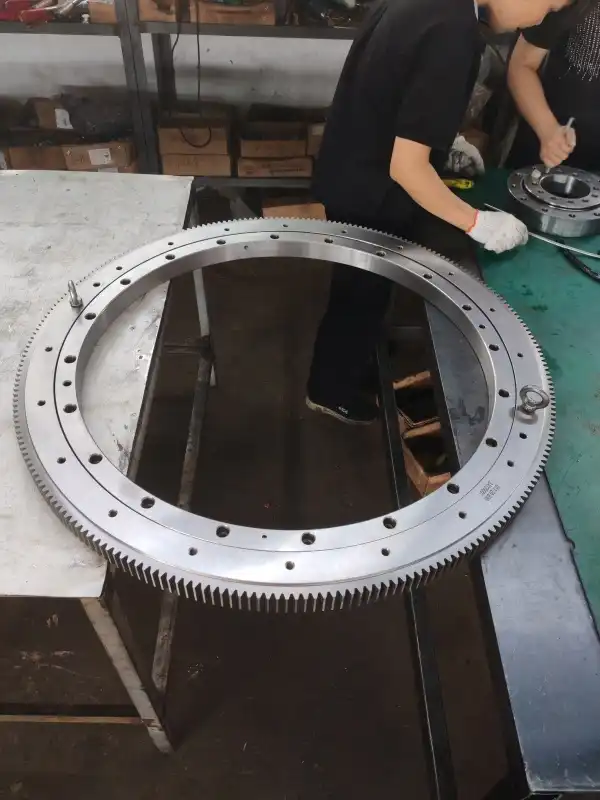
Load Capacity, Dimensions, and Rotation Accuracy: Key Selection Criteria
The load capacity should be suitable for the actual operating circumstances, including the moment load on the bearing and a reasonable safety margin. Next are the dimensions, as you will need the inner diameter, outer diameter, and height to match your construction. After this, the precision of rotation determines how effectively the machine can repeat a position. This is very important for robots and automated manufacturing lines.
We offer small slewing rings in precision grades P0, P6, P5, and P4 so you can select the grade that meets your budget and performance objective. P0 is for general mechanical applications, P6 is for moderate accuracy requirements, while P5 and P4 are selected for high-precision positioning and measurement equipment. A light, small slewing ring may minimize the total weight of the machine without loss of stiffness. How these criteria link together is shown in the table below.
| Criterion | What to Confirm |
|---|---|
| Load capacity | Axial, radial, and moment loads, plus a safety margin |
| Dimensions | Inner and outer diameter, height |
| Rotation accuracy | Grade P0, P6, P5 or P4 |
| Weight | Lightweight structure where needed |
Technical Specifications
| Parameter | Specification |
|---|---|
| Outer Diameter Range | 80 – 500 mm |
| Inner Diameter Range | 60 – 400 mm |
| Height Range | 8 – 40 mm |
| Bearing Type | Four-point contact ball / Cross-roller |
| Precision Grade | P0, P6, P5, P4 |
| Ring Material | GCr15 (SUJ2), 50Mn, 42CrMo, SUS440C |
| Load Capacity | Axial, radial, and moment loads (combined) |
| Rotation Angle | 360° continuous |
| Operating Temperature | -30°C to +80°C (standard) |
| Sealing Options | Contact seals, non-contact seals |
| Mounting Configuration | Through-bolt or threaded hole |
| Optional Features | Internal/external gearing, grease nipples |
Not sure which small slewing bearing size or grade fits your design? Send your drawings, sizes, or application details to mia@hgb-bearing.com, and our engineers will help you narrow down the right specification.
Which Small Slewing Bearing Type Best Fits Your Machine's Application?
It is contingent upon the application, the correct kind. A single-row four-point contact ball design is a compact and cheap option for typical applications and mild to medium loads. Cross roller constructions provide increased stiffness, accuracy, and moment capacity for robot joints and precision turntables, at a higher cost. Depending on your drive architecture, you may also pick between external gear, internal gear, and gearless variants. A gear-integrated device becomes a full drive system with fewer distinct elements.
If height is a premium, a tiny lightweight slewing bearing with a thin wall flange construction is a good option. Stainless steel SUS440C rings are available for use where corrosion resistance is important, such as in food processing or maritime applications. The table below provides a fast guide.
| Application | Suggested Type |
|---|---|
| Industrial robot joints | Cross roller |
| Precision turntables | Cross roller or four-point ball |
| Medical equipment | Thin-wall, lightweight slewing bearing |
| Security monitoring | Compact four-point ball |
| Solar tracking systems | Four-point ball, with gear and sealing options |
| Aerospace and stabilization platforms | Lightweight slewing bearing, cross roller for pointing accuracy |
How Do Material, Sealing, and Lubrication Affect Bearing Service Life?
The service life is a function of three factors in combination. Material is the most important. Our rings are made of GCr15 high-carbon chromium bearing steel, 50Mn or 42CrMo alloy steel, and SUS440C stainless steel, and then we use heat treatment to harden the raceways and maintain the dimensions steady during continuous operation. Dust and moisture are kept away from the raceway by sealing, so a tiny slewing bearing may function smoothly in workshops, outdoor equipment, and clean hospital rooms.
Lubrication then creates a protective coating between the rolling elements and the raceways. To achieve a long service life, the slewing ring and lightweight slewing bearing should be rotated on a regular basis and well greased. When installing, ensure the mounting faces are flat to within 0.05 mm. Tighten bolts in stages using a star pattern and recheck the smoothness of rotation. These easy actions can help preserve your investment for years.
| Interval | Action Required |
|---|---|
| At installation | Tighten bolts in a star pattern in stages (50%, 80%, 100% of final torque), rotate the bearing several full turns, and check for binding. |
| First 100 hours | Re-torque all mounting bolts, as vibration and thermal cycles can loosen preload. |
| Every 6 to 12 months | Re-lubricate continuous-duty equipment with lithium-complex or polyurea grease suited to the temperature range. |
| Routine maintenance | Check for unusual noise, vibration, or a noticeable rise in rotational resistance. |
| Annually | Inspect seals for cracks, tears, or hardening and replace damaged seals at once; re-verify bolt torque. |
Conclusion
Choosing a small slewing bearing is a matter of matching load, size, precision, type, and maintenance to your machine. With careful selection and appropriate maintenance, you get a smooth, long-lasting rotation. Heng Guan Bearing gives you full assistance from selection to delivery. Get a custom tiny slewing bearing solution now with Luoyang Heng Guan.
FAQ
Q: What outer diameters are available?
A: Outer diameters from 80 mm to 500 mm, with inner diameters of 60-400 mm and heights of 8-40 mm.
Q: Which precision grades can I choose?
A: P0, P6, P5 and P4. P0 suits common mechanical applications, while P5 and P4 are intended for high-precision positioning and measurement equipment.
Q: Where is it used?
A: Industrial robots, precision turntables, medical equipment, security monitoring, aerospace, and new energy systems such as solar tracking.
Q: Can you work from a sample?
A: Yes. Our engineers can reverse engineer from a physical sample without original drawings.
Q: Is a lightweight design possible?
A: Yes, a lightweight slewing bearing can be customized to your size and weight limits, including thin-wall flange construction where height is limited.
How Luoyang Heng Guan Solves Your Small Slewing Bearing Challenges
At Luoyang Heng Guan Bearing Technology Co., Ltd., as a small slewing bearing supplier, we combine engineering expertise, manufacturing capability, and technical support to deliver compact bearings that simplify your design and maximize reliability:
- Outer diameters from 80 mm to 500 mm, heights from 8 mm to 40 mm, P0-P4 precision
- ISO 9001-certified production meeting DIN, ISO, and GB standards
- Custom design, non-standard machining, and reverse engineering from physical samples
- Proven solutions for robots, precision turntables, medical, security, new energy, and aerospace equipment
Ready to find your ideal small slewing bearing? Contact Us at mia@hgb-bearing.com today with your drawings, sizes, or application details to receive expert guidance and a tailored quotation.
References
1. Harris, T. A., & Kotzalas, M. N. Rolling Bearing Analysis. CRC Press.
2. Budynas, R. G., & Nisbett, J. K. Shigley's Mechanical Engineering Design. McGraw-Hill Education.
3. ISO 281: Rolling Bearings – Dynamic Load Ratings and Rating Life. International Organization for Standardization.
4. Hamrock, B. J., Schmid, S. R., & Jacobson, B. O. Fundamentals of Machine Elements. CRC Press.
5. Oberg, E., et al. Machinery's Handbook. Industrial Press.
6. ISO 492: Rolling Bearings – Radial Bearings – Geometrical Product Specifications and Tolerance Values. International Organization for Standardization.

WHAT OUR CUSTOMERS SAY
Here is the customer's evaluation of us