



How Are Ball Bearing Slewing Rings Manufactured for OEMs?
Manufacturing ball bearing slewing rings for OEM equipment is not simply a matter of machining two steel rings and filling the raceway with balls. The final bearing has to match the equipment's mounting interface, load requirements, rotation conditions, sealing arrangement, lubrication system, and expected service environment. For that reason, OEM production normally begins with drawing review and material selection and continues through forging, heat treatment, precision machining, raceway inspection, assembly, and final testing. The manufacturing route can also vary according to the bearing's size, load configuration, raceway design, gear requirements, and application. A slewing ring intended for a crane, excavator, rotary table, or automated positioning system may have very different design priorities. For OEM buyers, understanding how the product is manufactured makes it easier to evaluate suppliers, review drawings, identify critical tolerances, and avoid problems after installation.
What Makes Ball Bearing Slewing Rings Different from Standard Bearings?
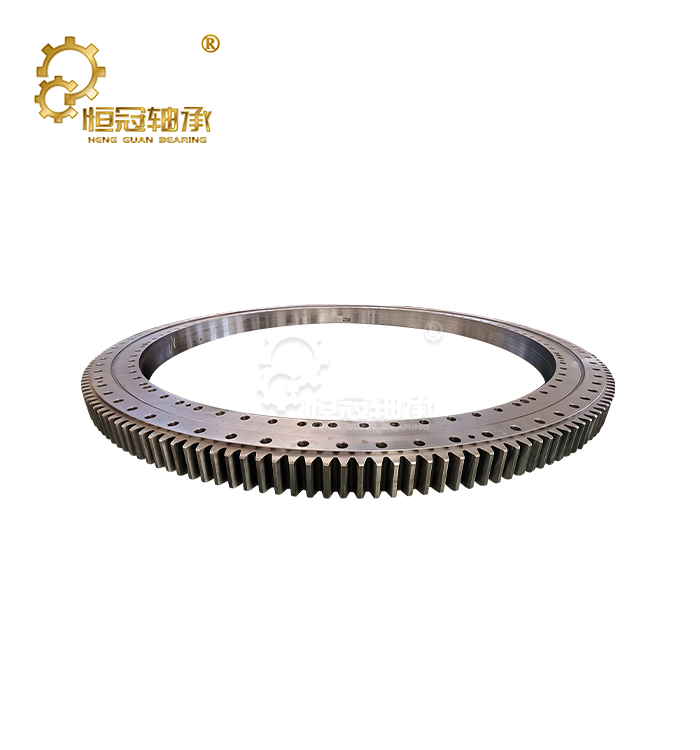
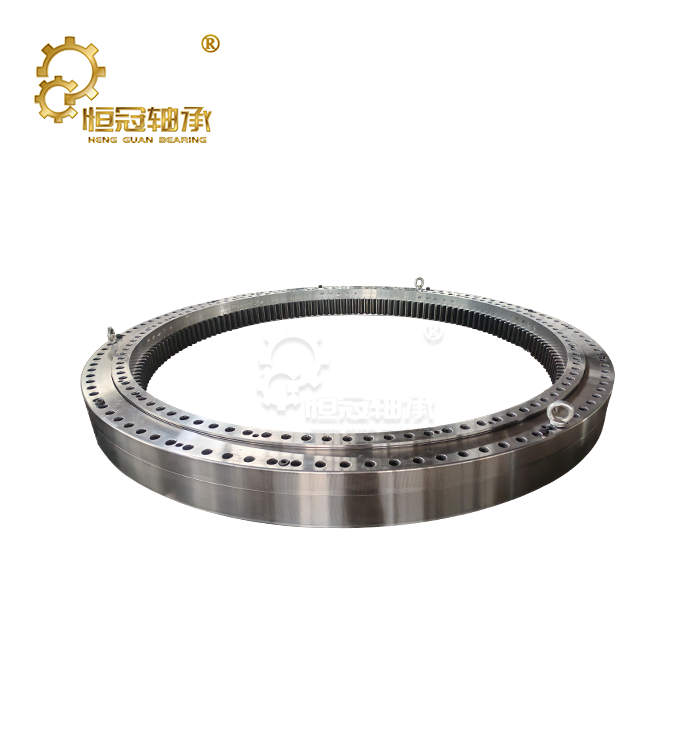
A slewing ring is designed to carry loads and allow one of the machine structures to rotate relative to the other. Unlike many common bearings that are placed as relatively small, standardised parts, slewing rings are often substantial structural components with mounting holes, seals, lubrication points and application-specific interfaces integrated into their design.
Main Components and Their Functions
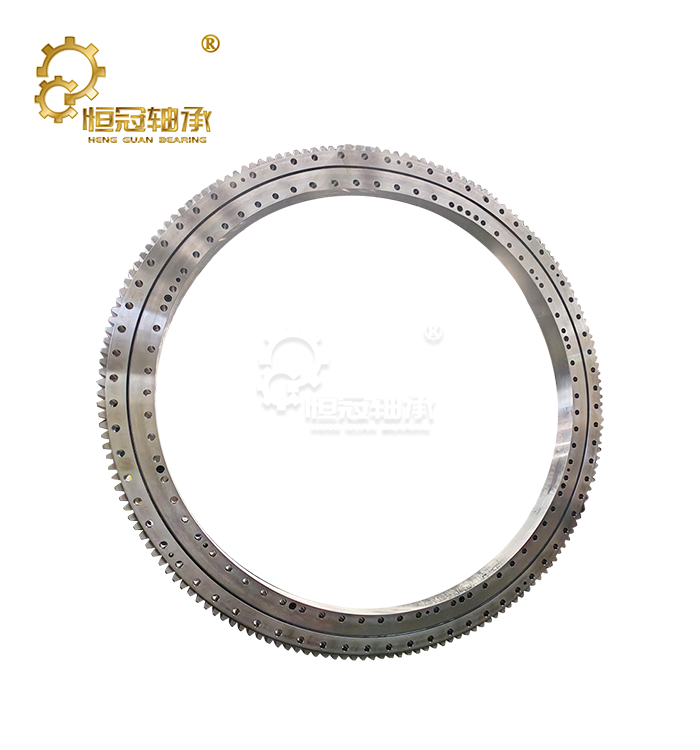
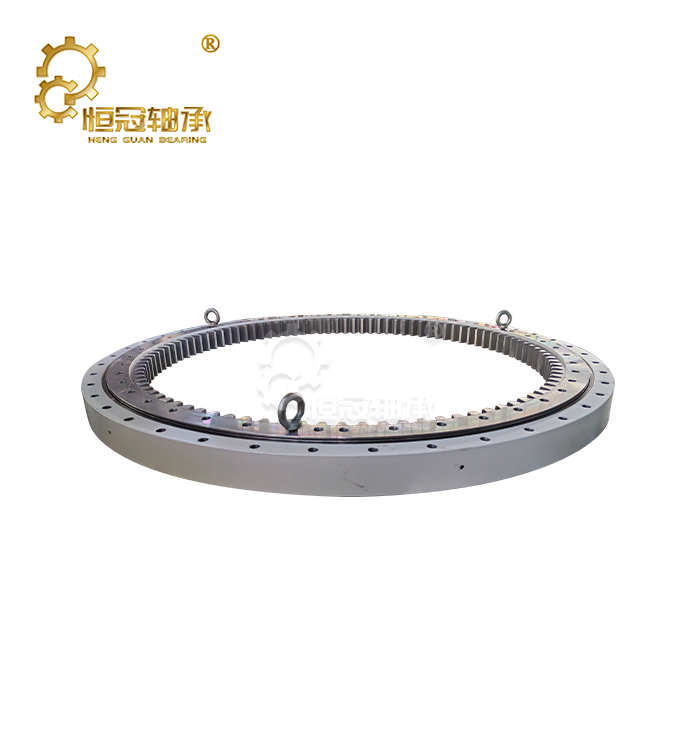
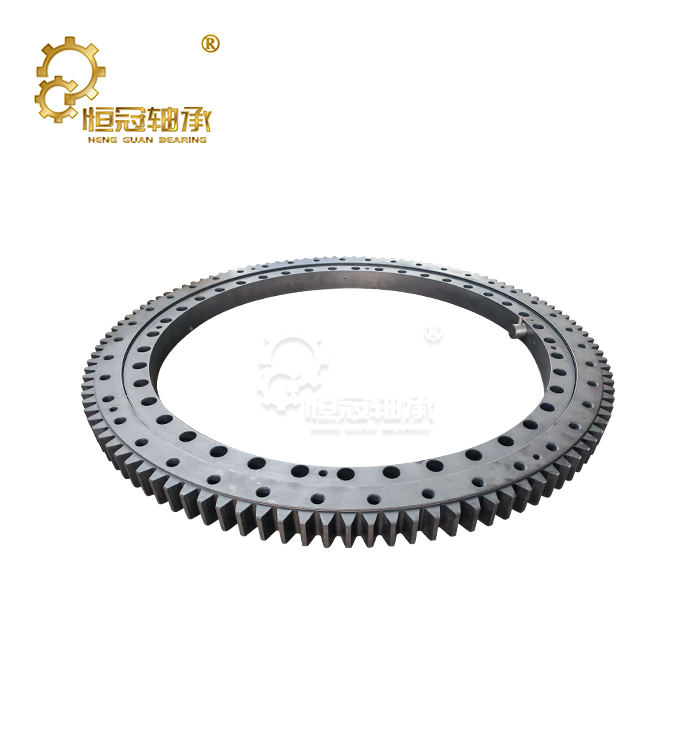
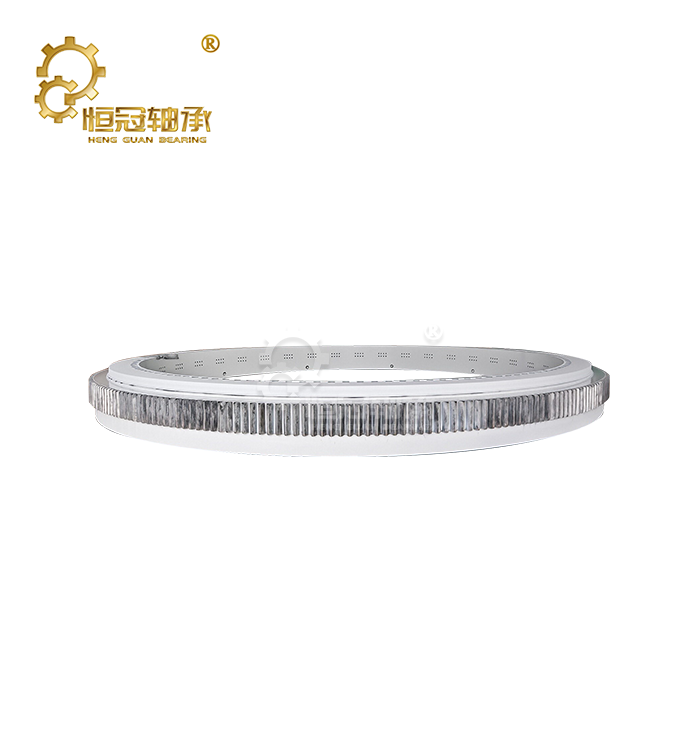
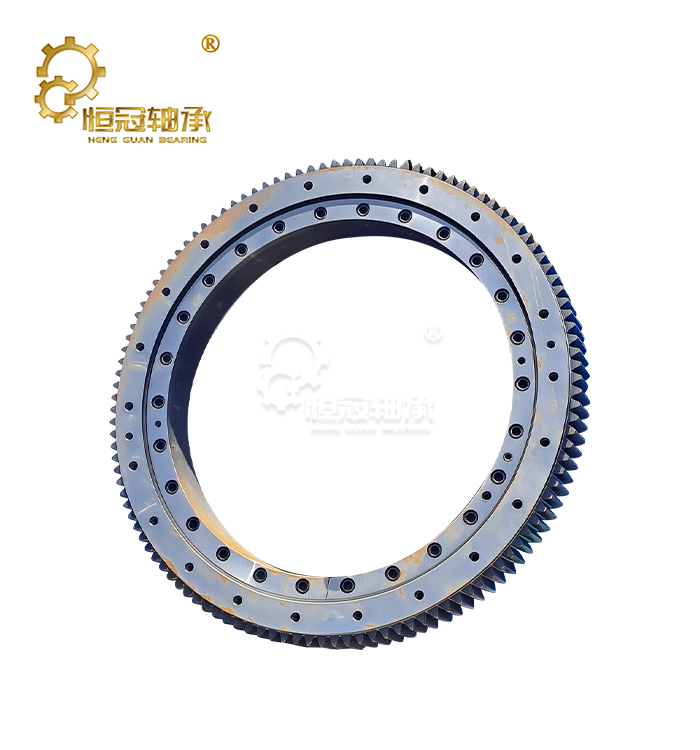
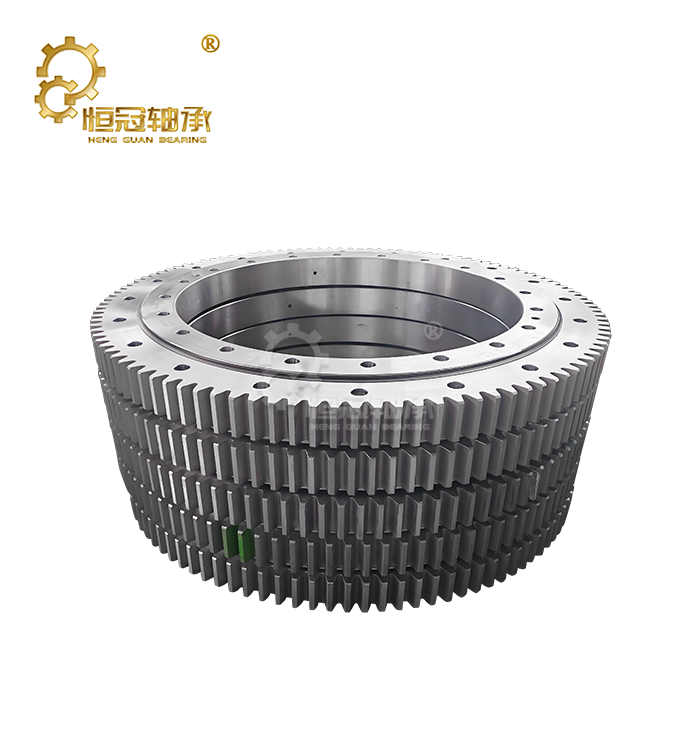
A basic ball slewing ring comprises an inner ring, an outer ring, rolling balls, spacers or a cage assembly, seals and lubrication arrangements. Depending on the design, the bearing may also be provided with an external or internal gear enabling direct driving via a pinion.
The inner and outer rings form the raceways and mounting surfaces. Their geometry dictates the way that the rolling elements contact the raceways and how loads are carried through the bearing. The balls provide rolling contact between the two rings, and the cage or spacer arrangement helps to maintain adequate ball spacing.
The raceway is one of the most significant parts of the whole component. Slight changes in its profile, hardness, surface condition or alignment can affect running characteristics and load distribution. That’s why special care should be paid to the machining and inspection of raceways in OEM production.
Material Selection Depends on the Application
Material selection should be based on desired strength, hardenability, fatigue resistance, machining properties and operating environment. Do not choose the strongest steel available.
Common ring materials include 42CrMo and 50Mn; however, the actual grade depends on the design of the manufacturer and the client specification. Balls for bearings can be made from bearing-grade steels, such as GCr15SiMn, if applicable.
For OEM projects, traceability of materials is of great importance. The supplier should be able to trace the material back to its heat number or batch information and keep records during manufacture. This provides a traceable link from the incoming steel through heat treatment, machining, inspection and the completed bearing.
How Are Ball Bearing Slewing Rings Manufactured Step by Step?
The precise steps vary depending on the manufacturer and the product design. However, OEM production typically follows a controlled sequence. Each stage influences the next. Dimensional difficulties should not be considered as a problem that may be rectified in final assembly.
1. Raw Material Inspection and Ring Forming
Production starts with steel selected according to the authorised drawing and material specification. Incoming material can be tested for chemical composition, dimensions and internal quality before it enters the forming process.
Large rings can be forged, and rings are rolled to form the fundamental annular shape. Controlled forming helps to provide the desired geometry and material structure before machining. An incorrect processing has an influence on the resultant microstructure, so that control of the processing parameters, such as the heating temperature, deformation and cooling, is required.
At this point traceability should be maintained. OEM buyers should be able to request material certificates and, if necessary by the project, inspection documents for the batch of production.
2. Rough Machining Establishes the Basic Geometry
After shaping and preparatory preparation, the ring is rough machined to set its major dimensions. These may include inner and outer diameters, end faces, mounting surfaces and other elements necessary for the succeeding processes.
Rough machining removes superfluous material but leaves a restricted allowance for finishing. This allowance is crucial because dimensional changes may occur during further heat treatment. Finishing all necessary dimensions and pre-heat treatment might be a challenge to maintaining final precision.
For OEM applications the mounting interface should be considered as a critical feature instead of a secondary machining procedure. The diameter of the bolt hole, the diameter of the pitch circle, the position of the hole, the flatness of the end face and the overall runout can affect the installation.
3. Heat Treatment Controls Raceway Performance
The working surfaces are heat treated to make them robust and wear resistant for rolling contact. Depending on the design, it can be used to harden the raceways locally, while the rest of the material remains tougher.
The idea is not to harden the entire ring as much as possible. The raceway requires an effective combination of surface hardness, hardened depth and supporting core characteristics. Too hard and not hard enough can present a different type of hazard.
The ring should be tested after heat treatment for hardness and dimensional changes. Distortion is especially significant for large-diameter components, since even a minor change might impair raceway geometry or mounting precision.
4. Finish Machining Brings Critical Surfaces to Specification
The finishing operations after heat treatment can bring the raceway and mounting surfaces to the desired proportions.
The design may require CNC turning, milling, drilling, grinding or other precise machining operations. The raceway profile should be paid special attention, as the geometry of the raceway has a direct effect on ball contact.
This is also where mounting holes are completed as required. For OEM equipment, the holes not only have to be within their diameter tolerance individually. Their placements must also be in accordance with the approved mounting pattern.
This is when the drawing control can be useful. The production team should work to an approved revision to avoid engineering changes causing a mismatch of mounting interfaces.
5. Raceway and Dimensional Inspection
The inspection needs to be broader than the total diameter. Depending on the bearing specification, manufacturers may evaluate raceway dimensions, surface quality, runout, mounting-hole locations, end-face geometry, hardness and other key properties.
Depending on the size and tolerance requirements of the product, coordinate measuring machines, precision gauges, hardness testers and other inspection equipment may be employed.
For the OEM customer, inspection documentation can serve as valuable evidence of manufacturing consistency. A provider who can explain what features of ball bearing slewing rings are considered critical and how they are measured would be able to give more technical support than one who just issues a generic certificate of compliance.
How Is the Bearing Assembled?
After machining and inspection, the individual components are prepared for assembly. Cleanliness becomes especially important at this stage because foreign particles can affect raceway and rolling-element performance.
Ball Installation and Internal Clearance
The number and size of balls depend on the bearing design and calculated load requirements. Balls are installed into the raceway using a controlled procedure designed to achieve the specified internal arrangement.
Internal clearance cannot simply be selected by visual inspection. It is related to the bearing geometry, operating conditions, temperature, and design requirements. Incorrect clearance can influence friction, noise, load distribution, and running behavior.
For OEM projects, the assembly process should therefore follow the approved design rather than using a generic ball-filling procedure.
Seals, Lubrication, and Protective Components
Seals help prevent water, dust, and other contaminants from entering the rolling path while retaining lubricant inside the bearing. Seal material should be selected according to temperature, chemical exposure, moisture, and other environmental factors.
Lubrication provisions also need to correspond with the application. A bearing used in dusty construction equipment may require a different lubrication and sealing strategy from one installed in a cleaner industrial positioning system.
Grease is normally introduced through designated lubrication points or during assembly according to the manufacturer's process. The quantity matters as well: excessive grease can create unnecessary resistance, while insufficient lubrication can increase wear.
Which Design Details Should OEM Buyers Confirm Before Production?
The most expensive bearing problem is often not a manufacturing defect but an interface or specification error discovered after the bearing has been installed.
Load, Speed, and Moment Requirements
OEM engineers should provide the supplier with the actual operating conditions rather than specifying only a nominal load.
Important information can include axial load, radial load, overturning moment, rotational speed, duty cycle, acceleration and deceleration, shock loading, and expected service life. The supplier can then determine whether a particular raceway arrangement and bearing configuration are appropriate.
A four-point contact design, for example, may be suitable for applications requiring combined axial and radial load capacity, while other designs may be selected when different load distribution or rigidity characteristics are required. The correct choice depends on the complete load case.
Mounting Interface and Gear Configuration
Mounting dimensions should be confirmed before production begins. This includes the bearing diameter, bolt-hole quantity and location, bolt-hole dimensions, mounting-face requirements, and any special locating features.
If the slewing ring includes a gear, the OEM drawing should also define the required gear geometry and interface with the drive system. Gear accuracy, backlash, tooth dimensions, and mounting alignment can affect the performance of the complete rotating mechanism.
A drawing review before production is therefore one of the most useful steps an OEM can take. It gives the engineering team and bearing manufacturer an opportunity to resolve interface issues before material and machining resources are committed.
How Should OEM Buyers Evaluate Manufacturing Quality?
A competitive quotation is useful, but price alone does not demonstrate whether a supplier can consistently manufacture a large rotating bearing.
Look for Process Control and Traceability
Ask how the manufacturer controls critical processes rather than only asking whether the company has a quality certificate.
Useful questions include:
How is incoming steel inspected?
Can the material heat number be traced through production?
Which heat-treatment process is used for the raceway?
How is raceway hardness verified?
How are mounting-hole positions inspected?
Which equipment is used for dimensional inspection?
Are final inspection records available for OEM batches?
How are nonconforming parts identified and controlled?
The answers provide a clearer picture of manufacturing capability than a general statement such as “strict quality control.”
Review Samples Before Approving Mass Production
For new OEM projects, a sample or first-article stage can reduce risk. The sample should be evaluated against the approved drawing, including dimensions, mounting interface, raceway characteristics, sealing arrangement, lubrication provisions, and other application-specific requirements.
Once the sample is approved, the supplier should maintain process consistency between the approved sample and subsequent production batches.
This is particularly important for OEMs purchasing ball bearing slewing rings repeatedly over several months or years. Consistency between batches can be just as important as the performance of the first shipment.
What Maintenance Practices Help Extend Service Life?
Even a correctly manufactured bearing can experience premature wear if the installation, lubrication, or operating conditions are poorly controlled.
Lubricate According to the Working Environment
Lubrication intervals should be based on operating conditions rather than a universal calendar schedule. Rotation frequency, load, temperature, contamination, moisture, and duty cycle can all affect lubricant requirements.
Construction and mining equipment, for example, may operate in environments with substantial dust and water exposure. In these cases, seal condition and lubrication frequency deserve close attention.
Automatic lubrication systems can be useful where frequent manual lubrication is impractical, but the system still needs to deliver the correct lubricant and quantity to the bearing.
Monitor Backlash, Temperature, and Running Condition
Inspection should focus on changes over time. Increasing backlash, unusual noise, rising operating temperature, lubricant contamination, seal damage, or abnormal rotation resistance can indicate developing problems.
For equipment with high downtime costs, inspection records can be used to establish a baseline after installation. Future measurements can then be compared with the baseline to identify changes before they become serious failures.
Follow Correct Installation Procedures
Mounting accuracy directly affects bearing performance. The installation surface should be clean and within the required flatness and alignment limits. Bolts should be tightened according to the specified sequence and torque requirements.
Incorrect mounting can introduce localized loads that were not included in the original bearing calculation. This is one reason OEMs should consider the bearing and mounting structure as one system rather than treating the slewing ring as an isolated component.
What Should Be Included in an OEM Slewing Ring Inquiry?
A detailed inquiry allows a manufacturer to provide a more useful quotation and reduces repeated engineering questions.
At minimum, the OEM should provide:
Equipment type and application
Required bearing dimensions
Axial and radial loads
Overturning moment where applicable
Rotation speed and duty cycle
Mounting-hole arrangement
Gear requirements, if applicable
Operating temperature
Environmental conditions
Lubrication requirements
Expected service life
Applicable material or quality requirements
Required inspection documents
Target quantity and delivery schedule
If an existing bearing is being replaced, supplying the current drawing, part number, photographs, or dimensional information can also help the manufacturer identify the required configuration.
For customized ball bearing slewing rings, the more complete the technical information is at the quotation stage, the easier it becomes to compare suppliers on engineering capability rather than price alone.
Conclusion
Manufacturing ball bearing slewing rings for OEM applications involves a controlled sequence of material selection, forming, heat treatment, precision machining, inspection, assembly, and final verification. The raceway, mounting interface, internal rolling elements, seals, and lubrication system all contribute to the performance of the finished bearing.
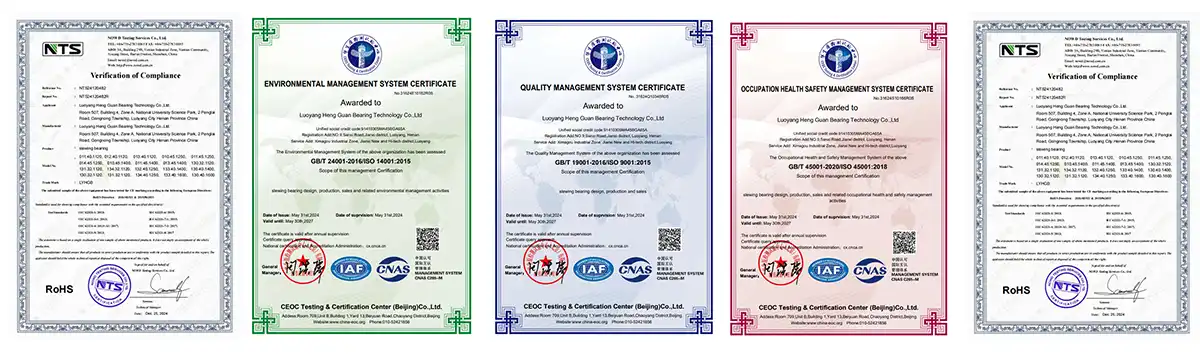
For OEM buyers, the manufacturing process is also a useful way to evaluate suppliers. Material traceability, controlled heat treatment, raceway inspection, dimensional measurement, drawing management, and batch consistency provide more meaningful evidence of manufacturing capability than general claims about quality.
Before placing an order, OEM engineers and procurement teams should confirm the load conditions, mounting dimensions, operating environment, lubrication requirements, inspection expectations, and delivery requirements with the manufacturer. A supplier that can support these requirements from drawing review through production and after-sales service is better positioned to provide a slewing ring that integrates reliably into the finished equipment.
|
|
FAQ
1. What makes ball bearing slewing rings suitable for OEM applications?
Ball Bearing Slewing Rings are great for OEM uses because they can handle complicated loading conditions and still rotate smoothly in small spaces. The precise production methods make sure that the parts are the right size and quality every time, which is needed for them to work reliably with OEM equipment. Customization features let you change things to fit specific placement needs and performance standards.
2. How long do ball bearing slewing rings typically last in industrial applications?
Service life depends a lot on how it is used, how often it is loaded, and how well it is maintained. When used in standard manufacturing settings, units that are properly chosen and kept can usually last between 20,000 and 100,000 hours. Service life can be shortened by harsh working conditions or poor maintenance. On the other hand, optimal conditions and proactive maintenance can stretch operational life beyond what is normally expected.
3. What are the key differences between ball bearing and roller bearing slewing rings?
Ball bearing designs provide lower friction and smoother rotation compared to roller bearing alternatives. The point contact geometry distributes loads more evenly under moment loading conditions. Roller bearings offer higher radial load capacity but may experience edge stress concentrations. Ball bearing solutions typically provide better cost-performance ratios for applications with mixed loading conditions.
Partner with Heng Guan for Superior Ball Bearing Slewing Rings Solutions
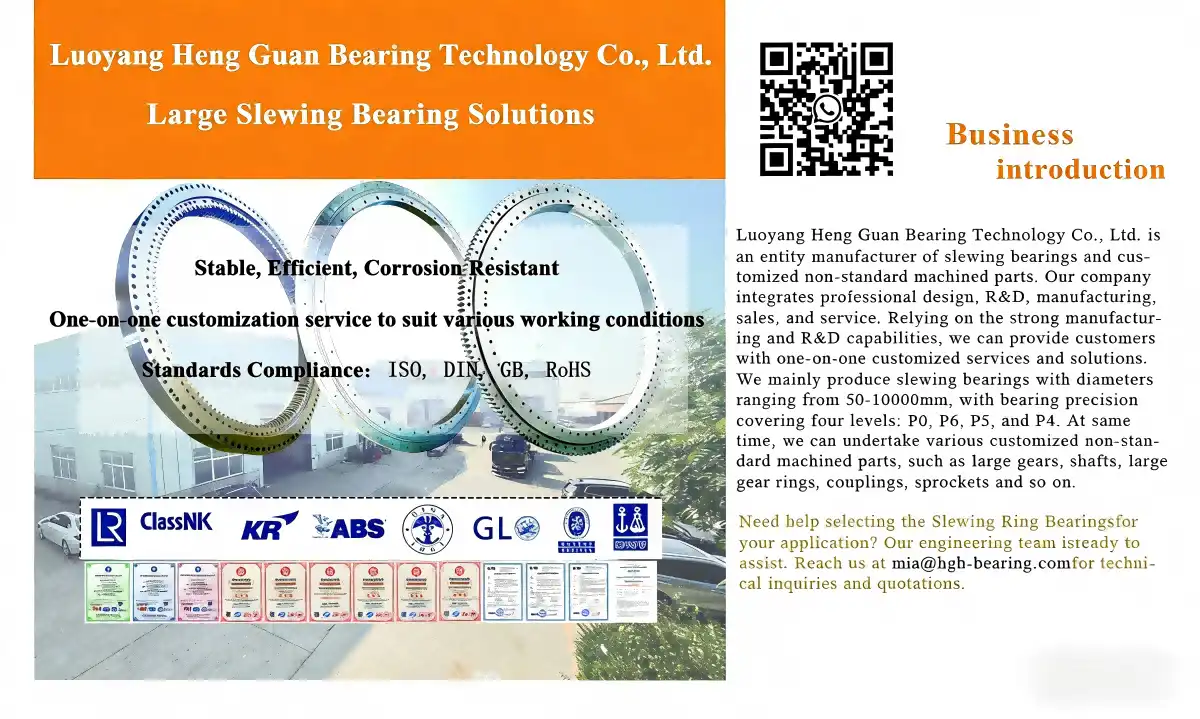
Leading OEM manufacturers trust Heng Guan's expertise in delivering precision-engineered ball bearing slewing rings that exceed industry standards. Our advanced manufacturing capabilities in Luoyang, China's bearing capital, combine decades of experience with cutting-edge technology to produce components ranging from 50mm to 2000mm inner diameter. We offer comprehensive customization services, rigorous quality control, and competitive pricing that make us the preferred Ball Bearing Slewing Rings manufacturer for global OEM projects. Contact our engineering team at mia@hgb-bearing.com to discuss your specific requirements and discover how our proven solutions can enhance your equipment performance while reducing total ownership costs.
References
1. Harris, Tedric A., and Kotzalas, Michael N. "Advanced Concepts of Bearing Technology: Rolling Bearing Analysis." 5th Edition. CRC Press, 2006.
2. Wensing, J.A. "On the Dynamics of Ball Bearings in Large Diameter Slewing Applications." International Journal of Mechanical Engineering Research, Vol. 15, No. 3, 2018.
3. American National Standards Institute. "Load Ratings and Fatigue Life for Ball Bearings - ANSI/ABMA Standard 9." American Bearing Manufacturers Association, 2020.
4. Palmer, David R. "Manufacturing Processes for Large Diameter Bearing Assemblies in Heavy Machinery." Society of Manufacturing Engineers Technical Paper, 2019.
5. International Organization for Standardization. "Rolling Bearings - Slewing Bearings - ISO 12855:2018." Geneva: ISO Press, 2018.
6. Johnson, Mark L., and Williams, Sarah K. "Quality Control Methods in Large Bearing Manufacturing: Statistical Process Control Applications." Journal of Precision Manufacturing, Vol. 22, No. 4, 2021.

WHAT OUR CUSTOMERS SAY
Here is the customer's evaluation of us