




Can Port Crane Slewing Bearings Handle Extreme Load Conditions?
Port crane slewing bearings can survive harsh load circumstances, provided that the bearing is suitably selected, designed, manufactured, installed and maintained for the actual working profile of the crane. Unlike a traditional bearing mainly subjected to radial or axial loads, a slewing bearing in a port crane can be subjected to axial force, radial force and overturning moment concurrently, while the crane is rotating under varying loads. This means that selecting bearings is not merely a question of going for the biggest diameter possible. Engineers should take into account the full load combination, operating cycle, rotation speed, mounting structure, demand for gears, environmental exposure, and desired service life. For demanding applications, three-row roller layouts are commonly explored since distinct roller arrangements can give significant load-carrying capabilities. But the suitable design still depends on the crane and the working conditions. The essential question for port operators and OEMs is not so much whether a bearing can handle a big load. The most relevant concern is whether the bearing has been designed for the combined loads, repeated loading cycles, environmental exposure and installation conditions of the envisaged port crane.

Why Port Crane Slewing Bearings Face Demanding Loads?
The slewing bearing of a port crane connects the rotating upper structure with the supporting framework, yet still allows regulated rotation. During lifting and slewing, the bearing is part of the major load transfer line between the crane frame and its foundation.
The loading pattern can vary greatly from one operating situation to the other. A heavier load at the end of the boom may result in an overturning moment that is somewhat different from a lower load toward the center of the crane. Dynamic effects due to slewing acceleration and braking can also be induced, which cannot be modelled by the static weight of the load.
The bearing should therefore be evaluated according to the actual load spectrum of the crane and not to a single maximum load.
The Three Main Loads Engineers Need to Consider
In general, the main loads acting on a big slewing bearing are axial load, radial load, and overturning moment.
The axial load acts along the bearing’s axis of rotation. In a port crane the cause can be the cargo hoisted and the weight of the rotating crane framework.
Radial load is a perpendicular force to the axis of rotation. It may be caused by horizontal forces, structural reactions, wind, acceleration, and other operating factors.
The overturning moment is very significant for crane applications. The relative position of the suspended load relative to the slewing center can cause a large moment to be transmitted through the bearing and its mounting structure.
These loads shall be considered collectively. A bearing that seems to be adequate when the vertical load is examined alone may not be adequate when the radial forces and the overturning moment are taken into account.
Dynamic Loading During Crane Operation
The operation of port cranes is rarely a fully static operation. The crane can accelerate, decelerate, start lifting, stop lifting, spin, reverse direction, or accurately place a load over a vessel or container stack.
Any alteration may affect the load distribution within the bearing.
Shock loading can also happen if the lift is not smooth or if the load moves suddenly. Not only the maximal force itself is crucial, but also its frequency. Therefore, repeated dynamic loading is a major factor in the performance of bearings.
For cranes with high duty, the engineer should give the bearing manufacturer realistic working conditions rather than just nominal crane capability.
How Does Bearing Design Support Extreme Operating Conditions?
The slewing bearing is designed to cope with severe loads by means of the cooperation of the geometry, rolling elements, raceways, materials, heat treatment, manufacturing accuracy, sealing, lubrication, and mounting arrangement.
No single feature determines the final load capacity.
Why Multi-Row Roller Designs Are Often Used
Three-row roller slewing bearings are usually applied in such cases where high axial, radial, and moment loads have to be satisfied.
The roller configurations can be arranged to accommodate multiple directions of load through different courses of the raceways. This can give significant load-carrying capabilities and allow engineers to tailor the bearing to the load combination of the application.
Three-row architecture, however, should not be assumed to be the ideal answer for any port crane. The choice of type of bearing depends on real load estimates, space available for mounting, requirements for rigidity, rotational needs, gear arrangement, and service circumstances.
Another slewing bearing configuration can be a better compromise between capacity, size, cost, and operational performance depending on the application.
Raceway Geometry and Contact Stress
The geometry of the raceways has a direct influence on the passage of load from the rolling elements to the bearing rings.
The mismatched geometry can provide local contact stress. Repeated severe loading of these concentrated stresses might cause raceway damage, surface fatigue, or premature wear.
A well-designed bearing spreads the applied load over an adequate pattern of contact. Thus, manufacturing precision is critical, as dimensional errors can affect load distribution, even when the nominal bearing dimensions appear to be correct.
For large-diameter bearings, inspection of essential dimensions, raceway geometry, runout, and related production factors is of considerable importance.
Materials and Heat Treatment
Large slewing bearing rings require materials that can give the appropriate strength, toughness, hardness, and fatigue resistance.
The 42CrMo alloy steel is widely employed in the production of demanding mechanical components owing to its ability to be customized through appropriate heat treatment. But the actual material specification and production technique, not only the steel grade, determines the final performance.
The rolling elements can be made from suitable bearing steels, e.g., GCr15SiMn, depending on the design and manufacturing requirements. The performance of them depends on several aspects, such as hardness, cleanliness, heat treatment, surface condition, and dimensional precision.
Buyers should seek material certificates and associated quality paperwork for important crane applications, since it is more than just a material name in a product description.
What Makes a Load “Extreme” for a Port Crane Slewing Bearing?
There is no universal load value that automatically defines an extreme condition for port crane slewing bearings. A load that is manageable for one bearing may be excessive for another because the bearing diameter, geometry, load distribution, speed, mounting arrangement, and duty cycle are different.
The operating environment can make the problem more demanding.
Heavy Loads and Large Overturning Moments
The suspended cargo is only one part of the bearing load calculation. The crane's own rotating structure, boom configuration, counterweight, outreach, and load position all affect the forces transferred to the slewing bearing.
For example, moving a heavy load farther from the slewing center can significantly increase overturning moment even if the cargo weight itself remains unchanged.
This is why bearing selection should use the crane's load cases rather than a simple statement such as “the crane lifts 60 tons.”
Wind, Salt Spray, and Port Environments
Port cranes operate in environments where wind, moisture, salt spray, dust, and temperature variations can affect equipment reliability.
Wind loads can create additional horizontal forces and moments, particularly when the crane is operating with a large exposed structure or suspended load.
Salt and moisture can also accelerate corrosion when protective coatings, seals, or exposed surfaces are not properly maintained. Corrosion is not merely a cosmetic concern. Severe corrosion can affect sealing surfaces, fasteners, gear components, or structural interfaces and may eventually influence the bearing system's reliability.
Repeated Duty Cycles
A bearing used occasionally experiences a different fatigue exposure from one operating continuously throughout a busy port shift.
Repeated slewing, acceleration, braking, and lifting cycles contribute to cumulative mechanical loading. The expected duty cycle should therefore be considered during design.
For this reason, service life should not be expressed as a universal number of hours for all port crane bearings. Actual life depends on load magnitude, load spectrum, speed, lubrication, contamination, installation quality, and maintenance.
How Engineers Should Select Bearings for Extreme Loads?
Selecting a bearing for a port crane requires more information than the outside diameter and bore size.
The manufacturer should receive sufficient application data to evaluate the complete operating condition.
Start With the Crane Load Cases
At minimum, the selection process should consider the relevant combinations of:
Maximum axial load
Radial load
Overturning moment
Static and dynamic operating conditions
Slewing speed
Acceleration and braking conditions
Duty cycle
Environmental exposure
Required service life
Mounting arrangement
The most demanding operating case should not automatically be assumed to be the only design case. A crane can have several critical load conditions, including lifting, slewing, stopping, parked conditions, and wind-related conditions.
Check the mounting structure as well as the bearing.
A high-capacity slewing bearing cannot compensate for an inadequate mounting structure.
The supporting structure must provide sufficient stiffness and dimensional accuracy so that the bearing rings remain properly supported. Uneven mounting surfaces or excessive structural deformation can alter the load distribution and place additional stress on localized areas of the bearing.
Installation bolts, mounting surfaces, structural tolerances, and gear alignment should therefore be treated as part of the complete slewing system.
This is an important distinction for buyers: bearing capacity and system capacity are not necessarily the same thing.
Match the Gear Arrangement to the Application
Many crane slewing bearings incorporate an integrated gear for connection with the slewing drive.
The gear must be evaluated together with the bearing because the crane drive system transfers torque through the gear teeth. Gear accuracy, tooth geometry, hardness, lubrication, backlash, and alignment can all influence service performance.
A bearing supplier with application engineering capability should therefore review the complete bearing-and-drive interface rather than treating the bearing ring and gear as unrelated components.
Maintenance Factors That Influence Heavy-Load Performance
Even a correctly engineered port crane slewing bearings can experience premature problems if lubrication, sealing, alignment, or inspection is neglected.
Maintenance is particularly important in ports because environmental contamination and continuous operation can accelerate deterioration.
Lubrication Must Match the Operating Conditions
Insufficient lubrication can increase friction and wear at rolling contacts and gear interfaces. Excessive or inappropriate lubrication can also create problems, including unnecessary churning and temperature rise.
The correct grease type, quantity, application method, and relubrication interval should follow the bearing manufacturer's recommendations and the actual operating environment.
Port operators should avoid adopting a generic lubrication schedule without checking the specific bearing design and working conditions.
Sealing and Contamination Protection
Saltwater, dust, and other contaminants can damage internal bearing surfaces when sealing is inadequate.
Routine inspection should look for damaged seals, grease leakage, corrosion, unusual contamination, and changes around the bearing housing.
A damaged sealing system should be addressed promptly, particularly in marine environments where salt and moisture can be persistent.
Monitoring Vibration, Temperature, and Wear
Condition monitoring can help identify changes before they develop into serious failures.
Depending on the crane system, useful indicators may include:
abnormal vibration
unusual operating temperature
changes in slewing resistance
abnormal noise
gear tooth wear
grease contamination
visible corrosion
mounting bolt condition
changes in backlash or rotational behavior
The objective is not simply to collect data. Maintenance teams should establish normal operating baselines and investigate meaningful deviations.
How to Evaluate a Port Crane Slewing Bearing Supplier?
For a critical lifting application, purchasing a bearing based only on price can create unnecessary operational risk.
The supplier should be evaluated on engineering capability, manufacturing control, inspection procedures, documentation, and after-sales technical support.
Ask for Engineering and Inspection Documentation
A qualified supplier should be able to discuss the bearing based on the actual application.
Depending on the project, buyers may request:
Material certificates
Heat-treatment records
Dimensional inspection reports
Raceway inspection information
Gear inspection data
Hardness results
Manufacturing drawings
Load calculation support
Lubrication recommendations
Installation instructions
Quality certificates
Final inspection documentation
The exact documentation package depends on the project requirements, but the principle is straightforward: critical components should be supported by traceable technical information.
Verify Manufacturing Capability
Large-diameter slewing bearings require suitable machining, heat treatment, grinding or finishing processes, assembly capability, and inspection equipment.
When evaluating a supplier, buyers should ask how the manufacturer controls critical dimensions and how inspection results are recorded.
It is also useful to understand whether the supplier can manufacture the bearing consistently at the required dimensions rather than relying on a one-off prototype capability.
Consider Total Cost of Ownership.
The lowest purchase price does not necessarily produce the lowest operating cost.
A bearing that requires frequent maintenance, has a long replacement lead time, or does not match the crane's actual load conditions can generate significant indirect costs through downtime and maintenance.
A more useful comparison considers:
purchase cost + installation + maintenance + expected replacement requirements + downtime risk + technical support.
This approach is especially relevant for port operations where crane availability directly affects cargo-handling efficiency.
What Information Should Buyers Provide for a Custom Bearing?
A supplier can provide a much more accurate recommendation when the initial inquiry includes sufficient engineering information.
For a custom port crane slewing bearings project, buyers should ideally provide the following:
Existing bearing drawing or dimensions
Inner and outer diameter requirements
Mounting hole pattern
Axial load
Radial load
Overturning moment
Maximum and normal operating loads
Slewing speed
Duty cycle
Gear requirements
Operating temperature
Environmental conditions
Lubrication requirements
Existing bearing model, if applicable
Crane application and installation position
If the existing bearing is being replaced, photographs, drawings, nameplate information, and previous inspection records can also help the manufacturer understand the application.
The more complete the technical information, the less likely the project will rely on assumptions.
When Should a Standard Bearing Be Replaced With a Custom Design?
A standard bearing can be practical when the load, dimensions, gear arrangement, and operating conditions fit an existing design.
Customization becomes more relevant when the application involves unusual loads, restricted installation space, non-standard mounting dimensions, special gear requirements, unusual environmental conditions, or a need to integrate the bearing with an existing crane structure.
A custom design may involve modifications to:
bearing diameter
ring dimensions
mounting holes
raceway configuration
roller arrangement
gear dimensions
material
heat treatment
sealing
lubrication system
However, customization should be based on a defined engineering requirement. Making a bearing “larger” or “heavier” does not automatically solve a load problem.

Conclusion
Port crane slewing bearings can be designed to operate under extremely demanding load conditions, but reliable performance depends on much more than bearing size or material grade. The complete system must account for axial load, radial load, overturning moment, dynamic effects, duty cycle, mounting accuracy, lubrication, sealing, and the marine environment.
Three-row roller designs are often suitable for demanding crane applications because their configuration can provide substantial capacity for combined loads. Nevertheless, the correct bearing must be determined from the crane's actual operating conditions and engineering requirements.
For port operators and crane OEMs, supplier selection is equally important. Material traceability, manufacturing capability, dimensional inspection, gear accuracy, technical documentation, and application support can all affect long-term performance.
A properly selected and maintained slewing bearing can provide dependable rotational support for heavy-duty port equipment. The most effective approach is to treat the bearing as part of the crane's complete load-transfer system rather than as an isolated component.
FAQ
1. What is the typical lifespan of port crane slewing bearings under extreme loads?
When used in heavy-duty situations, quality slewing bearings can usually last 100,000 hours or more if they are properly kept. This means that it will work for about 10 to 15 years under normal port circumstances. How long something lasts relies on how much it is used, how often it is used, the surroundings, and how well it is maintained.
2. How often should port crane slewing bearings be inspected?
Visual checks once a month help find problems like damaged seals or oil leaks that are easy to see. Every three months, full checks should be done, which should include vibration analysis and temperature tracking. Partially taking the machine apart may be needed for yearly thorough checks to look at internal parts and make sure they are properly oiled.
3. Can different bearing brands be mixed in the same port crane system?
Mixing bearing brands is generally not recommended due to differences in mounting dimensions, lubrication requirements, and performance characteristics. Sticking to a single manufacturer makes it easier to do upkeep, keep spare parts on hand, and get expert help. When it's necessary to mix brands, paying close attention to paperwork and connectivity helps keep things running smoothly.
4. What safety factors should be considered when specifying bearings for extreme loads?
For important port crane uses, engineers say that safety factors should be 2.5 to 3.0 times the expected operating loads. This margin takes into account dynamic load increase, impact forces, and working situations that were not predicted. Higher safety factors might be right for situations where a failed bearing would pose a big risk to people's safety or cost a lot of money.
Partner with Heng Guan for Superior Port Crane Slewing Bearing Solutions
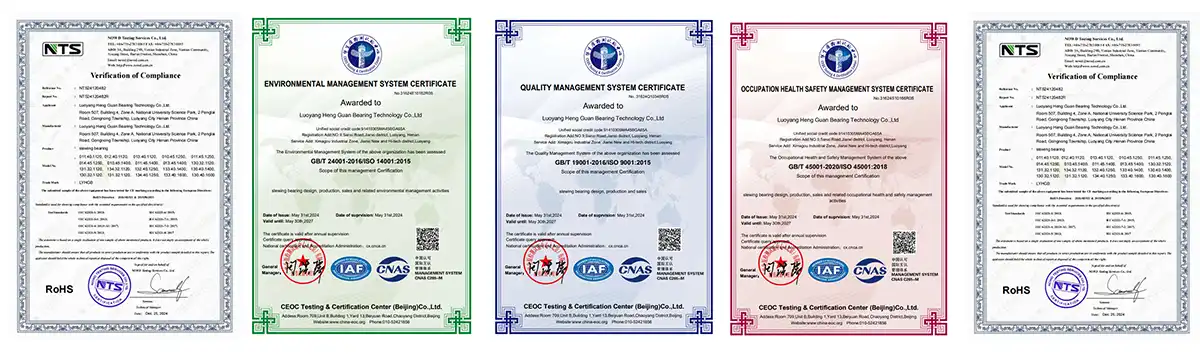
Evaluate your current bearing performance against the extreme load demands of modern port operations. Heng Guan Bearing Technology delivers engineered port crane slewing bearings and other slewing bearing solutions specifically designed for the most challenging maritime applications.Our three-row roller designs, utilizing 42CrMo alloy steel construction and precision manufacturing, ensure reliable performance under loads that compromise standard bearings. With over 20 years of specialized experience and ISO 9001 certification, we serve as your trusted port crane slewing bearing manufacturer, providing custom solutions ranging from 4238mm configurations to specialized designs. Contact our technical team at mia@hgb-bearing.com to discuss your specific load requirements and discover how our advanced bearing technology can enhance your port operations' reliability and efficiency.
References
1. Maritime Engineering Institute. "Load Analysis in Modern Port Crane Design: Structural Considerations for Heavy-Duty Applications." Journal of Port Engineering Technology, 2023.
2. Chen, L. and Roberts, M. "Material Science Advances in Large-Scale Slewing Bearing Manufacturing." International Conference on Heavy Machinery Components, 2022.
3. European Port Equipment Association. "Performance Standards for Container Handling Equipment: Bearing Life and Reliability Requirements." Technical Bulletin EPEA-2023-007, 2023.
4. Thompson, K. "Predictive Maintenance Strategies for Port Crane Slewing Bearings: Cost-Benefit Analysis of Monitoring Systems." Maintenance Engineering Quarterly, 2023.
5. International Standards Organization. "Rolling Bearings - Slewing Bearings - Part 2: Special Requirements for Use in Port Crane Applications." ISO 12813-2:2022.
6. Wang, S., Miller, D., and Kowalski, P. "Comparative Analysis of Three-Row Roller Bearing Performance in Extreme Marine Environments." Proceedings of the International Bearing Technology Conference, 2023.

WHAT OUR CUSTOMERS SAY
Here is the customer's evaluation of us