




Can a Custom Tower Crane Slewing Ring Improve Lifting Stability?
The first worry of site managers when a tower crane is lifting at full capacity is stability, and this starts with the slewing ring. So, can a bespoke tower crane slewing ring really make lifting stability better? Heng Guan Bearing thinks it can. A ring constructed around your crane's real loads and dimensions spins more smoothly and steadily than an off-the-shelf, catalog item. With over 20 years of slewing-bearing engineering knowledge, we can tailor the structure, raceway shape, and raceway material to each crane’s operating envelope, rather than forcing the crane to conform to a stock design. In general, stock rings designed for the nearest catalog fit oblige installers to shim the bolt pattern, live with uneven pre-load, and tolerate permanent deformation under boom load. A purpose-built tower crane slewing ring removes such workarounds and supplies the operator a sturdy platform right from the start of operation. Read on to explore how load type, design aspect, personalization, and material selection come together to provide steadier lifts on every job site.
How Does a Custom tower crane slewing ring Handle Axial, Radial, and Tilting Moment Loads?
Between the mast and the top structure is a tower crane slewing ring. The tower crane slewing ring bears the boom, counterarm, and raised material and allows the crane to rotate 360 degrees smoothly. It has to be able to simultaneously bear axial, radial, and tilting moment stresses without losing concentricity or adding backlash. Axial load is created by the weight of the cargo being hoisted, forcing the top structure down. Radial load is created by wind on the counterarm and by side forces during slewing. Tilting moment is created by the lever effect of the jib swinging out beyond the mast centerline.
Heng Guan Bearing provides three structures to meet various duties: the single-row four-point contact ball type for moderate loads, double-row different-diameter ball type for greater lifting, and the three-row roller type for giant cranes. They distribute the force at numerous points of contact to stabilize the crane at full load and to dampen the harmonic vibration that would otherwise go from the end of the boom back to the operator's cabin. You may tailor the ring to the specific construction of your crane type, whether it is a topless, luffing jib, or internal climber. The following table matches each of the typical tower crane configurations with the appropriate slewing ring construction.
| Tower Crane Type | Typical Duty Profile | Recommended Slewing Ring Structure |
|---|---|---|
| Topless tower crane | Compact urban sites, medium height | Single-row four-point contact ball |
| Luffing jib crane | Congested sites, variable radius | Double-row different-diameter ball |
| Internal climbing crane | High-rise construction, vertical lift | Double-row different-diameter ball |
| Wind turbine installation crane | Heavy outdoor lifts, exposed conditions | Three-row roller |
| High-speed tower crane | Fast cycle, frequent slewing | Single-row four-point contact ball (reinforced) |
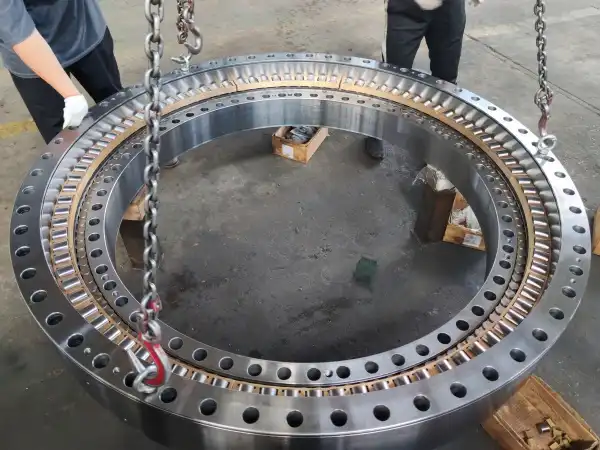
Key Design Factors: Load Capacity, Raceway Geometry, and Bearing Rigidity
Three design aspects determine stability: load capacity, raceway geometry, and stiffness. Load capacity should be computed for your individual crane, not duplicated from a catalog, and that is precisely what Heng Guan Bearing does for every bespoke tower crane slewing ring. We put the maximum payload, jib length, slewing frequency, and safety factor of your crane into a formula that gives the necessary static and dynamic load ratings, and then choose a ring that satisfies them with a healthy margin. The shape of the racetrack is important.
CNC-ground raceways decrease friction and vibration, leading to smoother rotation and reduced driving torque. A constant curve also ensures the contact ellipse is uniform, so no single ball or roller carries more than its share of the load. The combination of well-matched rolling parts and robust 42CrMo or 50Mn rings provides the rigidity. The ring can maintain its form under large loads on the boom. Section height and ring cross-section are calibrated to the crane’s bending moment such that deflection under load remains within the tolerance that the slewing drive can rectify. Custom sizes are available from 800 mm inner diameter to 8,000 mm, so the design may be very close to your plans. The table below outlines the contribution of each element to stability.
| Design Factor | Stability Benefit |
|---|---|
| Calculated load capacity | Safe lifting at rated load |
| CNC-ground raceways | Smooth, low-vibration rotation |
| High-rigidity rings | Stable shape under load |
Can Customized Bearing Structures Reduce Deflection and Improve Rotation Precision?
Customization may minimize deflection and enhance accuracy of rotation. When a tower crane slewing ring is tailored to fit your crane’s mounting dimensions, bolt pattern, and gear needs, the load path is cleaner, and the contact between rolling elements and raceways remains consistent. Heng Guan Bearing provides rings with directly machined internal or external gears, which eliminates the additional connection elements. It also offers precision grades from P0 to P4 for applications requiring more precise placement. Picking P5 or P4 for precision cranes helps keep axial and radial play tighter, so that the boom operator is repeatable lift after lift.
Integrated gears help reduce backlash, which is important when cranes are positioning loads with precision during concrete pours or steel construction. Alternatively, we may reverse engineer a replacement using images or measurements without 3D plans. By measuring important elements, we can match the gear module, tooth count, and pitch diameter to the current slewing drive. If you would like our engineers to review your crane data, simply email mia@hgb-bearing.com, and we will suggest a structure that fits. The table below lists common customization options and the rotation gain each one delivers.
| Customization Option | Rotation / Precision Benefit |
|---|---|
| Matched mounting bolt pattern | Eliminates shim stack, reduces deflection |
| Integrated internal gear | Direct drive engagement, less backlash |
| Integrated external gear | Higher drive torque capacity, easier retrofit |
| Precision grade P5 or P4 | Tighter radial and axial play |
| Custom raceway profile | Cleaner rolling element contact |
What Materials, Heat Treatments, and Manufacturing Tolerances Ensure Reliable Performance?
Good materials and good production are a good start to good performance. Rings are made of 42CrMo or 50Mn alloy steel, rolling elements are made of GCr15SiMn high-purity bearing steel, seals are made of imported nitrile rubber or fluororubber, and cages are made of brass, steel, or engineering plastic depending on the job environment. Controlled quenching and hardening provide a hard wear surface and a tough core capable of absorbing impact in each tower crane slewing ring. Induction hardening of the ball and roller paths, specifically, produces a working surface of 55–62 HRC while leaving the base material tough enough to resist crack propagation.
Tempering after heat treatment stabilizes the parts dimensionally, and then they are machined on CNC vertical lathes and gear cutting equipment, maintaining strict geometric tolerances. All rings are examined using coordinate measuring devices, checked for raceway geometry, measured for rotation torque, and non-destructively tested before being sent. Our ISO 9001:2015-certified plant is also compliant with DIN, ISO, and GB standards, with inspection points recorded from arriving steel to final torque test. These measures provide consumers with a reliable product from the first operation. The table below shows essential specifications.
| Item | Specification |
|---|---|
| Ring material | 42CrMo, 50Mn alloy steel |
| Rolling elements | GCr15SiMn bearing steel |
| Precision grades | P0, P6, P5, P4 |
| Outer diameter | 1,000–10,000 mm |
| Temperature range | -30°C to +80°C |
Conclusion
Yes, a custom ring can improve lifting stability. By matching structure, raceway design, materials, and precision to your crane, Heng Guan Bearing delivers a tower crane slewing ring that rotates smoothly, carries combined loads confidently, and supports safer, steadier lifting.
FAQ
Q1: Which structures are available?
A: Single-row four-point contact ball, double-row different-diameter ball, and three-row roller.
Q2: What size range do you offer?
A: Inner diameters of 800–8,000 mm, with larger custom sizes available.
Q3: Can you replace another brand's ring?
A: Yes, we reverse engineer from drawings, measurements, or photos.
Q4: What is the usual lead time?
A: About 4–6 weeks for standard sizes and 6–10 weeks for custom ones.
Q5: How is quality checked?
A: By CMM inspection, raceway verification, torque measurement, and non-destructive testing.
Ready to Improve Your Crane's Stability? Contact Us Today
Contact Heng Guan Bearing today to spec your next tower crane slewing ring. Share your crane model, load data, or drawings, and our engineers will propose a custom solution with a prompt quotation. Email us at mia@hgb-bearing.com and take the starting point toward steadier, safer lifting.
References
1. International Organization for Standardization. (2007). ISO 281:2007 Rolling Bearings: Dynamic Load Ratings and Rating Life.
2. International Organization for Standardization. (2006). ISO 76:2006 Rolling Bearings: Static Load Ratings.
3. International Organization for Standardization. (2016). ISO 4301-1 Cranes: Classification, Part 1: General.
4. Harris, T. A., & Kotzalas, M. N. (2006). Essential Concepts of Bearing Technology (5th ed.). CRC Press.
5. Budynas, R. G., & Nisbett, J. K. (2015). Shigley's Mechanical Engineering Design (10th ed.). McGraw-Hill.
6. Hamrock, B. J., Schmid, S. R., & Jacobson, B. O. (2004). Fundamentals of Machine Elements (2nd ed.). McGraw-Hill.

WHAT OUR CUSTOMERS SAY
Here is the customer's evaluation of us