




Can a Custom Gear Ring Reduce Wear and Maintenance Costs?
Every custom gear ring in use is under continual contact, stress, and friction; therefore, modest design changes may determine how frequently a machine is shut down for maintenance. A worn or mismatched ring produces noise, backlash, and unscheduled downtime, and these may build up fast. A well-matched custom gear ring distributes force evenly, runs quietly, and keeps maintenance schedules predictable. Based on the actual operating circumstances rather than general sizes, Heng Guan Bearing provides gear solutions that are designed and produced. Read on to see how customisation might help safeguard your equipment and your money.
How Does Custom Gear Ring Design Minimize Tooth Wear and Contact Stress?
The initial sketch is where design is important since tooth wear occurs where the contact stress is strongest. Your torque, speed, and duty cycle determine a bespoke gear ring with module, number of teeth, pressure angle, and face width selected to distribute load across a larger contact surface. Profile adjustment and proper tooth root maximize smooth engagement and fatigue resistance of the teeth. The tooth profiles may be involute, circular arc, cycloid, or entirely bespoke, and may be straight or helical.
When combined with unique custom ring and pinion gears, the whole mesh may be set simultaneously. This keeps the backlash consistent and lowers noise. Heng Guan Bearing experts may modify the diameter, teeth, and mounting holes to meet your structure and can include bolt circles and interface features, so the ring fits easily into your machine. Segmented designs use bolted joints, which, for large diameters, go above the normal limit. The following table demonstrates how design choices enable extended life.
| Design Choice | Benefit |
|---|---|
| Optimized module and face width | Lower contact stress |
| Tooth profile modification | Smooth engagement |
| Matched ring and pinion | Stable backlash |
| Segmented construction for oversized rings | Diameters beyond the standard range |
Technical Specifications
| Parameter | Specification Range |
|---|---|
| Outer Diameter | φ200 mm – φ8000 mm+ (larger sizes via segmented design) |
| Module | M1 – M60+ |
| Tooth Width | Customizable per drawing |
| Pressure Angle | Standard 20° or custom angles |
| Helix Angle | Straight or helical configurations |
| Material Options | 45#, 42CrMo, 20CrMnTi, 40Cr, 34CrNiMo6 |
| Heat Treatment | Carburizing, nitriding, induction hardening, quenching and tempering |
| Hardness Range | HRC 28–62 (material and treatment dependent) |
| Precision Grade | DIN 5–8 / ISO 1328 Class 5–9 |
| Surface Finish | Ra 1.6–6.3 μm |
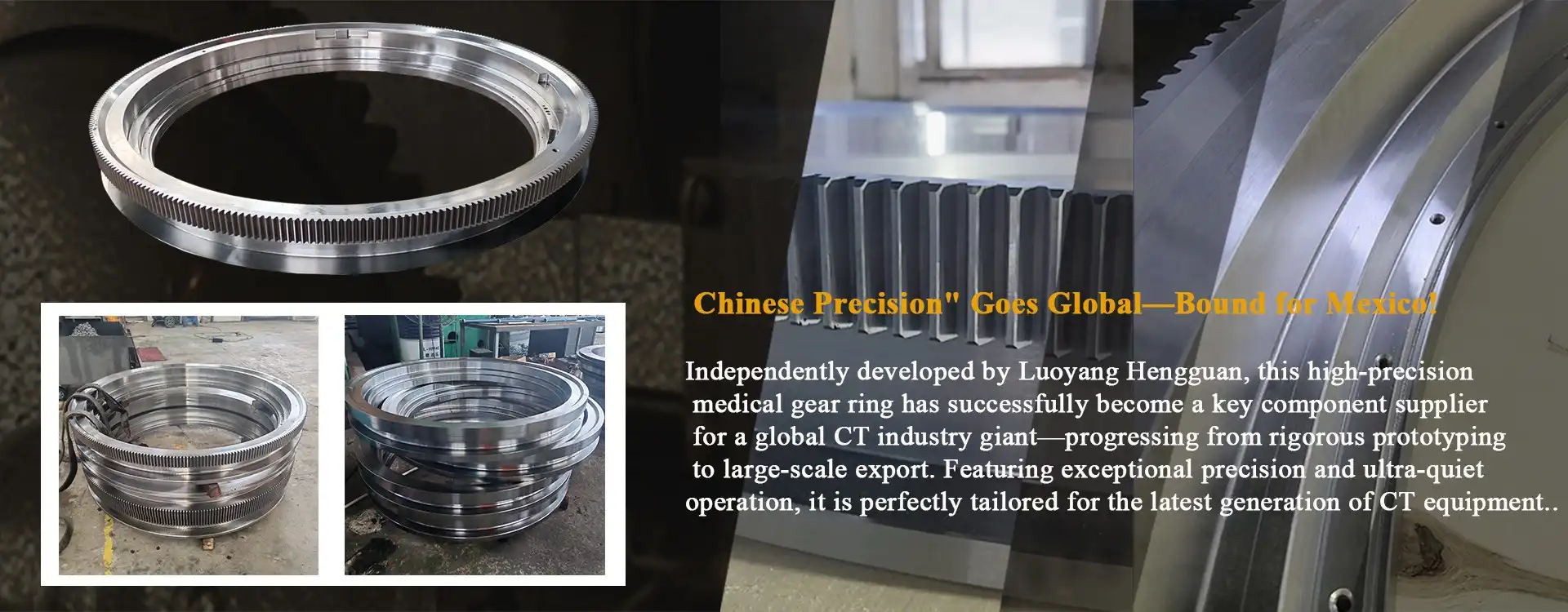
Can Precision Gear Manufacturing Reduce Misalignment and Premature Failure?
Precision manufacturing is what turns a good design into a dependable part. Heng Guan Bearing is based in Luoyang, known as China's "Bearing
Town,” with a mature processing base supporting each step of production. We have experienced designers and competent workers who employ sophisticated equipment and testing instruments, such as a CNC vertical lathe, CNC quenching machine, gear shaper, and hobbing machine to regulate tooth precision, roundness, and mounting surfaces.
If a bespoke gear ring is manufactured to fine tolerances, the teeth will meet their partner at the right angle, reducing uneven wear and keeping the mesh running true. Accurate handmade custom ring and pinion gears also install more easily and keep alignment throughout operation, helping avoid early failure. Quality from the raw material on ensures longer service intervals, fewer modifications, and steadier machine output. Each shipment contains material certificates, dimensional inspection records, and hardness test results. If you need a specific accuracy level, send your drawings to mia@hgb-bearing.com, and we will suggest a suitable manufacturing plan.
| Production Step | What It Controls |
|---|---|
| Gear hobbing and shaping | Tooth geometry and profile |
| Heat treatment | Surface hardness with a tough core |
| CNC turning | Roundness and mounting surfaces |
| Dimensional and hardness inspection | Conformity to your drawing |
Lubrication and Surface Treatments That Improve Gear Ring Durability
Even the greatest gear needs the proper surface and lubrication. Surface hardness and core toughness are achieved by heat treatments, such as quenching and tempering or induction hardening of the teeth. Also available are carburizing and nitriding for increasing the surface hardness, and coatings such as nickel plating or phosphating for corrosion protection. The finish should be smooth, without roughness, to minimize friction and to promote a uniform distribution of the lubrication layer across the teeth.
We suggest that any bespoke gear ring should be matched to the operating speed, temperature, and load using grease or oil, and that a regular inspection regimen be followed. Good lubrication also protects your ring and pinion gear from heat and micro-wear, lengthening the duration between maintenance stops. Heng Guan Bearing is able to recommend the best treatment for your environment, whether it’s dusty mining equipment or humid port equipment, so your gear ring will operate for years to come. The timetable below is our suggested practice.
| Interval | Action Required |
|---|---|
| Every 200–500 working hours | Apply oil to the tooth flanks. Lithium-based EP2 oil suits common applications; use specialized oils for temperature extremes. |
| Monthly (first year) | Check tooth wear and inspect for pitting, scoring, or discoloration. |
| Quarterly | Measure backlash. Excessive clearance may require shimming or replacement. |
| Yearly | Review surface protection and reapply coatings as needed. |
How to Calculate the Long-Term Maintenance Savings of a Custom Gear Ring?
A simple cost comparison really shows the value. Begin with the purchase price plus downtime, labor, lubrication, and replacement parts for the estimated service life. Custom gear rings may have a higher initial cost, but longer intervals between maintenance frequently decrease the overall cost of ownership. Compare the number of replacements a standard part would need vs. a custom solution and add the hours saved in production. The following table lays forth a general framework:
| Cost Factor | What to Compare |
|---|---|
| Initial price | Standard vs. custom |
| Downtime | Hours lost per year |
| Labor and parts | Replacement frequency |
| Service life | Total operating hours |
If you would like help building this estimate, Contact Us with your equipment details, and the Heng Guan Bearing team will assist with custom ring and pinion gears that fit your budget and goals. The OD, module, number of teeth, face width, and material choice help to be available for a quote. A 2D design with tolerances is desirable, but we can also work from images of an existing item and reverse engineer worn gear rings. Design & manufacture takes roughly 4 to 6 weeks after drawings are approved. We provide rush service for urgent assignments.
Conclusion
A tailored custom gear ring decreases tooth wear, provides correct alignment, and reduces long-term maintenance expenses. Heng Guan Bearing manufactures durable and cost-effective gear systems via accurate manufacturing and customized design.
FAQ
Q: What does a custom gear ring do?
A: It transmits motion and torque with a tooth design matched to your machine.
Q: Can custom ring and pinion gears be matched as a set?
A: Yes. Designing them together keeps the mesh smooth and stable.
Q: How does customization reduce wear?
A: Optimized tooth geometry spreads load and lowers contact stress.
Q: Which treatments improve durability?
A: Heat treatment, fine finishing, coatings, and proper lubrication.
Q: Can Heng Guan Bearing adjust size and mounting holes?
A: Yes. Diameter, teeth, and mounting holes can be customized, and diameters above 8000 mm are possible through segmented designs.
Q: What is the typical lead time?
A: About 4–6 weeks for design and manufacturing after drawing approval. Expedited service is available for urgent projects.
Ready to Lower Your Maintenance Costs? Contact Us Today
Contact Heng Guan Bearing for a tailored solution:
- Custom gear rings from φ200 mm to φ8000 mm+, modules M1–M60+
- ISO 9001-certified production, custom sizing, and material options
- Engineering support for design, drawings, and reverse engineering
- Proven solutions for mining, material handling, construction machinery, and rolling mills
Send your drawings and working conditions to mia@hgb-bearing.com, and our engineers will recommend the right custom gear ring for your project. Let's build a longer-lasting gear system together.
References
1. Budynas, R. G., & Nisbett, J. K. (2014). Shigley's Mechanical Engineering Design. McGraw-Hill.
2. Norton, R. L. (2020). Machine Design: An Integrated Approach. Pearson.
3. Dudley, D. W. (1984). Handbook of Practical Gear Design. McGraw-Hill.
4. American Gear Manufacturers Association. (2016). ANSI/AGMA 2001-D04: Fundamental Rating Factors and Calculation Methods for Involute Spur and Helical Gear Teeth.
5. Hamrock, B. J., Schmid, S. R., & Jacobson, B. O. (2004). Fundamentals of Machine Elements. McGraw-Hill.
6. Harris, T. A., & Kotzalas, M. N. (2006). Essential Concepts of Bearing Technology. CRC Press.

WHAT OUR CUSTOMERS SAY
Here is the customer's evaluation of us